
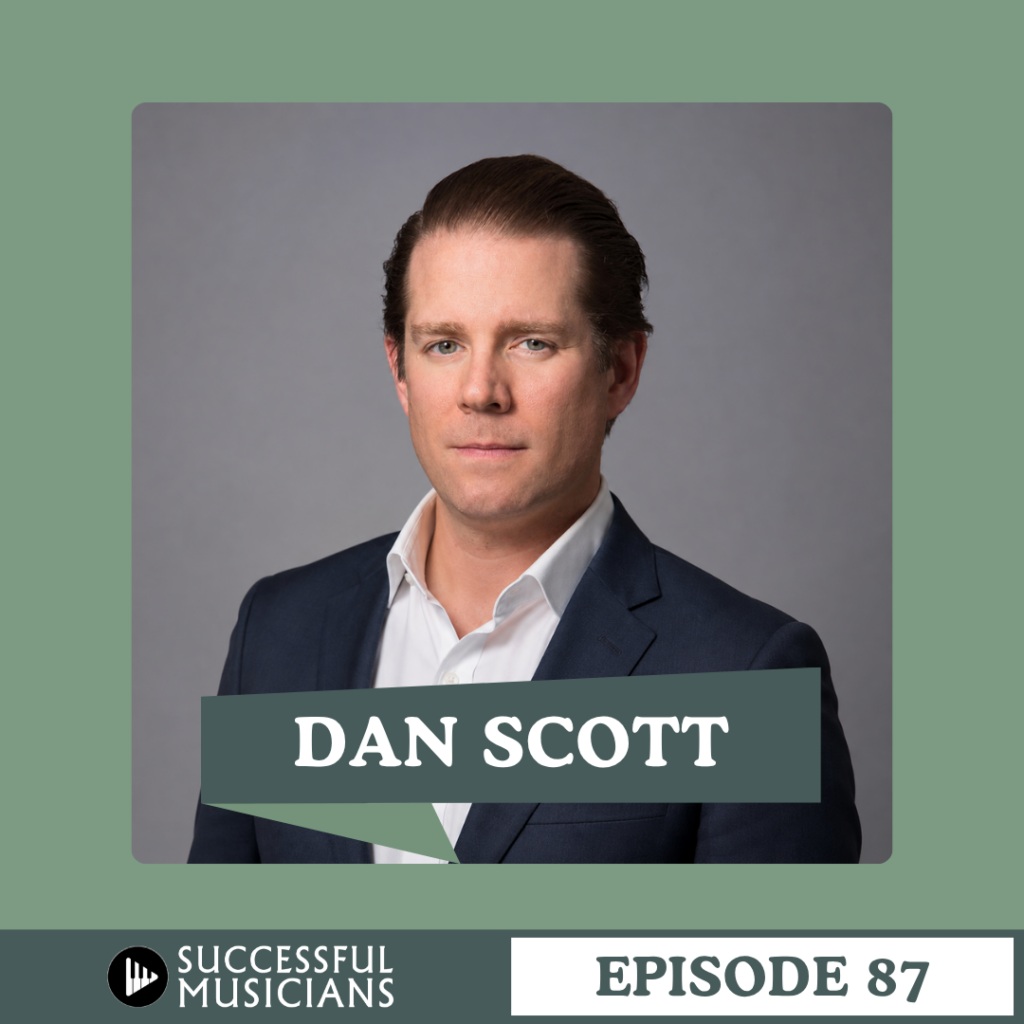
Successful Musicians Podcast
Interviewee: Daniel Scott
Interviewer: Jason Tonioli
Jason Tonioli
Well, welcome to the podcast today. My special guest is Dan Scott. Dan is, I would say, maybe a little bit of an unlikely person to have on the podcast because Dan, you are an attorney and most musicians don’t have many good things to say about attorneys. But what I find intriguing about you, Dan, is you’re kind of this music guy. You’ve been playing guitar for years.
Dan Scott
Recovery. I’m a recovery attempt.
Jason Tonioli
I think you told me as I’ve researched you’ve done come from the eighties, but you started down the punk rock path. That’s totally my world too. I mean, if I look back in the eighties, you’ve got all these old amazing punk bands, Pennywise, and then the rock stuff. I grew up listening to Bad Religion and Guttermouth and Blink 182, just some of the classics. I don’t know, I call them the classics. We’re both old now, which is kind of funny to say that we’re old.
Dan Scott
Yeah. Did you go back to where we started? Did Rancid take you to Operation Ivy? And Fugazi took you to Minor Threat, right? And all that stuff. So yeah, yeah, yeah.
Jason Tonioli
Totally.
So it’s just fun because we’ve kind of come from that classic rock, and then it evolved into that punk world, and then it evolved through the 90s, which has been fun. But I love that you’ve come from that world. I’m this quiet piano-playing guy, and people just think it’s hilarious that I started playing piano versions of Metallica and these punk bands back in the day. Then you decided to go down a little bit more of an attorney legal path, which is great.
But welcome to the podcast. I know you’re CEO of Spotlight Advisory Group, which helps artists, which I think is super unique and why people today ought to be super excited to listen to some of the advice you’re going to share with us. So welcome.
Dan Scott
Thank you, Jason, for having me. I’m excited. I’m excited to dive in.
Jason Tonioli
So Dan, just to get started, I probably just completely… that was probably the worst introduction you probably ever had. But I just want to tell us a little bit about how you ended up where you’re at. I think what’s going to be really interesting to musicians listening is what is it that kind of led you to want to help music people or just artists in general? Because I think there’s a huge gap there that most artists just want to do their creative thing and forget a lot of the more important stuff that’s going to make them successful enough to continue doing the music long term.
Dan Scott
Well, I mean I’m an artist, right? So I think my heart is always with artists. Creativity is really what makes us unique as a species, and I think what makes each of us unique within that species, right? And how we differentiate ourselves is our unique ideas of value. That’s sort of an institutional definition of creativity. So creativity is what fuels us.
So yeah, I think creatives and artists should run the world. Coming back to those punk rock roots, I say increasingly more, just very bluntly, I don’t think anything we’ve built is right. I think we need to sort of…
I love the Steve Jobs quote. I’m going to paraphrase it, but essentially, you have to realize that the world is built by people that are no smarter than you, and it’s not necessarily the case that it has to be this way or should be this way or that this is the best way.
So yeah, that’s it. I work with creators and visionaries, and I believe that each of us… I’m romantic about the idea that each of us is unique. There’s only one you and one me. Even if we clone ourselves, we can’t clone our experiences, and so therefore there’s still an individuality to it.
Our individuality, I think, leads to the logical conclusion that there is something that only you are capable of doing. And that is your greatest value. I would come back and call that your purpose, that you have a unique value that only you can fulfill in this lifetime. That’s your duty. Not only your duty, it’s what the world needs.
So where I am in my life and in my career is I want to help people live a life fulfilling their purpose. Creativity is really the gateway to that. So it’s living your purpose through your creativity, and that’s why I work with artists. Obviously I’m a musician, so I love working with musicians, but I work with people of all creative industries, including entrepreneurs, people who are creative in the business space. It’s just anyone who has a vision and wants to make, to go back to Steve Jobs, their dent in the universe.
I think we’re all creative, so actually it would apply to everybody. It’s just that I don’t spend my time convincing people that they’re creative. I have to cut it off somewhere.
Jason Tonioli
Why? So it’s interesting you talk about that. I find oftentimes creative people, or maybe it’s early on in their career, maybe you gotta get older and more mature to recognize this, but oftentimes they’re scared to kind of follow that purpose. It’s like we’ve been told you have to do something a certain way. And you talked about that there’s not necessarily a right or wrong, certain way that has to be done.
But how do you, as you look at artists and other influential people that you’ve worked with, how do you get over that first hump of not only believing in yourself, but then also being willing to go out there and pursue that purpose? Because I think that’s a hard step for a lot of people.
Dan Scott
It’s a good question, right? And I think what we’re going to get into quickly is really a definition of success and what people want.
I always… someone who’s chasing something, and I sort of said this before we got online here, I don’t believe in chasing anything.
Because it’s always fleeting.
Dan Scott
Because it’s always fleeting.
And we live in a society, this comes back to we’ve done everything wrong, right? We’ve created a society and a system of values that get embedded in us, that have definitions of success. Success is defined primarily by how much money you make, or how much power or influence you can wield.
For a lot of artists, you’re growing up thinking you want to be famous, maybe without even consciously choosing that. It’s just the image of fortune and fame. And that’s completely wrong.
Where I start with a lot of artists is I have to come to a common understanding of what the goal is. If what you want to do is get rich, go buy a lotto ticket because the odds are probably better than doing it through music.
Most musicians that I work with, I can’t say I’ve actually encountered one, or maybe I’ve just ignored them if I have, but I don’t know any musician that makes music, or any artist that makes art, because they want to make money from it. They do it because creativity is not what you do, it’s who you are.
Most artists, and this goes to the very successful ones who made a lot of money, they’re happy they’ve made money and it’s a great byproduct, but it was never necessary. They just really wanted to make music and be able to live a normal life doing that.
So I always start by breaking down what it is we’re really trying to accomplish.
Let’s start very generally. If you put a hundred people in a room and ask them what they want out of life, ninety-nine to one hundred of them are going to give you some answer about happiness or living a fulfilling life.
Whatever that means.
What do you want for your kids? Well, I want them to be happy. I want them to live a fulfilling life.
So what does that mean?
I’ve spent the time to go… to me, I’m preaching what I think is a logical conclusion. There is science around what happiness and fulfillment is. I am a student of the positive psychology movement, the study of happiness. They’ve identified five factors that really elevate your well-being. If you focus on these things in your life and you try to maximize those, you will live your best, most fulfilling life.
None of those are money.
It’s the acronym PERMA. P-E-R-M-A.
It stands for Positive Emotion, Engagement, Relationships, Meaning, and Accomplishment.
You focus on elevating those things in your life and you live your best life.
With that being said, the conclusion I’ve reached is that when you come back to the idea of your unique individuality, when you actually live in pursuit of shining that light on the world, of giving that purpose to the world, it leads to elevating those five factors to their highest.
So the answer to me is what we’re all actually trying to do is to live our purpose, whether we realize it or not. Because that is, one, what some of us feel spiritually we’re supposed to do, and two, it leads to the happiness and fulfillment that we all want, even if you don’t feel the mission element into it.
Success to me, and what everybody should really be striving for, has nothing to do with money. It has to do with the ability to wake up every day and live your purpose.
Live it.
We’ll get into a discussion around money because we live in a society where, obviously, we’ve created a system.
It’s a system. It’s one of many that could exist, but this is the world we live in.
You need money to provide for your needs.
So you have to make money.
You have to transform that purpose into something that makes money so that you’re spending your time living the purpose instead of being distracted.
That’s the net result.
But again, when it comes to money, very quickly you have to get to an understanding that you’re not trying to make a lot of money.
You’re actually shooting for enough money.
The word “enough” is very powerful.
It’s also a low bar.
This is where I start with most artists.
The idea of making enough money to wake up and be a musician, or whatever kind of creative you are, or just an entrepreneur, to have enough, to have your own business, your own bakery, to make enough money is a low threshold.
If you take the spectrum of salaries that’s out there, from teachers that make forty or fifty thousand dollars, not nearly what they should be paid, to doctors and lawyers, that spectrum of salary ranges, you absolutely can transform your purpose into a livelihood that makes enough money somewhere on that spectrum.
Most people don’t do it.
Partially out of fear because they don’t think it’s possible.
Partially because they’re looking to achieve the wrong goal.
They’re not going to make enough. They want to make more than enough money because those are the values that have been passed down to them.
They’re also being very short-sighted, realizing that when you sacrifice early on in your life and you keep that enough bar low, you actually lay the foundation for much greater financial success down the road.
But we jump into this societal image of, “Well, I need to get my own place, and I need my own car, and I need an extra bedroom for guests.”
All of these “I need to” statements are luxuries.
You’re making a decision to prioritize those over what should be your greatest priority of living your purpose.
Jason Tonioli
As you’re talking about that enough money, I was lucky enough right after I’d gotten out of high school to go down and spend nearly two years down in Argentina in the middle of nowhere. My very first places I was at, people lived in dirt houses. They’d sweep their dirt floors. We’d have two-walled outhouses. We were just living with the poorest of the poor.
The crazy thing is, in those experiences, I came back realizing that, in general, the people there were happier than most of the people that I knew here in the United States who were in pursuit of all of these things they thought they had to achieve to be successful.
I think that having enough is a great question that every human being ought to ask themselves. Can I eat? Can I take care of the people I love? I think that’s just a really important personal question that we all ought to ask ourselves.
Dan Scott
It also gets very quickly to an understanding of what money really is.
We have transformed money into a goal, if not a god. It is what we praise and measure our success by.
Money was designed to be a tool. It is a resource.
That’s what it comes back to with the idea of enough.
Imagine sitting in a room with ten million dollars in cash sitting next to you. What’s it worth?
Nothing.
It’s not doing anything.
It might feel good to have it there or have some false sense of security, but it’s actually not valuable unless it’s being applied toward something.
If you actually have more than you need to apply toward something, if you have extra left over, in other words, if you have more than enough, you’re wasting your time in some sense if that’s what you’re chasing.
The cool thing, and I just want to get this out of the way, I am not against money.
Money is great when you have it and it doesn’t have you.
It’s a tool.
It’s something that can provide fun, entertainment, and luxury once you have it.
I’m not saying making money is bad.
The trick is, when you don’t focus on money as the goal and you focus on purpose, you’re actually giving your greatest value.
There’s only one you.
From a supply and demand perspective, there’s nothing more valuable you can do than live your purpose.
Long term, you’re going to receive back the greatest reward.
It might not come entirely in money, but let’s face it, in this society how we exchange value is largely in dollars.
So you’re going to make the most money anyway, just in the long term instead of the short term.
You’re also going to be rewarded in other ways through experience, joy, fulfillment, and everything else.
That’s the conversation.
It’s about readjusting the perspective and shaking off those value systems.
As we’re saying this, I’m going to point a finger.
The finger I’m going to point to is industry.
This is the problem with artists and why I do what I do.
I’m not judging the industry, but to the extent that artists have professionals helping and advising them, they are industry people.
What is industry there to do?
Make money.
That’s its job.
These people are very good at what they do, and their worldview comes from that place.
Their value system comes from that place.
They’re not equipped to understand what we’re talking about because that’s not their job.
That’s not what they’ve studied.
The problem becomes that artists are thrust into an industry.
They’re told this is what you have to do to be successful.
All the advice they get is advice that leads toward dollars being the goal.
That’s not what artists are about.
The other thing I always talk about very early in a conversation with an artist is that the industry is also a tool.
It’s there as a resource for you to utilize for your purpose.
It serves two things.
It’s a tool to monetize your art, potentially.
It’s a tool to distribute your art.
But it isn’t necessarily an inevitable necessity in your career.
Artists have to start talking about that.
If you’re focused on enough, independent art produces enough.
If what you want is more, or if what you want isn’t purpose but fame, then yes, go to the industry.
You have to go to the industry for that.
Jason Tonioli
The older I get, the more I realize money’s great.
It’s great to have it come in.
Eventually you start to find greater joy and fulfillment in seeing others achieve and do the things they’re capable of.
As I’ve had the chance… we’ve got a recording studio.
I love watching people come in and create something and give themselves permission to do this thing they maybe thought they weren’t good enough to do.
Just kind of coming into their own or discovering their purpose like we’re talking about.
I have a children’s choir that we’ve had for a couple of years at the studio.
We bring these kids in that a lot of times can’t sing very well.
We bring them into this group, and all of a sudden they’re singing together.
If you want to watch people be happy or find fulfillment, spend time around kids that are realizing they can do something awesome.
There’s no dollar amount you can put on that.
That’s why teachers are willing to work for as little money as they do.
As you become a successful artist or musician, I think part of the lasting success hinges on this word, impact.
What’s your impact?
What’s the legacy you’re going to be remembered by?
Were you able to make a difference to even just one person?
Fame’s cool.
A million people at a concert is great.
But did you really make a difference for any of those people?
If one song helped somebody who just lost a loved one, I guarantee you that story is going to matter more to an artist than the fact they played to a hundred thousand people in a stadium somewhere.
Dan Scott
I think I have to press you a little bit there when you say successful artists. Again, how are we defining that? Are we taking the industry definition of somebody who has made millions of dollars and sold millions of records?
The reason I’m raising that is because a lot of times that is achieved by artists who are not actually sharing their purpose because they compromise their purpose in order to serve what they’re told is wanted by an audience.
A lot of very successful artists, and you hear those stories of frustration that come because of the pressures of industry and selling. I don’t know that I would compare an artist of Taylor Swift’s stature, a global phenomenon, and I’m not judging her. I think she’s great, so I’m not saying she’s not authentic.
But take someone of that stature who has achieved that without even sharing an ounce of who they really are, with that uniqueness we’re talking about, that individuality. That’s the spotlight, shining your light on the world stage.
Compare that to somebody who’s a modest, unheard-of independent artist who’s lived every day authentically, sharing that purpose and authentically connecting and changing people’s lives by doing that duty they’re here to do.
I would argue the latter is more successful.
They certainly have more fulfillment.
Maybe they can’t afford as many distractions as somebody who has those luxuries, but that’s all they are. They’re distractions.
This comes back to the punk rock ethos.
This is the world, the system, that we’re tricked into following the values of.
We are now, more than ever, a culture of consumers.
Consumption, consumption, consumption.
All that is is distraction.
That shot of dopamine, then it’s on to the next one.
That’s not fulfillment.
That’s not joy.
That’s not happiness.
That’s not putting anything of value out into the world.
What we have now deemed success is living a life of distraction.
I don’t think that’s the right worldview.
Jason Tonioli
I think in a lot of ways that’s why, if you look at happiness surveys and just in general whether people are happy with where they’re at, people are so not content.
Especially in developed countries, we’re continually chasing the next thing.
It’s like when you’re a kid on a sports team or wrestling, or you look at a UFC fighter. The best feeling in the world is getting your hand raised at the end of that match.
Or the Olympic gold medalist who chased that goal for years, finally got it, and then asks, “Now what do I do?”
Dan Scott
That’s the thing too.
Purpose is never fulfilled.
You can’t complete your purpose until you die.
It’s ongoing.
You’re always living it.
Jason Tonioli
I don’t want to dive into religion too much, but I think that’s why purpose matters.
I hope when it’s my time to go that I can continue having purpose and continue growing.
Let’s shift gears.
As you bring people in, you’ve done a lot of wealth advising and coaching.
When somebody comes to you and says, “I’m an artist. I want your help.”
What do you typically ask them to consider?
Dan Scott
It depends where they’re coming in.
I have a bleeding heart for the starving artist.
I’ll work with starving artists because I want to get them to sustainability.
The goal is helping them achieve financial freedom through creativity.
There are really three goals.
The first is financial freedom.
Having enough money to wake up every day and afford living your purpose.
The second is maximizing your impact.
The third is leaving a lasting legacy.
Early-stage artists need help understanding how to achieve financial freedom.
Once you’ve articulated your purpose, you’ve created your North Star.
Now you need to ask:
What resources do you have?
What resources do you need?
Resources are assets.
People immediately think of financial assets.
Artists often don’t have many of those.
But they do have human assets.
Social assets.
Creative assets.
Artists are wealthy in non-financial assets.
Your creativity is your greatest asset.
Your money tree.
Ideas are value.
Then it’s understanding everything that has to get done.
Identifying all the hats you have to wear.
Eventually building a team.
Then structure.
How your life, business, and creativity all fit together.
Finally, process.
Accountability.
Discipline.
Creating systems that make sure everything actually gets done.
When you fire on all those cylinders, you’re going to be successful.
Successful meaning you’re going to make enough money.
More importantly, you’ll know you did everything you could to live your purpose.
I can’t guarantee outcomes.
You can do everything right and still not become famous.
Outcomes aren’t up to us.
I believe if you consistently move toward your purpose, you’ll end up exactly where you’re supposed to end up.
Jason Tonioli
One of the biggest challenges I see with artists is that they’re incredibly talented creatively, but those systems aren’t naturally their strengths.
Sometimes sending an email, posting on social media, or building a fan base completely shuts them down.
Being able to identify those weaknesses and either learn enough about them or hire someone to help is incredibly important.
Dan Scott
A million percent.
A lack of financial literacy is one of the biggest reasons independent artists struggle.
Money isn’t real.
It’s a game.
Learn the rules.
One of the biggest mistakes musicians make is not following a budget.
They become aspirational.
They go into debt believing there’s going to be some future windfall.
That’s not what we’re chasing.
We’re chasing enough.
Young artists should have roommates.
Rent a room instead of an apartment.
Make sacrifices.
Keep reminding yourself what you’re really trying to build.
Jason Tonioli
Another big thing I see is artists trying to do everything themselves.
Today’s tools make us think we can learn everything.
But buying back your time is one of the most liberating things an artist can do.
I think many artists wait far too long before getting help.
Dan Scott
I encounter artists who think they already know what they need.
“I need a booking agent.”
“I need…”
Timeout.
If you knew exactly what you needed, you probably wouldn’t be where you are.
You know how to make art.
You probably don’t know the rest.
You need to know that you don’t know.
That’s why you need help.
Sometimes artists need someone willing to tell them the truth instead of simply telling them what they want to hear.
The biggest issue I still see is budgeting.
You really can build a modest living early if you’re willing to hustle and define that as success.
Debt is what often cripples artists emotionally and financially.
Jason Tonioli
My youngest daughter reminds me of that.
She always thinks she has all the answers.
Then I think back to when I was sixteen.
I thought I knew everything too.
As you get older you realize how much you didn’t know.
Being humble enough to admit that saves you a lot of heartache.
Dan Scott
Two things I’ve learned early in life.
First, happiness is a choice.
You are where you are because you’re choosing to stay there.
Second:
“All I know is I don’t know.”
Socrates.
Also Operation Ivy.
You have to know that you don’t know.
That keeps curiosity alive.
Jason Tonioli
Dan, I want to keep this conversation going.
We may have to have you back.
I think you need to write a book.
I also think artists would benefit from getting into a room together to have these kinds of conversations.
Dan Scott
While the book isn’t out, everyone can read my weekly blog at SpotlightAdvisoryGroup.com.
Sometimes it’s philosophical.
Sometimes it’s practical.
I also post thoughts on Instagram at @danscottspotlight.
People are welcome to email me.
I love having conversations.
That’s why we’re here.
To connect.
To communicate.
To share this strange human experience together.
Jason Tonioli
Dan, I think you’ve helped everybody’s opinion of attorneys today.
What I find refreshing is your focus on the human conversation.
Even if you think you’re not going to connect with someone, chances are you’re more alike than you think.
We need more of that.
AI is an incredible tool, but there will always be a need for human connection.
Music can never replace that emotion.
Dan Scott
Like money.
Like industry.
AI is a tool.
If we use it as a tool, it’s incredibly powerful.
When we allow AI to replace our creativity, that’s where we lose our way.
It’s wonderful for organizing ideas and administrative work.
Just don’t let it replace your creativity.
Jason Tonioli
Absolutely.
Dan, thank you so much.
We’ll put all your links in the show notes.
Thank you for taking the time to share with everyone today.
I hope this interview helps a lot of people think a little deeper.
Dan Scott
I really enjoyed it today.
Let’s keep it going.
All right.
Thanks.
Bye.