
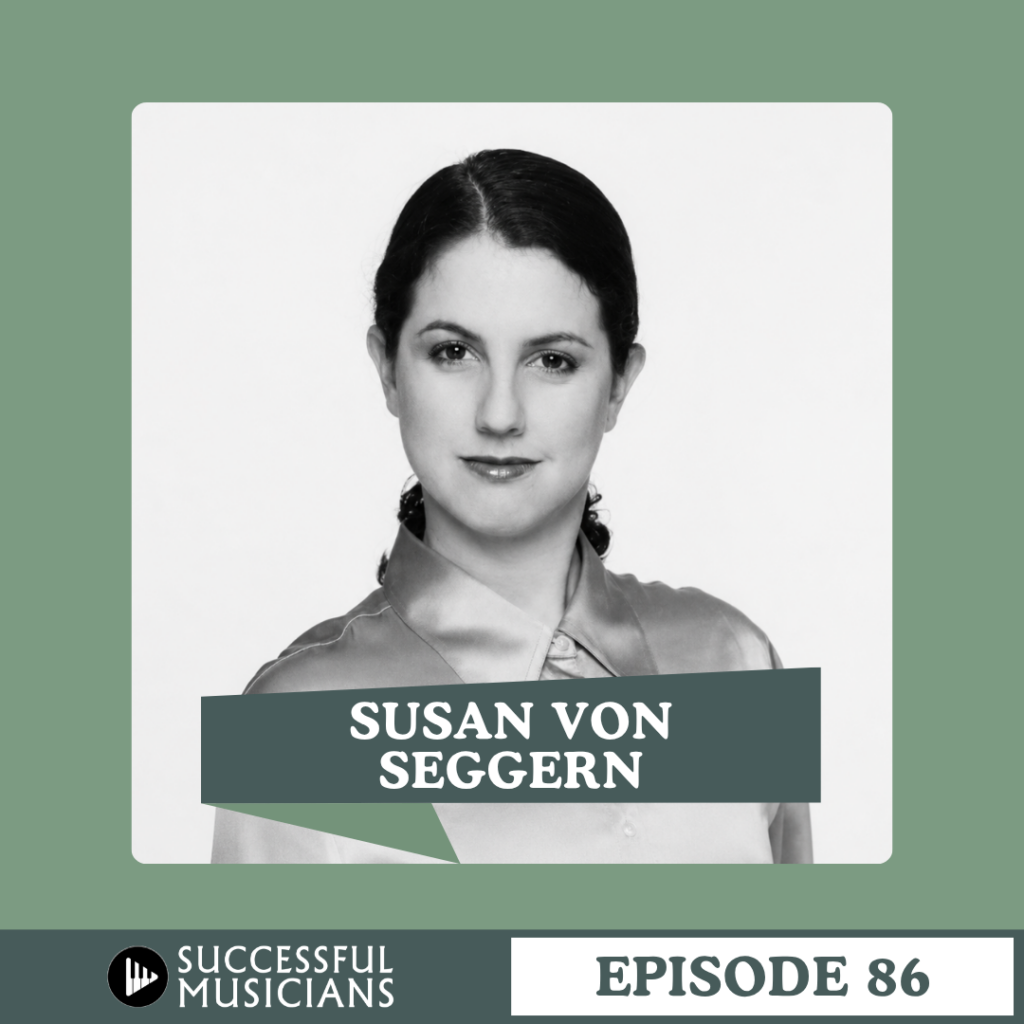
Successful Musicians Podcast
Interviewee: Susan von Seggern
Interviewer: Jason Tonioli
Jason
Hey guys, welcome to the podcast today. My name is Jason Tonioli and my special guest today is a PR, we’re going to call you Ninja Susan. Susan Von Seggern. She’s worked in the marketing and PR business for multiple decades. We’ll leave it at that. And funny story with how we ended up connecting on this is you were actually reaching out to pitch one of your clients to me, and I went and I looked at your background to see if, you know, tend to do a little bit of research on my end. I’m like, my gosh, we need to bring her on in addition to this musician. And next thing we know, we’re sitting here and I think we’ve become friends as we’ve been chatting before we’ve gone live. But Susan, I’ve been just really, really impressed with your background, some of the really cool stories on PR.
Susan von Seggern
Absolutely.
Jason
And I feel like for musicians in general, PR is kind of that thing that people ignore. And it’s one of the probably the most viral things that a musician could do if it’s done well. And especially for independent musicians, I feel like there are opportunities for stories and PR opportunities that like the indie musician does not even realize is right in front of their face. It’s usually better than most of the stories that if you were trying to like to plan it, the stories are oftentimes better. So I’m so excited you’re here.
I want you to share a little bit about yourself, but then I want to really just dive in and let’s talk about PR and what people as musicians need to know or should be watching for.
Susan von Seggern
Absolutely. So nice to be here. Thank you so much for having me on. Yeah, he’s just being funny. I was pitching him on my husband who runs Future Proof Music School, who’s also been a musician for decades. And he’s going to have him on at some later point. And my husband is a musician. So I’ve seen the music world from that side through him. But I have also been working in the music business either full time or part time since the early 90s. In the late 80s I was a student at New York University and I was on the concert committee. So I got to meet lots of people in the New York music business through that.
And then into PR, actually my first PR internship was between my junior and senior years of college and I was the PR intern for the New York Renaissance Festival. So that’s kind of the first thing I did in PR and then I had been doing the concert committee at NYU so I was producing these concerts. So I kind of got the PR from doing some concert promotion, but also from that. And then after I graduated from college, I went and I worked at a PR agency in New York called Set to Run, which doesn’t exist anymore. But at the time, it was like the super cool alternative rock and hip hop PR company. And both of those things were so new and bleeding edge and cool in the early 90s that it was just the place to be. I ended up moving out to Los Angeles to run their West Coast office.
And then I did that for only like seven or eight months and then I was recruited to be the head of West Coast PR at Island Records which I did 93, 94, 95, 96, between U2 albums so I didn’t actually get to work on the U2 album. And then after that I went and I had a cup of coffee running PR at Priority Records.
I was moving in a more dance music direction and they of course were a hip hop label so it was not, I wasn’t really aligned in terms of genre. So then I went and I started my own agency or actually I joined with my roommate who was running a little dance music agency of one and I joined with her and over six years we built that agency from just her and I to 12 people. We had an office in Los Angeles, we had an office in New York and then of course we got killed by the dot com crash and the 9-11 recession. That agency mostly focused on electronic music and electronic lifestyle and culture, so that was like dot com companies and electronic music and all kinds of super cutting edge stuff that was happening around that time. After we got killed by the dot com crash and the 9-11 recession, I actually went and worked for the Democrats for a couple years leading up to the 2004 election cycle.
After that I was just depressed and I didn’t know what I was going to do with my life and luckily the phone rang and it was a headhunter from one of the world’s largest online gambling companies. So I ended up working for, I know, it was great. I ended up working for this online gambling company that was based in San Jose, Costa Rica and Vancouver, British Columbia. So, and with that job I also traveled all over the world and it was one of those 100,000 mile a year travel jobs. So I was like so done with it. After three years they had to lay me off because the federales were cracking down on online gambling, which is crazy to think now because of how big online gambling is, but back then online gambling was like no bueno. So anyway, after that I was my own wedding planner for a minute and then I just started doing PR consulting and so I’ve been doing PR consulting ever since 2008. And, you know, I, even when I wasn’t doing music PR, I always was doing some music, like with the Kucinich campaign, which was my big 2004 election cycle thing. We did an amazing concert with Willie Nelson and Bonnie Raitt and the Doobie Brothers in Austin. And that was incredible.
Jason
Nice.
Susan von Seggern
And when I was at Bodog, they had a record label. We had Wu-Tang Clan for Europe, and we had some other artists in North America. So I wasn’t really doing the PR for the record label, but the girl who was the PR for the record label became a really good friend of mine. And so I would be like, this is how you do that, or let me help you with this. So I always was kind of like doing music, even though I wasn’t doing music. And since I’ve been consulting, I certainly have different areas of PR consulting that I’m stronger in, in terms of music, the areas that I’m the strongest in are New Age, ambient, jazz, and world. I mean, sometimes I’ll do a dance project because my husband will have a dance project. Sometimes a friend of mine will be like, please help me out with my indie rock thing. But mostly I try to keep it with genres that I know I can do a great job in, which is pretty much New Age, world, ambient, and jazz.
Jason
That’s amazing. I did not even realize you did the new age and that’s, that’s kind of my thing is the new age piano world. So that’s incredible. So I think what’s interesting with this is if you were to go to school for PR today, I mean, the world since about 2010, you know, has just come, it’s a whole another world. Then we’ve got all the AI stuff that’s completely changed stories. But if, if you rewind back, I mean, I was…
Susan von Seggern
Yeah, yeah, I do tons of new age
Jason
In the early 2000s when I was doing this, I mean it was you’d send faxes out and then it evolved into you’d send emails and but what it required you to do is you had to think through a story and and recognize what it was and you had to essentially Help write a really good story and guide that reporter who’s gonna write the story along. And I feel like the world is definitely transitioned where AI can help in a lot of ways to even help an artist uncover a lot of their stories. But good stories are always gonna have that human element and the human storytelling part to it. I almost feel like that’s the area that oftentimes musicians don’t realize it’s as cool as it is because they’re just in it day to day and doing the thing. Whereas they just, they don’t even realize there’s a story that exists right in front of them. They’re living by themselves at the moment, right?
Susan von Seggern
Right, right. Absolutely. Yeah, I mean, when I started doing PR, we were mailing press releases and then we were faxing them and then we were emailing them. I mean, I like the joke that I’ve forgotten more about PR than many people know because like, so much of the way I would do it in decades past has changed. Although, to be fair, lead times have gotten shorter. Although, to be fair, there’s still the basic stuff, especially if you’re doing kind of album release or single release PR.
Jason
Yup.
Susan von Seggern
Did you get it? Did you listen to it? Did you like it? Are you gonna cover it? You know what it means? Actually, when I first, when I moved away from doing only music PR in the early aughts, part of it was because I just couldn’t ask those questions ever more, anymore. I was like, I can’t have this conversation ever again. And then of course, you know, music, I love music, I’m a music person. I could not do music PR, but I did have to take a break there for a while. But it is, you know, those are the main things you want to find out when you’re, when you’re actually actively pitching. you get it? Do you listen? Do you like it? What can you do?
Jason
Yeah. Well, I’m just curious from a framework standpoint, what are things that kind of you nor like your independent musician that frankly, a lot of us out there are like, I don’t even want to do marketing. What’s kind of a framework that they, somebody ought to at least be thinking about as they’re creating music that would make something newsworthy or able to end up being pressed, you know, interesting.
Susan von Seggern (09:15.793)
Right. So, you know, the main thing with music, there’s kind of two things with music that are going to help you get covered. First of all, people need to understand. And when I say people, I don’t mean just musicians. mean, entrepreneurs, everybody. People need to understand that you don’t start at the top. Like you’ve got to work. You’ve got to build it up. You’ve got to build your buzz and then people will start recognizing you and start wanting to cover you. I’m on a freelancer platform and I get so many ridiculous tasks on the freelancer platform. Like I saw one yesterday, I have a fashion company in Northern California and I only want to be in these outlets. And it’s like Vogue, Glamour, like, honey, do you live in New York? Do you have a show during fashion week? no? Okay. Then maybe Vogue is a little out of your league.
So, some musicians, you know, sometimes they’re like, if I’m not going to be Rolling Stone, I don’t want to do it. And it’s like, no, it’s about finding your audience and finding your fans and then super serving them. And the way to do that, honestly, for musicians is vertical coverage, which is, you know, genre coverage and regional local coverage. So if you’re in Salt Lake City, you want to get all the media around Salt Lake City. If you’re in the New Age, you want to get all the media who cover New Age. And then once you’ve got those kinds of bases covered, if you’re getting the Spotify plays, if you’re getting the other attention, the social attention, you know, whatever, then maybe we can talk about Rolling Stone.
You gotta be just killing it in your genre and your region before you can do that. So say you are killing it in your genre and your region, and then you’re going on tour and you’re super busy and you’re like, my god, I’m on tour and I’m doing all these things. That’s maybe when you want to think about hiring a PR person. When you are at a point in your career where you’re too busy to do it yourself and you think it would be worthwhile to bring in somebody else to manage it to maximize the potential coverage. Does that make sense?
Jason
Yeah, no, it makes total sense. I think that the sad part is most people don’t ever even think about the fact that they could, you know, do the thing, let alone hire the person. Right. And so what, what would you say, what, goes into a, interesting story if you’re, if you’re that musician and trying to figure out, okay, you know, you mentioned new age. If somebody is wanting to do a new age album or new age piano album what is it that that person probably should be thinking about during the creation phase all the way up through the end I mean what does something like that look like.
Susan von Seggern
So I try to not tell people what how their music should sound or what they should record but You know, it should be as great as it can be and as high quality as it can be and you know If it’s a genre thing you want it to really be in that genre I have a new age project right now that I’m working on that is actually See mammal sounds with kind of like world instruments so like Negroni didgeridoo Indian flute and then the mammal sounds. So, you know, so I’ve been pitching that to obviously like all the new age people, but also I’ve been trying to find people who like to write about whales or dolphins or, you know, other things that are kind of aligned with the topic.
Jason
Interesting.
Susan von Seggern
So if it’s a new age thing, maybe you have a spiritual background. Maybe it’s a Buddhist thing. Maybe it’s a Hindu thing. Maybe it’s a Christian thing. So if it’s one of those things, you want to get to the people who are writing about that kind of music. But let’s back up a little bit. You’re a musician, and you’ve decided you want to hire PR. You want to get PR. Or you want to do it yourself. thinking about it. You watch Jason’s amazing podcast and you’re like, gosh darn it, I’m going to do PR. How am I going to do PR? So in 2025, there are four, there are four ways that you basically get PR.
So one of them is just media outreach, which also is called pitching. So with that, I want to get a list. Like maybe your friend has a list. Maybe the club you’re playing at has a list. Definitely ask them because they well might. Or maybe you just have a bunch of blogs and a bunch of outlets that you love, that you know cover your genre and you’re so into your genre and you’re so into these blogs, you want these blogs to cover you. So great. So then you do the research to figure out who to pitch at these blogs or at these media outlets, and then you pitch them. And honestly, I was just having this conversation earlier today. Journalists love when the subject pitches them. They love that much more than me pitching them. So don’t feel weird. Don’t be like, they don’t want to hear from me. I’m too scared. Screw that. You want to get your music in front of people, right? So you got to pitch. Got to pitch. that sustains media outreach. You get a list every time you have a single or an album or a tour. Yes, they get the press release, but they also get a little personal email from you that says, hey, I’m going to be in your area or I thought you would like this album because please check it out.
You know, personal pitch really goes a long, long way. Only, but for each project, you only want to pitch people two or three times. Any more than that is a little, makes you look crazy. And people don’t need to, if they haven’t given you an answer after you’ve sent the first pitch and done two follow-ups, they’re not going to answer. But don’t get discouraged. Journalists are busy people. They have assignments from their editors of things they’re supposed to write. They need to do those assignments and then they look at the zillion emails they get, pick some, pitch their editors. Sometimes the editor says, yes, you can write about Jason’s album. Sometimes the editor will say, no, I want you to write about Susan’s album. But that’s okay. They’re not saying we don’t like Jason’s album, we don’t like Susan’s album. They’re just saying, they’re not saying no, they’re saying not yet. And if they’re not saying anything…
Jason
So I’m thinking the dumb and dumber Jim Carrey, like, you’re telling me there’s a chance, right? If you remember that. So one other thing is, I see this from people that end up pitching to me sometimes is you’ll get that email and you can tell that everything’s been automated and there might be a different font or a bold.
Susan von Seggern
Yeah, so you’re telling me there’s a chance. Exactly! That’s… That’s right!
Jason
If you’re going to go to the effort of sending me an email, if you can’t even like to look at your email and make sure it’s going to look personal. mean, it’s just like a quick and easy delete right off of there as well. I mean, just a tip for musicians or any salesperson, no matter what role you’re in, the way everything’s become automated, make sure you’re not shooting yourself like shooting yourself in the foot. I mean, I see some people, it’s almost like, okay, you just took your shoes off and your socks off, then you shot yourself in the foot. made it like it was so, so poorly executed, right? And they’re just little things that I think give it a way of, you genuinely, know, did you care enough about the thing to make sure it was quality and professional before you wasted my time to look at your email?
Susan von Seggern
Right, so what I’ll often do is I’ll write a kind of basic pitch and then as I’m going through my outreach lists, I’ll go, I just talked to her about that, so let me put a little note in that, or was her birthday last week, so let me put a little note in about that, or I just saw that she covered XYZ that I really liked, let me put it, so it’s like, you do want to personalize, but you also want to get the information across, so you kind of have to strike a balance there.
Sometimes there’s no personalization that can be done. I don’t know them. I haven’t read an article about them recently that they read that I liked. I just know that they’re with a big outlet and they cover my topic and I need to get it out there. So maybe I won’t do a personalized pitch. But if you can do and have like an organic thing that you can personalize a pitch with, definitely, definitely, definitely do it. One thing is that journalists use their inboxes as if they search them.
So like if I have a new age project and it’s in people’s inboxes, make sure the word new age is in that press release or in that pitch. And then when the journalist is searching, they’ll find you. Like speaking of new age, so a lot of people meditate with new age music. So I’ve totally had people find, like do a search for the world meditation in their inboxes, find my pitches about my new age artists, and then be like, hey, can I talk to your artists? Because I’m doing a thing about meditation. So, you know, I’m not a fan of keyword stuffing, but make sure the important points about your project, artist, album are in the pitch. So that’s sustained media outreach.
The next thing is press releasing. Everyone’s like, isn’t the press release dead? No, the press release is not dead. The press release is actually the most popular way journalists like to get information. 74 % of journalists in the last season annual or muckrack annual, can’t remember which one, said that is their preferred way of getting information. The reason for that is because it’s low pressure. It’s not personalized. It’s not. I wrote all these paragraphs just for you, just to pressure you into covering my thing. No, there’s this album, there’s the single, there’s this tour. It’s happening. These are the reasons why you might be into it. Cool.
And then they can look at that and then they can go, great, thanks for the info, without feeling like, my god, this person spent two hours running this pitch and now I feel bad. So they don’t feel bad, they know that you’re just giving them the information and then they can do with it whatever they want. Also, I get press releases picked up all the time. Sometimes it’s just the whole release, sometimes it’s, Suze, this is so great, I didn’t realize, I’m gonna use your release and then I’m gonna write make it into my own thing. I mean, that literally just happened to me with this Sea Mammal project, which is called Whale Dreaming. It’s coming out Monday. And people just got the press release. They wrote about it. So press releases are not dead.
Jason
Right.
Susan von Seggern
The third way, and this is where you’re talking about musicians, unique things that
might not even have anything to do with their music but might make them interesting and cool anyway, it’s called lead service monitoring. A lot of people have heard of the original lead service which was called Harrow, to help a reporter out. Harrow has had all kinds of ups and downs and comings and goings. It is back. It is okay. The guy who started Harrow has a new one called SOS. Also, it’s okay.
The one that I really, really, really love the most and really recommend is called Qwoted and that’s Q-W-O-T-E-D and that is a web based platform and they have seriously like 100 leads a day and they’re all different. I mean, you know, different verticals have, you know, like if you’re in real estate or professional, you know, personal finance or I do a lot of wellness PR, so sleep, hair loss. There’s definitely parenting, pregnancy. There’s definitely certain topics that are heavy, heavy, heavy in the Lead Services. But there’s also some that are completely weird and left field and you could be perfect for. Just recently, I saw a lead, it was from Business Insider, and they were looking for people who had gone to college in China.
Well, you know who went to college in China? John von Seggern. So I pitched him and he got in. And now there is a story that is basically an interview with John about his experience going to grad school in Hong Kong. And there’s a link to future proof music school and it’s a whole story on him and a cute picture of him in front of the Great Wall, as you’d expect.
Jason
Very, cool.
Susan von Seggern
I’m the publicist, so obviously I know my husband better than anybody, so when I see something like that I’m like, aha! But obviously, you know, if I see something about whales, or sea mammals, I’m gonna send my whale people their way. If I see something about meditation, I’ll send my other New Age clients their way. But you, as the artist, know yourself better than anybody. So, you know, take a cruise, you know, take a 15 minute cruise through Qwoted every day and see if there’s something that you can respond to because seriously…
Jason
So you’re telling me there’s a chance for a whitewater kayaking piano playing person who has things happening in Costa Rica that’s as random as that. That’s all.
Susan von Seggern
Yeah, no, believe me. I see. There’s definitely Costa Rica leads. Yeah, definitely. And white water rafting and, you know, people who live in Utah. Like there’s all kinds of leads for everything, you know, because it’s whatever journalists are looking for. So it could be like, do you have somebody who can talk about, you know, people with dementia getting lost, you know, around this, the…
Jason
That’s amazing.
Susan von Seggern
…kidnapping or you know so there’s sometimes they’re looking for things that are related to the news but sometimes they’re just looking for evergreen lifestyle things like my sleep expert like you know what is the best mattress, what is the best blanket. But anyway, so lead service monitoring is a really, really powerful way to get coverage. It might not necessarily be coverage about your music, but anything that has coverage about you and links back to your website is good. All press is good press, as they say. So.
Jason
Well, I’m curious, I mean, there’s often these awards, you know, there’s the Grammys and you’ve got all these different awards. There’s another, I mean, I think people make up awards sometimes to make it look like a big deal. If somebody is wanting to try and look like a bigger deal, then maybe they are Like some of those awards, like it’s almost like, I got this Grammy or Grammy nominated on my name as a musician. All of a sudden you’re, you’re a big deal and in somebody’s eyes and can, you know, so I’m just curious if you were advising someone on, that type of thing where, Hey, I think I want to try to get a Grammy or whatever other award it is you want to go for. What should that artist be thinking about?
Susan von Seggern
Yeah, mean, certainly the Grammy is super validating. It’s super validating for any kind of musician to get a Grammy because it shows that your peers really, really appreciate what you’re doing. And the process of trying to get a Grammy also is great for meeting your peers and finding your tribe and stuff. I mean, I’ve worked with some…
I’m part of the organization called Mamas in Music and so I’ve worked with some of the musician mamas on Grammy campaigns and I mean, it’s amazing. If you get that, you win a Grammy, now, a lot of great things come along with that. But there are other awards. There’s, you know, there’s regional awards. There’s like, you know, there’s like the LA Music Awards, the New York Music Awards. Those are great to get. Many, many, many millions of years ago, I had a DJ client, a pretty famous DJ client, DJ Irene, and she got a bunch of dance music awards. I don’t even remember what they were, but those were press releases. And, you know, ultimately after, you know, the press releasing and the pitching and her winning awards and her touring and playing, I was able to get her in Wired and Oprah magazines.
She had an amazing history, she had been homeless and then she was a UPS driver and then she became a famous DJ. So she had a really interesting story. But it was definitely the journalists, I got this press release about DJ Irene, she won some awards. I got this other press release about DJ Irene, she won some other award. You know what I mean? So it’s all part of building the story, showing people that you’re interesting and active over time.
Jason
Yeah.
Susan von Seggern
Showing that you are that somebody is impressed with what you’re doing enough to give you an award. You know what I mean? So it is there’s you know that that stuff can be very very powerful and helpful. Absolutely.
Jason
Yeah. The key thing is, in that case, and in most cases, there’s a strategy behind it. You’re moving towards something that has things that interconnect and make sense and ties together. I think a lot of times the idea of like, was just like, there’s probably once in a while where there’s some really cool story that just pops and shows up. But usually those types of stories are something, somebody did something really dumb and ended up in jail.
Susan von Seggern
Absolutely.
Jason
The good stories don’t end up coming from just like some happenstance most of the time you know it’s not a random
Susan von Seggern
I mean, it’s all, you know, it’s all building relationships and showing people that you’re interesting and showing people that you’re talented and showing people that you’re working hard and showing that you’re building an audience. So I don’t do social media, but you want to either do it yourself or have somebody doing it so that you can show the growth of your socials, you know, playing increasingly bigger rooms. I mean, hopefully it doesn’t happen as quickly as it does. Hopefully it happens quickly, but not as quickly as happened to poor Chappell Rome. Like she was booked into tiny rooms and suddenly like you know there was like massive stampedes outside her gigs although honestly like even when i was a little tiny baby going to shows and i started going clubbing when i was like 14 years old it was the 80s it was different.
I was really into the Bangles, because I was really into the LA Paisley Underground, I was really into Rain Parade, and I was into all those Paisley Underground LA bands. So I knew about the Bangles before Maddox Monday. So I was like, great, the Bangles are coming, I’m gonna go see the Bangles. So between the Bangles gig being announced and the Bangles gig.
I think Walk Like an Egyptian had blown up or maybe it was Manic Monday, it was one of those. And what would have just been like a normal night at a normal club, like I had just seen Rain Parade like two weeks before and it was full, but it wasn’t like full. And then like then the bangles come and it’s like, you could not get in. So, I mean, that does happen, but that’s a great, it’s a great problem to have. You know what I mean? So you wanna, you wanna show growth. You wanna show…
More people are listening to you, you’re playing bigger rooms, you’re selling more records, you know, you want to show growth. Like even if you start out really, really, really small, because guess what? Everyone starts out really, really, really small unless they’re like having a nepo situation, but that’s, you know, very rare. Everybody starts out small and then you just want to, you know, you want to push the growth and you want to show the growth. so that kind of also brings me to events, but go ahead. You had a question.
Jason
Yeah. Well, it was just, I know we’re about out of time. you were, if you were to just have any kind of advice for the musician person that’s, know, releasing music or wanting to give what, what would be, if you just had that little short opportunity to give somebody like that advice, what would you tell them?
Susan von Seggern
Okay, I can’t finish this episode and not talk about event PR. Got to do event PR. If you’re touring, if you’re gigging, you have to do event PR. You have to get out in front of your events by at least four to five weeks. You want to do a press release, you want to do outreach, you want to do social inviting, you want to do last minute outreach. Anybody can look up my timeline for public event media outreach.
I did an interview a couple years ago on PR news.io. I’ll give Jason the link so he can put in the show notes. Yeah, like you want people to come to see your gigs, right? So I have a PR strategy that you can use to invite people to your gigs and have the media show up at your gigs. Also have the media cover your gigs ahead of time to let people know about your gigs. And then they come to your gig.
Jason
We’ll put that in the show notes for sure.
Susan von Seggern
Or like the media writes about the gig, then you invite them to the gig, then they may or may not do a gig review, live reviews are way less of a thing these days, but you still want to get people to go because you want them to see you because then the next time you come through town they could write about you again having seen you. So, you know, definitely like if you’re a musician, ideally you’re playing and you want to get media to your gigs. That’s a huge, huge, huge, huge, huge part of music PR. I don’t want to leave without saying that.
Jason
Well, if you were, and maybe there’s some books out there or some really good resources. If somebody’s, if you were advising somebody on, go learn about this stuff. What would you advise them to go check out? I mean, obviously, I mean, if you, if you gotta get to the point where you hire some help, that’s going to be key. But I think a lot of the time, if you, as a musician, can at least be educated.
Susan von Seggern
There’s some music PR books out there since I am a professional music publicist. I haven’t really read them. I know there’s a gal named Ariel Hyatt, H-Y-A-T-T, and she has written quite a few books on PR and marketing for independent musicians, and I’ve always heard good things. The AIs can give you a lot of tips these days as they can about anything.
Ask deeper questions. Don’t just say what media outlets say like, what’s my plan? Or maybe put my plan in and then get a deeper plan that’s just for you. You know, when you’re looking for outlets fan of people doing themselves to the point where they just absolutely can’t because it’s good for you to A, learn how to do it and B, build those relationships yourself. You know, you’re going into a market. What kind of media is in that market? Well, there’s probably a daily paper. There’s probably a weekly paper. There’s probably a college station. There might be another kind of NPR non-commercial station that has music. There might be a music blog. You know, if you’re in kind of a genre like if you’re a new age artist there might be like a yoga blog or a meditation blog for that area so just think like let me find these six types of outlets for the cities that I’m going to you know like don’t make it harder than it has to be.
Jason
I think using AI, it’s only going to keep getting better, but there’s so many things that you can ask a lot of those initial questions and probably help to put together a plan. I think there’s absolutely a place for the live person to kind of coach and mentor. It’s the fastest way to level up and kind of elevate your game.
Susan von Seggern
Absolutely. Absolutely.
Jason
AI is definitely a game changing thing that if you’re not using it, you need to for some purposes and then use it to just help speed things along and make them better than what it would be if you, you know, as a team. So, gosh, Susan, I could keep talking for, for an hour or this, this is awesome. but we’re out of time. Let’s, if people want to go learn more about your, what you do, or I’m sure you’ve got some case studies or just kind of check out some things, where should they go?
Susan von Seggern
Absolutely, absolutely. Yes, yeah, so my website is www.susanvonseggern.com, it’s all one word. My socials are generally at Susan Von Seggern and I do have, if you go to my website and hit frameworks, you’ll see the four things that I recommend and if you go to prnews.io, Jason will put up the link that will give you my event PR timeline and yeah, just you know, you know if you need if you ever need PR I try to have nice prices for musicians because I know you guys don’t have as much money as corporate clients, but I like working with musicians So, you know, maybe I’ll have space and we can work together.
Jason
Awesome. So you just heard it from the PR Ninja, So Susan, thank you so much for taking time and just sharing your insights and wisdom. I just think I’m so appreciative of people who are willing to just take time out of their busy schedules and kind of give back. So thank you. I think this is one for sure you had to go listen back. Some of those ideas that you were throwing out there can absolutely be game changing for artists if they’ll just think, OK, how would this apply to me? And so yeah, so awesome. Well, thank you so much. And we will, we may have to have you come back again and share some more. We may go deeper on this one. This is an important topic. So thank you.
Susan von Seggern
Yeah, I’m happy to come back. It was so nice to talk to you. Thank you so much for having me on. Thanks.
Jason
Awesome, thanks Susan.