
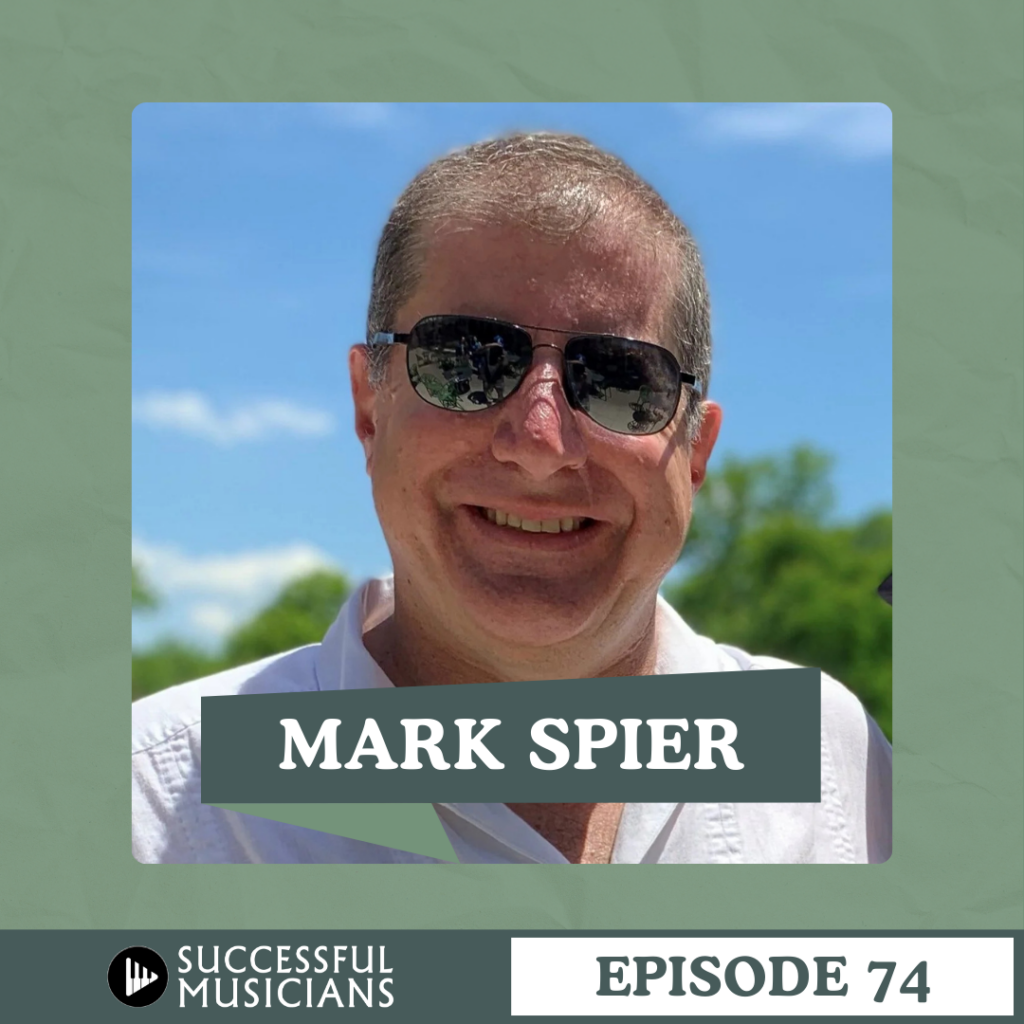
Successful Musician Podcast Episode 74
Interviewee: Mark Spier
Interviewer: Jason Tonioli
Jason Tonioli (00:01.166)
Welcome to the podcast today. My name is Jason Tonioli and this is the Successful Musicians Podcast. My special guest today is Mark Spiar. Mark is a true expert in the publishing and royalty administration world for music. He’s the president and CEO of Royalty Solutions. It’s a company that he actually founded back, I think it was 2009 with the goal of providing a kind of transparent efficiency, just efficient royalty processing and publishing services for artists.
I know you work with labels and publishers around the world as well. So you’ve been at this for a long time. It’s been, I mean, it’s been a ride for the last 20, 30 years for sure. As you’ve been, you’ve been on this ride. What I find interesting as I’ve kind of done a little bit of research on you though, is your family, goes back a long, long time that you’ve been kind of the family legacy in the music industry.
Mark Spier (00:42.684)
Yes.
Jason Tonioli (00:57.23)
But your background is actually you were a computer guy and you’ve got your MBA, you also worked at IBM and Credit Suisse. I got a fellow banker on the call with me today. So my guess is spreadsheets and numbers are something that makes you happy, kind of like with me sometimes when I’m looking at data and numbers.
Mark Spier (01:19.356)
Yeah, so, you know, I mean, my family has been in the music business since 1921. My ASCAP membership is 1921. My grandfather was a songwriter and realized he really wasn’t the best songwriter in the world.
Jason Tonioli (01:34.498)
Wow.
Mark Spier (01:44.286)
… and decided to go into the music side of the business and went into the publishing end of the business. He was involved as general manager of Chapel Music when it was just Chapel, not wanted Chapel, in the 40s and was really involved with Rodgers and Hammerstein and all the shows, Broadway shows back then in the 40s because that was a lot of the big music that was selling. Sheet music for Broadway shows was like a big selling thing. So that’s where he started it. He went into business for himself. After that, my father joined the business in the 1950s and continued working until he passed away in 2003. I joined the company after, again, being a computer science person and getting an MBA and working 10 years at Credit Suisse.
It just became time to move on and my father was looking to retire, was semi-retired, so I joined the company in 2002 working with him and then when he passed in 2003, I took over the company and it was a company and we had a lot of big, big songs. We represented What a Wonderful World and all the works of George Weiss, Santa Claus is Coming to Town, the works of Larry Stock, which is You’re Nobody Until Somebody Loves You, and Blueberry Hill. We represented some niche groups, Black Ivory, which was a cult group in Harlem in the 1970s, whose music has been sampled so many times it’s crazy. They had a unique sound and so I kept, I’m just trying to go through, we also represented Louis Prima, Jump Driving Well, so we had a large catalog.
But most of the catalog was on administration, on short-term contracts and handshake deals for the most part. Really, I mean, there was paperwork, but they were one-year contracts. And what happens? The songwriter dies, my father dies, I don’t know the heirs, the heirs don’t know me, and they get lured away to bigger companies. Concord, Sony. And back in the 2000s, that was the start of funds coming in and buying catalogs. And I just got caught up in that and being behind trying to get my own funding, which I never got, but I was behind the net and started to lose catalogs. Being a computer person and a business person, about 2008, I started seeing the rise of the digital world and a digital distribution and people moving away from the major labels because they could DIY it. I find out that through just understanding a major label did three things, well four things for you. One, they gave you a nice check if you were good enough.
Two, they were able to distribute your CDs or I call them records. They’re called vinyl now, but they were records back then. They needed a big distribution network to actually physically get your records into stores. They did marketing for you, radio and marketing, and they did royalties. OK, so.
We moved to digital, which means there was no need to physically distribute. So you could distribute the records yourself. Social media replaced all the marketing. So now you could just do your own marketing or not need a major company with connections to radio stations to get your music on the air. But the one gap they had was the royalty and the accounting and all the financial work that was not there, it was a void. And people got into this business and then started to make money and then they didn’t know what to do. So that’s how I sort of ventured into using my connections as a music publisher and not having the funds to buy catalogs until now working with companies that did all that stuff.
Jason Tonioli (07:22.52)
Well, and I think one of the hard things with, know, especially for independent artists is we’re kind of thrown into this and artists are good at creating things, but in general, most are not very good at doing the business or the bookkeeping or, know, that that’s just stuff that almost for I’ve seen it in so many people where it just kind of shuts them down when they have to start thinking business. I’ve just watched so many eyes glaze over.
And just the joy of music goes away very quickly for artists. So, but, but I’ve also watched so many of those people when they don’t or aren’t willing to kind of go down that path and at least learn the basics, it hurts them and their ability to earn money and, and run their business and grow. Right.
Mark Spier (08:08.146)
Well, that’s the whole left brain, right brain scenario. The creative person is not the financial person in most cases or the analytical person. What generally happens or just the flow is that most artists are doing the music as a hobby. And they get to a point where the hobby becomes a job.
Jason Tonioli (08:17.036)
Right. Yep.
Mark Spier (08:33.862)
They don’t know how to do the job. They know how to do the hobby part of it, but now we’re starting to make money and starting to have to deal with a lot of business sides of the music and it just falls short. Well, they don’t have time. Let me put it that way. They don’t have time. They want to spend their time working on their music and not dealing with all the ancillary things it takes to run, to be in the business of music.
Jason Tonioli (09:10.872)
So, I mean the biggest problem people run into with the business. What advice do you have? I mean you’ve been around, mean gosh since the Roger and Hammerstein days, you’ve heard stories of so many artists kind of doing dumb things. I mean what advice do you have for that individual that needs to get some help so they can continue to focus on creating and writing music and performing. What does somebody do? How do you know when there’s that point where I need to hire help or get a team member to come in?
Mark Spier (09:43.73)
Well, there’s a lot of pieces to the team, right? There’s a lot of different areas of the team. There’s the team that gets you the gigs, the tour manager, you want to call it, or something like that. If you’re starting to become successful, you want to get into bigger venues and make more money. You can’t just do that on your own. You need somebody who is involved with that. Then once you start recording, you need to figure out who is going to be your distributor and what the best distribution plan is and how they’re going to, what they’re going to offer you and what percentages, because people don’t know what the right deal is.
You know, a lot of people look for the money now instead of the money later. Like it’s always, do you want less money now or more money later? And
That philosophy is based on, if I’m going to be successful, I want more money later. If you think I’m just gonna take the money and stop, or don’t think I’m gonna be that successful, I’ll take the money now, be my one hit wonder, and retire on it. Because those deals, that’s how they’re structured. They lock you in and in essence they’re giving you a bank loan at a very high interest rate, assuming that you’re going to recoup the advance. If you’re not going to recoup the advance or you don’t think you’re going to recoup your advance, then take it and you’re stealing their money. But if you think you’re going to recoup the advance, then in essence they’re giving you a bank loan at a very high interest rate.
Jason Tonioli (11:50.286)
And I guess the question, if you’re that artist, how do you know which it’s going to be, right? And the beauty of it now is it’s become, you know, as an independent artist, you can now pretty much do most of that on your own. And there’s not nearly as much need, I guess, these days. But I’m guessing that as an independent artist, there’s probably a lot of things that people are missing when it comes to collecting royalties and just publishing rights, now, just all the money. You know, there’s probably things left on the table that you guys just shake your head having been around this industry for so long.
Mark Spier (12:25.106)
Right, so as an independent artist that is, and I’ll even go back, not even an artist, but more of an independent songwriter, okay? It’s important that your songs get registered in all the right places, okay? I’ve heard people say, well, I registered with ASCAP or BMI. That’s not going to really help matters, okay? You need to register in all the right places. Streaming income, you have to register with the MLC in the United States. I have stuff on YouTube. Well, you gotta tell YouTube that it’s your money. You wanna monetize. YouTube produces a lot of money. TikTok, Facebook, all these places, they just don’t send you the money. You gotta tell them, this is my song and you should pay me.
I’m just talking about the United States. Now you’re talking about everywhere because now when you release your song in a distribution through a distribution company, it’s being released throughout the world. Right? So there could be sales in England that, you know, someone picked it up and all of sudden you’re getting sales. And if you’re not registered there, you’re not going to get your publishing royalties. You’ll get your streaming royalties, but your publishing royalties will just go into a black box and you’ll never see them. I figure that publishing royalties are about 25 % of your distribution royalties. So if you make a $100 distribution, you should have $25 in publishing income at a minimum.
Jason Tonioli (14:25.55)
Interesting. Well, and so, and I think the, the thought is, okay, I released my song through tune core distro kid, too lost, I think is another one that’s kind of an up and comer. A lot of my old songs back before tune core was a thing. Reverb Nation is one that I’ve released some of my tunes under. So if I’m an artist and I’ve done the distro kid tune core thing, which I think is the bulk of newer songs that are independent have gone through those types of places. Are people just totally missing out on that? And they don’t even know what they’re…
Mark Spier (15:01.192)
They’re not putting, they’re not doing anything with the publishing. Now, yes, Tune Core offers publishing, all these companies quote off of publishing, but they don’t offer the service. It’s just really an automated type of situation. I’ve had a lot of clients come to me and say, we’re with them and they’re doing such a poor job. Or what else? They don’t know that they’re doing a poor job.
Jason Tonioli (15:04.344)
Gotcha.
Mark Spier (15:31.002)
Okay, till we get in and look at it and say well they’re not collecting here. They’re not collecting there and they’re losing out on revenue.
Jason Tonioli (15:42.476)
Yeah. So, so with a, I know you guys will sometimes do audits for companies. As an independent artist, let’s say you’ve got an artist that’s made a hundred thousand dollars or, you know, let’s just keep numbers simple, like a hundred thousand dollars, in streaming revenues. Would you typically expect to find that $25,000 that they just haven’t collected? Is it just free money that they didn’t even realize they have?
Mark Spier (16:04.432)
In publishing income, yes, probably. That’s correct.
Jason Tonioli (16:08.558)
Is there a timeline? Do you lose it after seven years or is there a certain timeline?
Mark Spier (16:13.406)
It’s like two to three years. It’s two to three years because right now what the MLC does, because now it’s the new organization of being very transparent, I get a month, as a member you get a monthly report of unmatched songs. So it’s like here’s all the songs that earned money this past month, but we don’t know who to pay.
Jason Tonioli (16:17.655)
Really?
Mark Spier (16:42.29)
You know, and it’s a big spreadsheet.
Jason Tonioli (16:46.666)
I’m sure, well, I still remember this was several years ago. got a, reached out to me from sound exchange and they were like, you know, Hey, we have this check for like 15 or $18,000 that is yours. I want to send you money, but we need your bank account. And so the banker in me is like, okay, somebody’s asking me for a bank account. This has got to be a fake thing, but they, they kept, were persistent to the point where I’m like, okay, this is either a Nigerian print scam or these are for real.I ended up getting a very large check, which was amazing. But I mean, for those, you know,
Mark Spier (17:22.856)
Sound exchange is another source that people do not register. I mean, yes, it doesn’t pay for terrestrial radio, but it does pay for the internet and Sirius pays them. so if your songs are on there or on other streaming platforms, again, money’s out there that if you don’t tell them who to pay, you won’t get paid. At least in your case, they knew who to pay, they just didn’t know how to pay.
Jason Tonioli (17:51.916)
Right. talk a little, I think people have heard a lot about MLC. Just for those that maybe aren’t familiar with MLC, what is it and what do people need to know about MLC?
Mark Spier (18:02.682)
Okay, so the MLC is the Mechanical Licensing Collective. It was created five or six years ago when there was a Music Modernization Act passed by Congress. And this empowered an independent organization to collect and distribute streaming income. Okay, and what was the issue prior to this is that the labels and the DSPs, Spotify, Pandora, Apple Music, if they didn’t know who to pay, they kept the money. So now, they’re required to pay everything to the MLC and the MLC will determine who gets paid and again send out this unmatched report and then after a few years if the money is still unclaimed then they distribute it pro rata to all its members.
Jason Tonioli (19:15.79)
And cost wise, if an artist wants to register, who should register with MLC?
Mark Spier (19:24.296)
Your publisher. And if you’re self-published, then you should register your own publisher. You should create a publishing company and register it yourself. Or you can use a service like Royalty Solutions, and they can do all the registrations for you.
Jason Tonioli (19:44.664)
Yeah. Do I just have some interesting things I know, think MLC reached over two was over $2 billion in royalties. Distribute very, very large sums of money in those first few years of being out there, I mean, that’s, it’s pretty incredible what they’ve done, in such a short time. So yeah, I mean, so royalty solutions.
Mark Spier (20:01.427)
Yes.
Jason Tonioli (20:14.798)
I mean, so, so I guess the big takeaway I’m hearing is if you’re on Tune core distro kid, you are missing out on 20, 25 % of your money that is probably there for you. Is it often that…
Mark Spier (20:22.502)
on publishing and a little bit on sound exchange also, depending on what, where it is and all that, you know, where it’s being played.
Jason Tonioli (20:26.124)
Yeah.
Jason Tonioli (20:32.846)
Is this something that most people could do or should do on their own? I mean, is it something where a group like yours comes in and probably makes, I mean, there’s, probably makes a ton of sense to bring the experts in obviously, but you know, where are the kind of the top three places? I mean, MLC is probably the biggest opportunity that most people are missing, right?
Mark Spier (20:51.206)
Right. Yes. And then YouTube is probably the second one and then ASCAP BMI is the third. So those are and that’s only in the United States. Right. So there. So if you’re making income outside the United States, then those areas, the equivalent of the ASCAP BMI in each country, there’s something called pan-European licensing, so that’s an impel or a mint that will collect all the streaming publishing income throughout the European Union plus. It started as the European Union and then it has expanded into something like 50 countries right now.
Jason Tonioli (21:37.998)
Got it. One of the other things I think is interesting with MLC is, now, I think they were saying that they get 85, 90 percent match rate on songs that come through, you know, so guess so long as you’re registered, right? I mean, that’s the key if you’re registered. Right.
Mark Spier (21:53.554)
Well, the first thing is to register. But also, when you’re doing the distribution, you make sure your metadata is correct so that you can identify, so that the metadata knows how to identify it. There’s something called an ISWC, which is the International Standard Work Code. So every composition, not every, every track has an ISRC, but every composition has an ISWC. And that’s how the world matches up songs, tracks to, tracks to compositions. And it’s important because if, if you’re releasing a song, a track. The world needs to know what the underlying composition that goes with it and who the writers are and who the publishers are.
Jason Tonioli (22:46.638)
And are you finding that these distributors now, is there one that you like over another that does, seems to do a better job? You know, are there flags that people ought to, not to talk bad about any companies in particular, but are there some that you would say are doing a better job in general with helping the artists to do this correctly?
Mark Spier (23:07.624)
That’s sort of not my area. I could tell you some distributors report better, are more transparent in what they’re reporting. Some report very minimal data. Some report everything possible. So when you report minimal data, sometimes you have to question why they’re sending in minimal data to you.
Jason Tonioli (23:37.176)
Yep, for sure.
Mark Spier (23:38.77)
But each one has their own marketing techniques and specialties and different scenarios.
Jason Tonioli (23:47.95)
Yeah. What, um, with getting all that set up correctly in the publishing, um, when, when is the right time for someone to kind of step back and say, gosh, I, I need to hire somebody to come in and help me. know, there’s, there’s other companies like, you know, your group, but when is that right time where somebody ought to consider, okay, I need to, I need to get some help. mean, is it when they do their first song, is it once you’ve had a hit, I mean, what’s, when does.
Mark Spier (24:17.84)
I think once you start to make some money because obviously it’s going to cost money for these services. So you have to figure out, you know, a lot of people don’t want to do it. It’s a catch 22. Well, I can make more money by doing it, but I don’t have the money to do it. So you could probably start off manually putting things in yourself, but there’s paperwork involved. You have to create, you have to register with all these companies and you have to create agreements with all, so it’s not as easy. And if you want, if you’re on the road touring for a lot of time, can’t. wake up in the morning and okay, I’m gonna do all this stuff and then I’m gonna do my show at night. Or I’m traveling and doing it in the car or on the plane.
Jason Tonioli (25:12.502)
Yeah. I mean, I mean, is there a certain dollar amount when you say making money? mean, is, there, is there like a threshold where it’s like, okay, once you’ve made a hundred thousand dollars, $10,000, I mean, is there kind of that point where you’re like, okay, you really ought to get some help.
Mark Spier (25:25.822)
At like 20 to 30 thousand dollars from the distribution side that it’s probably smart to get the publishing set up because you obviously are making, you’re selling a lot of or streaming a lot of music right to get that amount so you have you already have a fan base so you know…you know, things like that.
Jason Tonioli (25:28.748)
Really? Okay.
Mark Spier (25:51.518)
And I’m just gonna even give you another scenario about why it’s important to even just minimally register with ASCAP and BMI. When you go out and you do your show and they settle with you after the evening and they say, well, you’re gonna get $1,000 for the show. And then, oh, by the way, we’re deducting a PRO amount from that because they have to pay ASCAP BMI for you doing the show. Well, you know what? If you are registered with ASCAP and then you send ASCAP your set list, guess what? You’re gonna get 95 % of that money back from ASCAP. If you don’t do it, ASCAP just throws it into a black box. Yes, exactly.
Jason Tonioli (26:42.638)
You just made a donation to somebody else.
Mark Spier (26:46.012)
So it’s knowing all these little pieces of how the financial world works in the music industry. It’s not just that check for the gig or the distribution check.
Jason Tonioli (27:02.638)
Yeah. Yeah.
Mark Spier (27:03.87)
And then the factors come in when you have co-writers or you have producers that have to be paid on this and you have to then figure out how to get, how to pay them. So there’s a lot of different pieces at once, it’s not just you.
Jason Tonioli (27:24.642)
Well, and I think the hard part is there’s a lot of good intentions that go into it. And then it probably would make people’s heads spin to know the amount of money that should have been paid out to somebody that never was oftentimes because somebody didn’t know any better, right?
Mark Spier (27:41.158)
Yeah, well, it’s not that they, A, they don’t know better, but B, it’s not that they don’t know better, they just don’t know. They just don’t know what they don’t know. And that’s what happens. Touring, people make a lot of money touring and they think that’s all I need.
Jason Tonioli (27:59.532)
Yeah. Interesting. Well, Mark, I think this is a topic that every artist really ought to know. This is good information. Your group,Royalty Solutions. If somebody wants to go and learn more about it, know you guys have a lot of resources on your website. They’re really helpful. where, where should they go? And I guess what is, is there any specific type of service that or offer that people ought to look for? And, know, whether it’s you or somebody else that you’re like, you know, is it hiring somebody to come in and do an audit of all of your stuff and is that an expensive thing to do or not?
Mark Spier (28:34.982)
It depends on how much our audit services are built on the hour. So it depends on how many songs, how many years you want to audit, and what the analysis has to be. And obviously the more we find, the longer it takes. You know, if it’s all squeaky clean, it’s not going to take very long because it’s all going to be there.
Publishing administration, we do it, we call it a white label, publishing administration, which means we’re not administering your catalog. We’re managing your catalog and we work on a fee based system and not a percentage based system. So if you go to a company like a song trust, which a lot of people have been using or a cobalt or, even tune cores publishing arm. They’ve gotten too big, very impersonal. They charge you for each track up front and then they take a cut.
Jason Tonioli (29:47.82)
They win and they win either way, even if you don’t win.
Mark Spier (29:50.786)
Exactly, exactly. They’re in the business to make money. So yes, it would be great if your music made money, but they’re making enough money upfront that it doesn’t matter to them. And then if you become important, then they’ll really concentrate and go and work on your music.
Jason Tonioli (30:14.4)
Well, Mark, I know we’re about out of time, but if people want to go and kind of learn a little bit more and kind of dive into it, where should they go online to find you?
Mark Spier (30:22.766)
Our website is royaltiesolutionscorp.com. You can find us there. You can find me on LinkedIn or Royalties Solutions on LinkedIn. Probably the two main places to inquire about information for us.
Jason Tonioli (30:38.944)
Awesome. Well, I think this is a topic that every artist really needs to at least give a little bit of attention to. I didn’t even realize that it was as high as 25%. That’s crazy. There’s so much money that is being left on the table.
Mark Spier (30:59.848)
They’re actually fighting. I think 25 % is low. The Music Publishers Association should be more, but it’s been going up. Okay?
Jason Tonioli (31:09.41)
Got it. Well, thank you for what you’re doing to help artists to be able to get more money. And thank you so much for taking time to share today.
Mark Spier (31:19.294)
Thank you.