
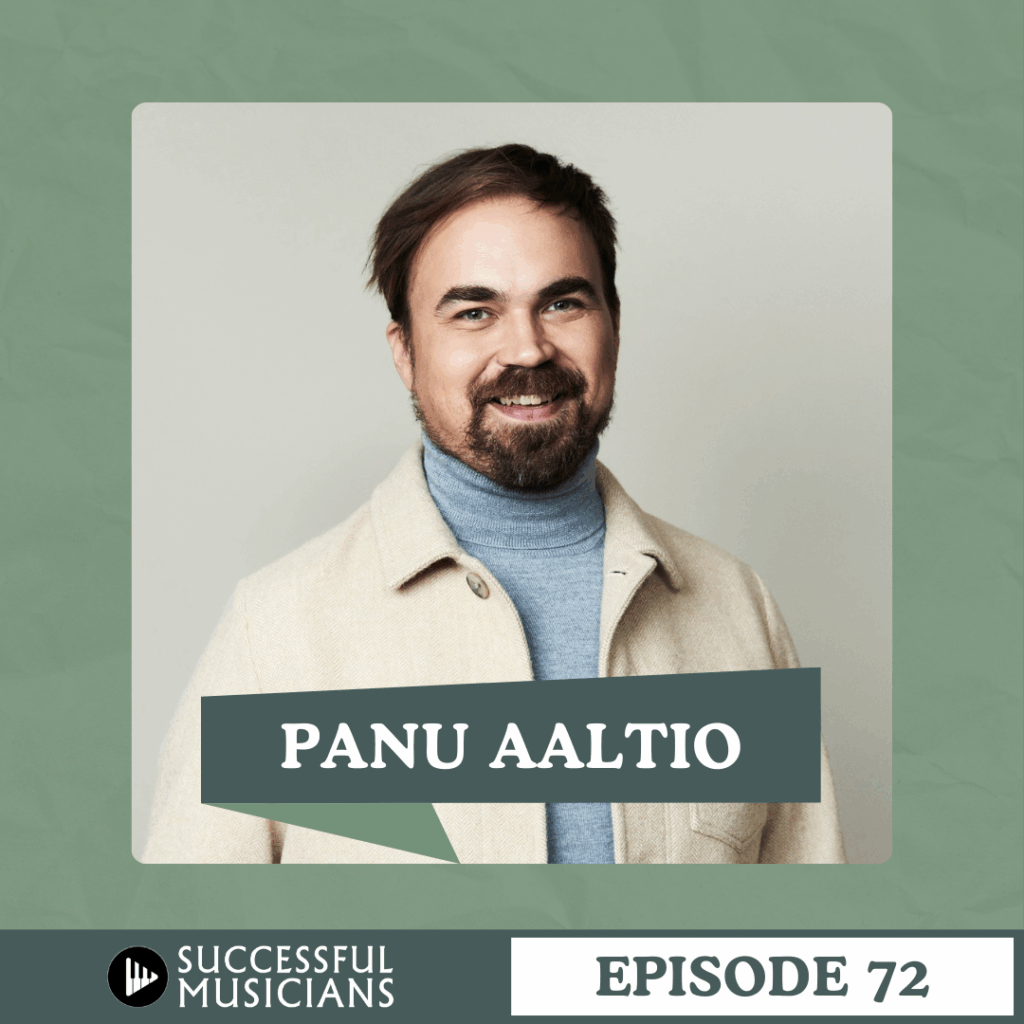
Successful Musician Podcast Episode 70
Interviewee: Panu Aaltio
Interviewer: Jason Tonioli
Jason Tonioli
Welcome to the podcast today. My name is Jason Tonioli. This is the Successful Musicians podcast, and my special guest is Panu Aaltio from Helsinki, Finland. He is an amazing composer. Orchestration, Panu, that you’ve done is incredible. It’s very rare that I run across somebody who’s as talented as you when it comes to just bringing the orchestra together and getting the sound you get. It’s amazing. You are doing TV and film. You guys should go check this out. Make sure you scroll down and click on the show notes for sure. But Panu, you’ve won multiple awards. You’ve got the International Film Music Critics Association, where you’ve won multiple times with that for some of your nature films. I know with one of the Composer of the Year in 2022, you were up for Composer of the Year up competing against Hans Zimmer, James Newton Howard, Johnny Greenwood, Nicolas Bertel. I mean, that’s a big deal. So welcome to the podcast. I am excited to share your journey, your story, and just have you share some advice for other musicians that are wishing they could have gone through the 20-year overnight success that you’ve gone through with your career. So Welcome.
Panu Aaltio
Yeah. Thank you very much for that introduction. Yeah, thank you. It’s great. Thanks for having me.
Jason Tonioli
Panu, let’s start out. I know you grew up in Helsinki, right? So that’s where you were born and raised. You were a cello player. Give us a little bit of the story. How did you end up starting out in music? Talk about the journey to get to the USA and then to where you are today. I’m just curious about that arc and story arc that you have to get to where you are to share first.
Panu Aaltio
Yeah, there’s definitely music in the family. My parents actually met in a choir, so they both have been doing music. But my mom has had a long career as a piano teacher, and she was originally a concert pianist. She graduated from Sibelius Academy in Helsinki, found her calling and taught music. Also my cousin, she’s, I would say, one of the top classical singers in Finland, and she’s a bit older than me. She went to Sibelius Academy before me. There’s a bit of pressure when I said I would apply to Sibelius Academy because it’s like, if I don’t get in, then I’m the odd one out because everybody else seems to be doing great. But I also had a very weird idea of what musicality looks like because of my cousin who was so talented. She has a perfect pitch and everything, which I don’t have. I always felt like I’m probably not good enough for this music stuff because I’m not the child prodigy that she always was. It was an interesting environment. I played the cello for a fairly young age. That was an instrument that my mom really loved, and she actually owned a cello just as a hobby.
But she sold that at some point because she did ask me, I think I was four years old when she asked me if I wanted to play the cello. I just learned about some TV series, some crazy lines, Don’t even think about it, or something like that. I just wanted to use that. I didn’t even know what I was using that for, really. But she sold the cello, and then a couple of years later, around, I don’t remember how old, maybe I was six years old or something, and I told her, Maybe the cello actually might be a thing. So we had to buy another one. That’s how I got into playing music. Also, I’ve been really into computers from a very young age. I think I was four years old when I got my grandfather’s old Commodore Wix 20, and I had some cartridges that I would play some video games on. But then when I had a Commodore Amiga, then there were music programs on that, and I started to experiment with that. Very quickly, the computer became more interesting than the cello because I was like, Oh, I can use all these crazy sounds and I can do my own things.
That’s how I started just experimenting with it, composing. But I still thought I was going to be actually a computer programmer. While I was in high school, it was clear, I was going to the University of Technology in Helsinki. I’m going to study programming. I’m just going to be a computer programmer. Music is just going to be a hobby. But I just got really into film music at that point. I’d always been a big film buff, and I used to make my own horror movies in grade school already. But then it was like, Oh, the film and music, and actually I can do all these things at once. That’s how I ended up applying to Sibelius Academy to the music technology Music Department because that felt like the most logical place to do this because they don’t have a film music department. I got in there and then started looking at what’s next. I want to study actual film scoring. Then I noticed research in a lot of schools around the world. I landed in the USA because it just had many names that I could recognize, like Chris Young. They were these people that I actually knew from films.
I thought, That’d be interesting because I’ve just been learning theory for now. Now I want to actually go to learn from people who are doing the actual work right now. That’s how I ended up applying to the USA, and I got in 2005. I moved to LA for a couple of years and did that. Then I started getting offers for feature films from Finland. That also coincides well because I had… Actually, that’s probably the most important advice that I ever got was when I got into Siphols Academy, I called this Finnish film composer, Tuomas Kandaleen, and asked him to be my mentor. But the first thing he said was, just go to the local film school and just offer to score all the short films they were doing. It was those relationships that took five, six years to actually graduate into professional feature films. It was just about the time I graduated from USC. I was like, Oh, hey, do you want to do a feature film? Like, Oh, okay. Yes, I do. It was really important advice because if I hadn’t gotten out of my comfort zone or just been locked into the music track of the Sibelius Academy. I was just doing my theory assignments. If I hadn’t actually gotten out there and tried to work with people, I wouldn’t have those relationships. That’s really what led me into the actual career.
Jason Tonioli
Interesting. It’s interesting. I would say almost everybody who I talk to that’s in the film, TV type of business, it all comes down to the relationships. But the ones that made it are the ones that they can always go back to that moment of like, I went out of my comfort zone. Just like you said, I was out of my comfort zone, and I didn’t feel like I was probably good enough maybe to do it either. But I did this thing. I went to this extra thing. I offered to do the thing for free. They did more than what everybody else did. My guess is you had 10, 20, 30 people in the classes with you that all went through the same program. There’s probably very few of them who are actually working in the business and doing film scoring like they thought they were going to do. But really, I think it’s interesting to see from a success standpoint, if you want to achieve whatever the thing is you want to do, going out of your comfort zone, even though you don’t feel like you’re maybe worthy, you’re not good enough, you’re not ready, and giving yourself that permission to just go for it.
Jason Tonioli
What’s the worst that can happen? If you went there and they said, I don’t want you to do that, but, oh, well, you’re probably never going to see that person ever again in your life, right?
Panu Aaltio
Yeah. It was certainly when you were starting out with working in films, you really don’t have the intuition of what to do. You’re really trying to just grasp at stories, basically, and try to figure out what to do. At the same time, you’ll have directors who are just working on their first project, so they’re very insecure about the whole thing, and they’re afraid that composers will ruin the whole thing. It’s this perfect storm of anxiety that you get thrown in when you start off like that. But it’s just such an important way to learn how to work with people. And also, really, that’s how you start to build that intuition of what works and also what people mean when they say certain things. That’s really important. Half the time, you’re an interpreter of what they actually meant, that they said something.
Jason Tonioli
I’m guessing that from a… You go back a little bit over 20 years is when you got your start, right? So the computers and digital music world were just coming into existence. Back when you and I were both using five and a quarter floppy disks to run everything. But it’s been interesting to see the evolution. I look at the film scoring. There’s never been more opportunities for TV and film than there are today. But I also feel like the library and the ease of access to the library of music to put in as placeholders when you’re working directors, it’s almost overwhelming to see how much there is. How do you, as a composer, work with that director and not have them be like, I’m just going to use this stock music because it works well there? How does a composer or music person have that conversation with the director to help them want to use original music, I guess?
Panu Aaltio
I’ve had very little discussions where they would rather use the stock music. Sometimes we’ll have a temp score that does some things that they want me to retain in some way. But I think the strength of best-spoke music for scenes is so strong, usually, that there’s not a big I want to use some temp tracks because they often end up being just static enough to feel a little often. Obviously, the horror scenario I don’t know if there’s a perfect track that they’ve really edited the scene, too. That’s hard. That’s going to be an issue. But I’ve, unfortunately, had fairly little issues like that because I feel like people today are very aware of the temp love problem, and they’ll pre-empt that by not even listening to the temp or using a little worse temp. That’s a really good tactic to not use the big film music hits because the people understand that you’re never going to get that. Even if you hire an A-list Hollywood guy, but if you put their best cue in the place, it’s not going to be that when they score that. People understand that. If you set the bar too high, you’re setting up the composer failure.
I’ve had fairly good experiences actually with… Also, I find that people are very interested in really doing the temp track with the composer and having original music in the temp, which is great. It makes you write maybe a bit more because you may have to just try different things and find the direction. But I find that’s always been better for me to just start very early and just get my music in the temp so I don’t even have to think about the issue of do I need to match some stock or temp track?
Jason Tonioli
I’m sure that as you’re sitting down or having those discussions with the one or two or three people that are going to be important in deciding on that music, sharing and capturing their story they want to tell. A lot of times, if you look at musicians when they’re performing and doing gigs, telling a little bit of the background on the music is super important. But I’m sure… I guess, how does one collaborate with that director to find the story and then also tell the story to them about the music? Is there instrumentation that you use that matches that? What’s some examples? I’m sure you’ve done it several times. I know with the Netflix one, you just did with the… There’s some interesting interesting instruments that were used specifically that you’re not going to find on a temp track. Maybe share a little bit about that and how that conversation happened.
Panu Aaltio
Yeah, that film actually, a little cyber area, we really started from scratch because I talked with the director of Domeo at O’Sky about the direction of the music. He said he had been trying to find reference tracks, but he couldn’t really find things that worked for the film because it had this very specific aesthetic. We really started from scratch, which was scary because then if you fail, then you have no backup plan because it’s like, Nobody’s going to tell me what to do if I don’t have the temp track as a safety. I just started experimenting basically with different sounds. There was a point where I was playing some gamelan percussion loops for a domain. It was like, Hey, that sounds like icicles because this takes place in winter time Finland, very cold sceneries. He was like, Hey, that sounds like icicles. I think there’s something interesting there. I took that as like, Okay, I’m going to at least have some percussion that works. We’re going to start to build from that. Then it was a long process because I already started composing when the director, Harriula, started editing in the spring. I had been composing demos for him to use in the edit as temp music for a while.
Actually, we went for a very Finnish-style summer vacation. All of us were off for July, basically. It was like, See you in August. But that was perfect because I had spent enough time with the project where my subconscious was already working on it. It was like week two of my summer vacation when suddenly I’m like, I want this Finnish folk instrument. I want that in the score. I went and listened to some records from folk musicians. The first day I got back to work in August, I just immediately wrote this theme for the Oasis, which became the main theme for the film. All that time, I’ve been struggling. I don’t know what the main theme is. This is such a different score. I cannot find a melody or something that works. Then literally on day one of coming back from vacation, there it is. That’s it. It’s just It’s an interesting example also of the power of the subconscious to solve these composition questions sometimes.
Jason Tonioli
Yeah. With that film, you use it very interestingly. I don’t even know how to… For those that don’t know the instrument, it almost reminds me of a boxy cello. How would you describe this to somebody if you only could describe it with words? How do you say the instrument again? Because I’m sure most people have never heard of it.
Panu Aaltio
Yeah. Yo,. Yeah, it’s a really interesting very raw string instrument because you don’t even have a fingerboard, so you’re just hovering your hands in here and you’re That’s why you get this very interesting microtonal variations in intonation because you’re just trying to keep your hand in the right position and move it between positions. It brings it this very very almost mythical quality somehow to sound. I just love everything about it. It’s one of these instruments that you cannot possibly make work with samples on the computer. You have to play it because it has so much the live variation that happens that you cannot fake that on the computer. I was trying to make some demos, but I had some… There’s a Swedish instrument, which is similar. I had some of those samples, but they were not there.
Jason Tonioli
It was not there.
Panu Aaltio
The ballpark.
Jason Tonioli
With that little Siberian Netflix project you did, you’ve got that unique instrument. Then I know from a… I look at it like a chef in a kitchen, and there’s all these flavors, and you’re putting different things in the pot. A lot of time, there’s the known recipes that every composer knows. You got the John Williams recipe, and you got some of these orchestra recipes. But with that, it’s a very interesting score because you had not only that instrument, but you have all these other elements where there were vocals, but then the vocals go… When I was listening to it, the vocals go a whole different direction into this jazz, scat type of thing that you’re just like, whoa. But it totally worked. That was what was so interesting and unique about it. There’s some orchestral sounds that really just are warm. How do you find that inspiration, I guess, to when you’re cooking in the kitchen for those instruments, how do you decide, Hey, let’s go crazy, finish the instrument to jazz? How does that work? What advice do you have for composers as they’re trying to decide on the palate or the ingredients for the big pot they’re going to throw this in for the show?
Panu Aaltio
Yeah, that’s really hard to say what is actually happening. There’s just this period every time when you start with the project where it feels like it’s just you’re not… Well, sometimes you might get an idea quickly, but very often it feels like this time it’s going to fail. Now I’m totally out of ideas and I’m not going to come up with anything. But I think it is, again, related to the subconscious that you teach your subconscious what you actually want to do. Then present the puzzle, basically, and then it gets into solving it. Then those things just come up like, Oh, it’s just a random thing that pops up. I think that might work. I always try to reach this flow state almost in conversation because it’s so great when you just start to experience the music and it just comes out. It’s so different from when you’re forcing it and you’re trying to be very intellectual about it. Sometimes you need to do that to get going. But I think whatever helps you get into that flow state, or maybe not necessarily flow state, but just some place where you feel like you understand the language of the film and the music, then it just becomes so much better what you’re able to do.
But I don’t know where all this stuff comes from. It’s this weird free association that sometimes happens when you’re like… It’s like if a random thing that feels like it works, then you might as well try it. I love those fusion, genre fusion type things that can really make the audience feel like you don’t really know what’s going to happen because it’s really going to… It plays on your expectations when you go into one direction and then you present something completely different, just what they’re about to understand like, Oh, I know what this is about, and then you have something else.
Jason Tonioli
Well, I’m curious. Some of the music that you’ve done that has had some real… I mean, you’ve gotten a lot of awards for your nature documentary stuff. I mean, Tell of Forest, Tell of a Forest, and Tell of a Lake. And I mean, that’s been interesting. I mean, your evolution of that, I’m guessing the icicle percussion that you talked about, are there any other really unique types of inspirations as you were working on those documentaries and seeing just some of the beautiful nature types of things that are in those types of projects? I mean, I’d be curious to just know from a musicality standpoint, if there’s any of those moments that are cool stories behind the music that people don’t know about.
Panu Aaltio
Yeah, there’s a bunch. I think on Tale of the Sleeping Giants, we had some really fun experiments. We had this vocal group, Finnish folk music vocal group, Tugletar, and they were in the studio for… We had two sessions. The first one was a more experimental session because their own music also has experimental vibes. I wanted to see, can we come up with some interesting sounds? Because that’ll just do some very… I asked them to sound like the stars in the sky, and they would like seeing all these cool little things, bright short lines. But we did this experiment where I think I got this idea when I was listening to the Johann Johansson score for Arrival, I think. Yeah, Arrival. There were some almost speech-like vocals that I thought were interesting. That just stuck to my mind throughout the years. Then when I was working on this documentary, there was an idea in the script of this message that the whales send and it travels throughout nature. I was like, What sounds like a message? Well, speech, but I can’t really use speech, and I don’t want to use language because it’s like nature doesn’t have a human language.
I don’t want to use that. But what sounds like language? I was like, Let’s try this experiment where I asked the director to provide some important lines in the script that he really feels are central to the movie. I gave the lines to the vocal group and asked them to hold a chord while they speak that line and then hold a different chord and hold a different chord. We recorded that line with different cords. Then I would take the single chord of that speech and build this random granular texture out of it. It had this interesting quality of, you feel like it’s speech, but it has a tonality because they kept the chord going while they were speaking, and it just brought this interesting texture. That was one of the favorite, actually, cues of the director because of this quality. But the interesting thing is now we’re doing live concerts of that documentary. The vocal group, they had to go back and listen to what I manipulated their voice into, and now they have to emulate that as a live vocal. They’ve actually done an amazing job doing a live version of that texture. We’ve gone back to live with that.
But yeah, that was a really fun experiment that ended up working. It totally sounded weird in the studio because if you’re just reading text by keeping a constant pitch, it sounds like you’re in a religious ceremony or something. People are just looking at me weird like, this doesn’t sound like this fits this movie at all. Just wait. I have an idea, but you need me to just edit the material a bit before I share it with you.
Jason Tonioli
I’m curious because you’ve done so many projects over the years, films, just dozens and dozens of projects that are really world-class level. I’m curious, what advice, if it was a director of a feature film or a movie director, what advice would you give to a director to better work with the composers and get the best out of the composer? I’m just curious, from your perspective over the years of working projects, how does a director get the best out of a composer?
Panu Aaltio
What I find really important is to get a very good understanding of what the subtext of the film is and what are the things that I could be playing that are not immediately obvious to me. I really want to hear what the director really wants to tell, what’s the deeper meaning of the story that the director wants to tell. Being able to describe and verbalize these things is really useful for me. Also just having that very positive experimental atmosphere, especially in the beginning of the project where it’s really bad if you get scared of failure. That really messes with creativity because then you’re just trying to not get yelled at, basically. But if there’s this feeling of like, Oh, that’s really cool. Let’s try even something crazier or whatever. That’s this positive vibe to it that really makes you want to just try out different things. I think that’s a really important part of the process to make sure that you’re really discovering all the possible things that you are there to discover. Once you have a good set of ideas, then you can build the score out of that. For a little sub area, I’m sure there’s as much music that we didn’t use that I just…
Because I tried so many different things, but it was just so fun because it was like, Oh, it’s just more. Let’s see what we can do. I think that a really important part of the process is to have that discovery phase and make it as fruitful as possible.
Jason Tonioli
Well, and I What you talk about for the director is that communication of your vision is so critical. I think both sides are not scared. Let’s say that’s a newer composer and they get their first project, what advice would you have for that person that’s early on in their career doing some films? How does the composer better communicate? Are there some key things that happen with the director to help extract that out of the director Or is there a checklist? Is there some magic spreadsheet that I’m going to ask this question, this question, this question, and make sure that… I mean, are there any tricks like that that you found over the years that have really been helpful for somebody going into a project?
Panu Aaltio
Yeah, I find directors don’t necessarily love the question of what is your movie really about? Because that can sometimes be really hard to give a satisfactory answer to. I think actually what’s really worked best with new directors, I don’t mean new in general, but new to me, directors, when you don’t really know the person yet. I think it’s really good to sit down together at the studio and just try out things and you get immediate feedback because the… It depends, but sometimes the feedback loop of I do something, I send an email, I get an email back, that can be slow. It can also be hard for some directors to really describe what they actually want. When you get that more immediate feedback of being present in the room, that’s really useful. I mean, it can be very uncomfortable. I’m one of those people who’s really, I really want to be in my own dungeon and just compose and then present the piece and run away when people listen to it. I need to experience the anxiety of if they don’t like it. But it’s just very useful to get as much of that immediate feedback as possible.
I would always encourage that, especially if it’s your first time working with the director, then being able to be present in a room somehow, at least at some point when they’re listening to music, it’s very useful because you can get a lot more information that way. But also just the fact if you’re able to join the project early so you can actually get the temp track going with your own music, that’s really useful. Silent feedback where you get just by seeing what they used and how they used the music. That tells you a lot, actually, that you don’t need to discuss if you just see like, Oh, they liked that piece, but maybe they used it in a way that I didn’t even think about. That’s one thing that I think helps, usually, is to just be there early and allow them to experiment with your music. But yeah, also the in-person working at some stage is very useful.
Jason Tonioli
I think that in-person, I sometimes think with the younger generation, it’s so easy to communicate with text or WhatsApp or email. As quick and easy as it is, there’s something to be said for having the facial expressions of body language. Almost, you can just feel that energy. You’re in Helsinki, and my guess is a lot of these projects are you’re working with people that are in LA. I’m guessing that there’s been times that it’s been absolutely worthwhile for you to come over and be in the room, even though I don’t know how many hours of flight to get over here would be to get to LA, but it’s probably a lot. But it sounds like taking that extra effort to be there in the room is a difference maker.
Panu Aaltio
Yeah, especially if you don’t know the director before, I would say. Once you work with the director before, you start to know how the process is going to go and how they communicate. Then I’ve noticed with people who I’ve worked with for many times, I’ll have a very short brief and I’ll just do something. Yeah, it’s fine. It really depends. But yeah, especially when you’re working with somebody for the first time, I definitely prefer it.
Jason Tonioli
Luckily. I’m curious. We’re talking about these younger composers. What are some of the weaknesses that you see in the newer composers that they may not even be aware of? You probably had some of these types of things that you’ve learned to overcome, but what are some of the weaknesses or areas that you’re like, Okay, as a composer, you need to watch out for that? Maybe you’re sitting in the room with yourself 20 years ago, and if you could just say, Hey, don’t do that thing or do this thing. Just be aware of what you aren’t even aware that you’re doing to help somebody who’s newer.
Panu Aaltio
I think for me, that’s something that I’ve really had to learn is try to see the big picture of what is That’s where schedule often helps because you have a deadline, so you cannot really spend time fixing the counterpoint in some small moment or whatever because it’s like, I got to move on. But that’s definitely… I think that’s being able to look from the top down at the project. That’s really important because it’s really easy when you’re starting out to get caught in the details. Also, that affects your scoring because you might completely lose that here’s a great place to just play the theme over the sequence, and you don’t need to worry about every cut and everything that happens. But when you’re starting out, you’re really eager to just hit everything, and I want to show that I can do these complex things and I can show off my composition technique. Then you completely forget the music and the film and what it’s actually about. There’s this bigger thing that you’re about to tell and you’re not just describing this action in the scene. I think that’s definitely something that I had to learn during the years is to just get a more of a top-down view of the projects.
I don’t know if there’s a quick way to get to that point. Maybe that’s just something that happens with experience. I don’t know. But I would certainly, if I was advising myself again in the USA, I would say, You better pay attention to that because that’s going to be really important. You don’t get caught in the details and try to find ways to just play music in the scene and not worry so much about all the techniques that you think are important. That’s definitely one.
Jason Tonioli
That’s great. As you’ve evolved as a composer, I’m sure your definition of what success 20 plus years ago as a musician, a successful musician, what you thought was then is different now. I’m curious to know, having gone down the path, what would you define somebody now as a successful musician to you?
Panu Aaltio
Yeah, that’s a tough one. My first instinct is to say that you can make a living doing that, but I think you can still be a very successful musician and make a living with something else as well. I don’t know if that’s a good way. I think whenever you’re just really doing something that you’re really good at and you’re able to do that and provide something that people really want. I think that’s the definition, I think. But obviously, if you’re able to make a living doing that, then that’s an embedder.
Jason Tonioli
I think making a living is like a bonus. But what I can see just from hearing your stories and you find a lot of joy in capturing those emotions and seeing those moments in the pictures that you’re scoring, I can feel I can feel that joy. In a lot of ways, I almost wonder if that’s the success you almost don’t want to say, but I think that’s in a lot of ways just finding that happiness in your music and being able to do that, right?
Panu Aaltio
Yeah, that’s actually that’s a really good point because that’s something that has definitely changed a lot. Because when I started off doing this, I was so focused on the like, I got to get successful projects, and I was looking at how well does the movie go and all that. I’ve just become so laser-focused on the journey now. I just get into my studio every day and I get to work on music, and that’s the best. No premiere is going to top that feeling anymore because I’m able to concentrate on that. That’s, I think, a really important thing to realize because you can always lose the premieres and you might get bad numbers or you might not get gigs at all, but you can always get the joy out of working with music. I think just being able to really focus on that, I think, has also helped get some of the stress out of working, even though, like right now, I’ve been working 14-hour days because I’ve had some crazy deadlines, and it’s just almost… I think I would pass down if I did this when I got out of school because I would be so stressed.
But I’m actually like, the days are long, but I’m like, I know, it’s going to be fine. I’ve done this before. Anyway, it’s like I get to do music, so I just focus on that. I think the outlook has really changed in that way. I really focus on the joy of music.
Jason Tonioli
Last question for you. I’m curious if you could identify, is there one moment where you had that aha moment or the most memorable music moment you’ve ever experienced? Whether that’s getting to have your orchestra play for you. Is there one of those moments, just the emotions, you just had this realization that you just will remember forever? I’m curious what that moment might be.
Panu Aaltio
Yeah, there’s multiple ones, but I feel like the thing that really stuck to my head is when I was working on this first feature film, The Home of Dark Butterflies, and I actually booked a recording in London for that because I had been just studying in LA, so I felt like I would be very comfortable with the London studio scene because it’s so similar. That was a Finnish film, but I booked Angel Studios in London for that and musicians from there. But the schedule was really tight. I remember I was up all night the day before my flight, and I almost missed the flight. I went to the airport because I realized I had been up all night and now it’s too late. I need to move. The checking desk was closed. I was like, Oh, no. I think I missed my recording session. But the airport person helped me on the plane. It just got into the gate at the last minute. It was a surreal experience because that was my first time in London. I haven’t got any sleep, so I’m just feeling very surreal about the whole thing. But it was such an amazing feeling just having those top players of London and the entire world, basically, playing that score, which has really turned out to be really important to me also in my career.
That whole thing felt surreal because if it had been this such a Basically, it’s just an extended sprint into the finish line because we had a tight schedule on that and having it turn out quite well. It just sounded really nice. Obviously, the players were amazing. It was an unforgettable experience because that was my first feature and just a very special one. Then that whole experience of being there, very tired and happy. That definitely sticks to my mind.
Jason Tonioli
It’s interesting. The hardest, most difficult or most painful things we sometimes do are oftentimes the thing. I think it’s just because they mean more to us. You realize what you went through to get to that thing. So that’s interesting, that’s one that comes to your mind most. Well, Panu, thank you so much for taking some time and sharing. There have been a lot of golden nuggets and some amazing advice that you have shared today. For those listening, go listen to Panu. It’s Panu Aaltio. We’re going to put the links in the show notes, but it’s A-A-L-T-I-O. If you’re going to type it in on your phone, you want to go listen to some of the scores and music. It’s incredible. Spotify has got a whole bunch of… There’s a whole bunch there, but this is a very talented person and composer that you can learn a lot from just probably studying your scores and go in and look at that. Keep doing amazing things, Panu, and appreciate you taking time and sharing time out of your busy day with all the people that are listening today.
Panu Aaltio
Yeah. Thanks so much for the interview. It was great. Pleasure bringing on. Thank you so much.
Jason Tonioli
Go look at his website. It’s panuaaltio.com. Again, click those show notes and go check it out, and you are in for a treat. So thanks so much, guys.