
Jason Tonioli
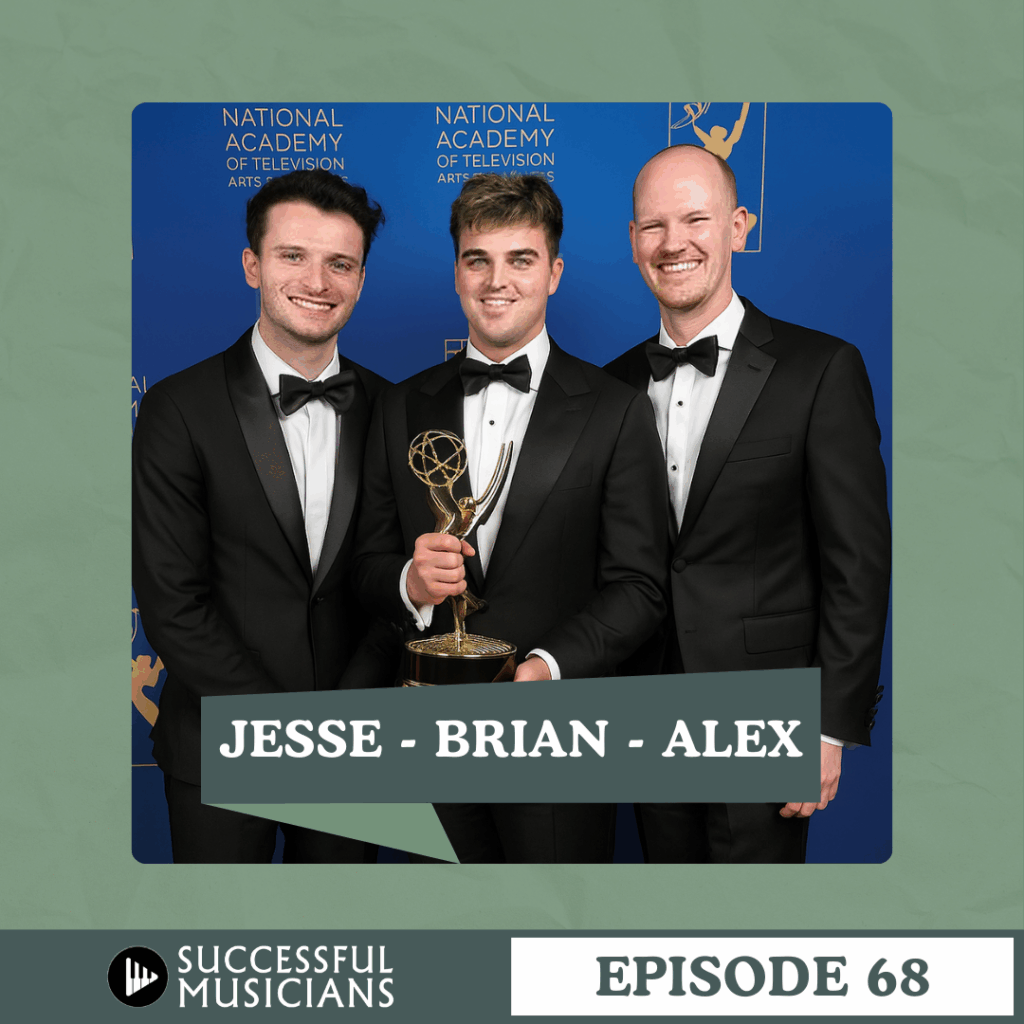
Welcome to the show today. My name is Jason Tonioli. This is the Successful Musicians podcast, and I have three special guests today that have been working on some incredibly cool projects, and I think they have one of the more interesting stories for collaboration and just composing that I’m super excited to have them share with you. I have Jessie Hartov, Brian Clays, and Alex Cote. I don’t know if I said that right, Alex.
Alex Cote
Nailed it.
Jason Tonioli
I did. I got it. Cool. So, these three, and I know there’s other people involved as well, have just recently been the composers and the music people that have done the Disney Plus Percy Jackson series, which is awesome. My kids watch… That’s one of the few shows, actually, we watched the whole series. It was good. My kids were… It was funny. They were so excited that it was good. I guess there was another version of it that people weren’t as excited about. Hopefully, I don’t hear any feelings about that, but the Disney Plus, it’s been incredible. I think across the board, it was just really, really fun to see that. You guys have been part of the Sparks and Shadows, I think, is the studio with Bear McCreary.
Recently, for the first time ever, there was an Emmy that you guys won as a composer team. And normally, Emmys are like an individual award. And for the first time, you guys just, you received this Emmy for the… I don’t know how that all works. It’ll be interesting to hear the story behind that. But you guys are doing some really cool things. So welcome to the show.
Alex Cote
Thanks, J. Happy to be here.
Jesse Hartov
Thank you so much. Yeah, thrilled to be here.
Jason Tonioli
So let’s start out. I would love to jump in and share a little bit about how you guys maybe met and then just talk a little bit about the project. Just give us a little bit of an introduction. I don’t know who wants to take it but jump in and let’s just hear a little bit about who you guys are and how you guys ended up where you are today.
Alex Cote
Sure. I think the simple version is we all met at Berklee College of Music. I was a long, fun time doing music to get there. I met Jesse when I was a senior and he was a freshman at a very nerdy club called the Video Game Music Club, because that was the passion at the time. I was in charge of it, and I thought Jesse would be a good fit to help me out, and so I dragged him into it. And then I met Brian out here in Los Angeles when we were coworkers originally, I suppose that’d be the word.
Brian Claeys
Something like that.
Alex Cote
Something like that.
Jason Tonioli
Back when you were in school, was it the dream to do video game music? Is that what you thought you wanted to do, or is that more to just broaden what you guys were doing? I’m just curious how the Berklee music space works there.
Alex Cote
At least for me at the time, I was really interested in video games. I grew up more as a gamer than a TV filmgoer, so I was really passionate about that world. But work has… I’ve done some stuff in video games, which we didn’t talk about, but at least my work out here has brought me more towards film and TV, which I love, and it’s been great. But video games are a big part of my upbringing and very inspiring in terms of wanting to pursue music as a real thing.
Jason Tonioli
Right. Well, Brian and Jesse, any thoughts on… I’m just curious, how in the world do people… As you’re looking back on this, what lessons would you have for people in coming into this collaboration zone or building those relationships to try and do something similar to what you guys have done?
Jesse Hartov
Yeah. I don’t know if me and Alex and Brian could have predicted at the time that we all met originally that we’d end up doing this podcast here after an Emmy. I think we’re all friends, and we met either through work or nerdy club stuff at school. It’s just an example of connections. 04:11 This industry, whether you consider it the film industry or the music industry, just being heavily about connections and who you know and friendships. We all are part of a very supportive community of creatives. In short, I think that’s how we ended up in this situation.
Brian Claeys
I feel like it has just as much to do with the fact that we like working together as much as the fact of how good musicians we are or composers. 04:50 I think that the reason that we’ve been able to work on so many different projects together is because, personally, I feel like the three of us just work really well together and are good friends and have good rapport. I trust both of these guys a lot. Even if I’m not working on them with something, I’ll send them music that I’m making, and I always appreciate their feedback and stuff like that. It’s the thing where it’s like there’s a lot of great musicians and composers out there, but when you have a good relationship and friendship with people, it lends towards a better product, I think, and a better experience.
Jason Tonioli
So, you guys all came together under the Sparks and Shadows. Bear McCreary, it’s his studio, right? Tell a little bit about what he has got going there. I know there’s been projects like Call of Duty and Godzilla, Lord of the Rings, the new Amazon one. I mean, there’s just some really, really crazy, cool things coming out of that studio and have for years. But what has been like, and how did you guys all come under that umbrella, I guess, originally?
Alex Cote
Jesse, go for it.
Brian Claeys
I guess-Yeah, Jesse was the first one to start working there.
Jesse Hartov
Yeah, out of the three of us, not ever by any means. When I was still at Berklee in 2015, I was looking for an internship in LA, and I ended up applying to Sparks and Shadows, where there were a lot of Berklee alumni working with Bear already. And so, I think they were very interested in looking for interns from Berklee and things like that. Long story short, I ended up interning there during that summer, went back to school, finished school, kept up my connections with the very talented composers there that I had worked for, ended up on their tech team doing a lot of technical assistance stuff, a position called scoring tech, transitioned to more of a composition and writing position there and while I was in that position, Brian came on as an intern. He absolutely crushed it. I think, and Brian can tell you more detail, but similar path, and ended up being an employee and a composer there. Alex was not an intern or employee, but Alex and I had known each other for a long time at that point. And as he said, he was a senior when I was a freshman, so Alex was a mentor of mine back at Berklee, and he was the one who pressured me into our very pressure-intensive dual major nerd.
Alex Cote
You did great. Yeah.
Jesse Hartov
Thank you. So did you. And when we got the Call of Duty Vanguard project, we were looking to put together a team similar to Percy. And I thought of Alex, and he joined us on that and did an amazing job. And that’s how the three of us started collaborating in this particular combination. And I don’t know, I’ll let you guys take over from there. But that’s the origin story here, I guess, right?
Brian Claeys
Yeah. That was quite the pressure cooker of a project for us all to start on, too. It was a crazy one. But yeah, like Jesse said, I met him. I actually think I met and visited Sparks and Shadows with the film scoring Department. And then I moved out here after I graduated. I remember I drove to LA, got in my apartment, and then got an email that they wanted to interview me a few days after. I was hired seven days after I moved to LA, and I started. I moved to LA in January 2019, and I’ve worked for Bear McCreary since January 2019. It’s been an amazing-
Jesse Hartov
When Brian visited the company, he stuck out, and we all remembered him. I remember us being like, Let us know when you- It’s a cool place.
Brian Claeys
It’s a cool place, and it’s something that I didn’t really know about when you’re growing up, even at the beginning of Berklee. But I think especially as a kid, when I did, I really knew I wanted to do this for a long time, especially film and TV music. I was always very interested in it, and that’s composing and making music that was awesome, but that also worked with pictures and TV. I didn’t really know. I thought you just had to go out and get yourself a movie or get yourself a TV show, and you’re able to just… That’s how you do it. It sounds really daunting, and I just hoped it would work. But I don’t think you really know how much it takes to go into the project because that’s the thing about Bear and about Sparks and Shadows is it’s not even just additional music writers or the Sparks and Shadows writing team. There’s so many people that it takes to make the scores. Bear has a ton of tech people that help him with an insanely awesome rig that we all get to benefit from. An admin team for booking all the sessions.
Lord of the Rings, we record so many… The amount of sessions is insane. It’s like 20 hours out of 24 hours in a week you’re doing sessions. To do stuff like that when you have so many projects, it’s impossible for one person to do it, let alone the orchestrators and the engineers and everything like that. If you’re just thinking that it’s just a composer doing everything by themselves without any help, you don’t really know where you could fit in if you came out here and you were maybe not fully ready to be a composer yet or to, you’re not doing your own thing yet, and you’re still trying to learn. But I was just really lucky that a place like Sparks and Shadows, I know there’s other places in LA like it, too, existed to give me that opportunity because there’s just so much to learn. I’m still learning now. Everyone’s I’m sure Alex and Jesse are, too. That’s what it’s been. It’s just been an amazing opportunity to learn and for us to prove ourselves.
Jason Tonioli
I want to go on that vein. So you were an intern, just came out there, and you mentioned that you stood out. So if I’m that kid sitting in listening to this, what types of things would help somebody stand out when they do get their shot, whether it’s a tour or even just trying to get noticed, what types of things would make somebody stand out in your mind to a studio like that?
Jesse Hartov
I remember a few times we would have students, and at one point, I was one of those students, not specifically on these trips, but visiting places in LA or visiting places where you might be interested in opportunities. And I think it’s just clear which students are more engaged in the work that’s going on there. And I think Brian was one of those people. I remember him asking questions. I remember having a one-on-one conversation with him about what we do. And I recall him just being engaged with that work and expressing interest in it. And some of the other students might not be as interested. And maybe it’s because the program dragged them to a film scoring thing, and they’re more of a mix engineer or whatever. It’s not necessarily bad, but I think when you’re an employee there and people are coming through, you can tell. Or for example, sometimes I get asked to talk to younger students. I recently talked to some high school students in Australia about film scoring, and some of them send me a lot of follow-up questions, and they stick out to me because I remember that they emailed me after, and I remember their names, and I remember what they asked me because they made a point to put in that effort. Some people maybe aren’t interested in what I do, and that’s fine, but I can’t recall who they are because we didn’t have another conversation.
Jason Tonioli
In talking about it, I think it’s interesting as I’ve talked with young people… I’ve got some teenagers, and so around my house right now with my kids, I’ve got lots of people in that age group, and a lot of them are hesitant to send a follow-up, or they’re like, oh, I can’t send an email, or I’m not able to talk to them. I think there’s this fear that a lot of people have that maybe they’re going to look stupid or that these cool film composer guys are going to think that I’m dumb for asking a question, but I’m not hearing that vibe at all from you. You’re saying that that’s what’s going to make somebody stand out, is if they’re willing to say, I don’t know everything, and they’re genuinely curious, right?
Jesse Hartov
Yeah. And I completely relate to not wanting to. I mean, I’m an introvert by nature. I am shy by nature. I don’t like to put myself out there and send an email to someone who… So I totally understand. It takes practice, honestly. The first email you send, you’re going to be uncomfortable. But you have to remember, the worst thing that happens is they don’t reply to you. It’s not the end of the world.
Jason Tonioli
It’s not like they probably even remember you if they didn’t reply. Yeah.
Jesse Hartov
Funnily enough, now that we’re talking, I’m just making this connection now, but now that we’re talking about it, Alex, again, he asked me to come on board with the Video Game Music Club, and I had to get a lot of practice cold emailing composers that I thought had no business talking to me, this super green 18-year-old, 19-year-old. But we would get heavy-hitting A-list composers to come talk to the class. Part of it was we were saying, hey, it’s Berklee and all these students would love to learn from you. But part of it was just sending a polite email, say, hi, we’re really interested in your work. Would you be willing to blah, blah, blah? So I was lucky to get a little bit of practice on that ahead of time, I think, from that experience. But I definitely think because a lot of people don’t do it, you stick out a lot more when you do follow up with people like that. So, yeah, that would be my advice there, I guess.
Jason Tonioli
And you guys have been, again, you’ve been on some very high level projects. And yes, there’s, at least as I look at across all industries, isn’t just even a music thing, but you get these people who people think, Oh, they’re famous or they’re a big deal. Oftentimes, those people are way more approachable than I think most of us realize. They don’t want to waste time, and they’re very protective of their time and who they maybe spend a lot of time talking to. But I think in general, they’re human beings as well, and they want to help somebody or serve somebody. I think if you’re successful in life, it’s probably because you’ve been a nice enough person to get along with people. And that bodes well if you’re trying to get somebody to get in a job at a studio like what you’re doing with Bear. I don’t know Bear, but I’m sure he’s one of the coolest people out there.
Brian Claeys
Yeah. And I was going to say, if you did email someone and they did blow you off and they were stand-offish or whatever, you probably don’t want to work for them anyway. I’m sure that there’s some of those people who exist, but they’re probably not going to continue to get people who want to work with them. And that’s the thing. It pays off in itself. You want to work with people that are invested in Jesse’s talking to students in Australia about doing film scoring. People generally want to help other people and to collaborate and work with people. There are some people who probably don’t. And so I wouldn’t take it personally if there are some people who don’t do that, but they’re doing it wrong, probably.
Jason Tonioli
Well, and I’ve done sales for a long time. And I know for me, just as busy as I am, sometimes you have the best of intentions. Somebody emails you, but because you’re getting 100, 200, 300 emails a day, it just accidentally falls through the cracks. And they may have had every intent of responding to you, but they forgot. And so if somebody doesn’t respond, don’t take that as, oh, that guy’s a jerk or that lady’s jerk. I’m not going to do anything. Send them another thing. But I do what I will say, having been on both sides of receiving emails from people and sending them, make sure that you have something valuable so it’s something worth responding to, or add some value or even Just something as nice as a thank you for saying something nice to somebody that doesn’t need a response goes a long ways. People remember those types of things. You get three nice things like that from somebody, you’re for sure going to remember it. How did you connect with the Music connected you with you this, or, hey, I was listening to this tune and loved how you brought in the drums.
There’s just so many things that show that you’re interested in them that will stand out that I think younger people need to pay attention to, whether it’s music or any industry you’re trying to get a job in. Talk to me a little bit about working on these big projects, you talked about how it was very daunting to work on a project like this. Logistically, how in the world does something like the Lord of the Rings or these Percy Jackson projects, how do you guys keep that organized? Is there some superhuman logistical person that manages everybody? How does that work? And what advice would you have for somebody coming? Maybe they’re an intern coming into a situation like that. What advice? What do they need to know about how it works? And then what advice would you have for somebody if they do end up on a project like that?
Jesse Hartov
I think Brian is very well equipped to answer this.
Alex Cote
Brian is the.
Jesse Hartov
Not only because Brian was the project lead on Percy, but also because the way that I started on the tech team at Sparks and Shadows, Brian started on the admin team, and he has a lot of experience with the logistics of scoring, if you don’t mind my saying, Brian.
Brian Claeys
Yeah. No, it’s… And Jesse’s had the same role before. Alex has also done that on a project. It’s a different job in a way, but the most important job is that we’re all obviously writing the music, but there’s just a lot that goes into making the score and getting it all approved and recorded and sounding good, everybody happy, and making something that hopefully wins an Emmy. I just wanted to make sure that we had a team of people that I liked working with, namely Alex and Jesse and Bayly and Omer and Kelsey who are on this call. But it’s the thing where I’m able to… If I know who I’m working with, we’re all working on the cues together in a way. Alex is writing the cue, but he’s using themes that Bear wrote or something that I wrote, or we’re going directions from the spot. There has to be somebody to cohesively make the score whole, make sure that someone isn’t writing something completely off the wall or using the wrong thing. But other than that, it really is everyone bringing their own thing to the table. I’m just safeguarding that, if that makes sense.
Jason Tonioli
Got you. And from a workload, I know musicians end up, especially when they’re working on projects like this, the hours are crazy. I mean, what should somebody expect? What is normal? Or what’s the perfect scenario? And then what’s likely to happen? So the people are like, oh, I want to be a film composer. I want to do video games. What is the reality of that from your perspective?
Alex Cote
I’m sure we all have different answers. I have some days where it’s a normal 9: 00 to 5: 00, so to speak. But those are the… I would say I normally can keep it to standard working hours. But then when the project starts to crunch up upon a deadline, I’ll start putting more in. And we frequently will take on multiple things at once or just the way deadlines work out, you don’t predict when you say yes to a thing, and they end up overlapping, and that becomes a logistical challenge to get through. So I suppose in short, it’s always going to be at least eight hours and it’s likely going to be 12 or more. So that’s been my experience.
Brian Claeys
I’ve always said I’m always so jealous that sometimes I don’t have a job that’s making a burger at McDonald’s where it’s like, you make the burger and it’s done. With music, you could keep going forever. If I could have a month to write one cue, I would take the month. And not just because of my procrastinating on it, but because I can mix and tweak and program and write forever. The thing is, you go until you don’t want to go anymore. That’s actually one thing I wanted to say about an intern or someone that’s trying to be a writer is 22:11 that everyone’s at a different stage in your career in terms of learning. If I’m working with someone and I’m reviewing their keyword, I’m not expecting it to necessarily be at the same level. It could be better than what I’m doing, whatever. But I think putting in an acceptable amount of time is really important. There are some things where it’s like, if you send a cue over, you write a cue and the audio just cuts off, like rambling. You know what I mean? That’s something where you should catch it, right? Versus if you’re just writing something that maybe someone could write a better cue. That’s not important. I think a lot of people coming out of Berklee get caught up in like, Am I a good enough composer? You definitely are, but 22:50 you need to care and put enough work and time into it that you’re not letting things slip. Because when you have to write so many minutes in a short amount of time and there’s a lot of pressure, it’s easy to do that. But that’s the thing that sets people apart. It’s people that I can depend on that they’re going to deliver really good quality stuff and put the time in because that’s what it is. It’s just time.
Alex Cote
Something Brian is highlighting here is the job, as much as music is a big part of it. So much of it, 40% maybe is composing, and the other 60 or shifts is administration, tech. I’ve talked to some of my non music friends who, when I describe what I do, they compare it to engineering in terms of how you approach all the different ins and outs of the computer and the gear that we use to make this happen. Where we’re at, there’s an assumption that you’re going to be good at composing. It’s, do you have a lot of things to make the deadlines, serve the project? That becomes the thing that’s more important. I already know and believe that Jesse, Brian, and anyone I work with, has the composing chops to get projects done.
Jesse Hartov
I’d love to add something, if you don’t mind. Because some of the context here, too, is composing, and especially composing for film and TV, is part of the… We’re more part of the postproduction team on a movie than we are in the film industry than part of the record industry, for example. In the record industry, if you’re a producer, you might take a lot of time to work on one track and make it work on one track for a long amount of time, I don’t know, weeks, months, however, just because of the context and the schedule and the way that that industry works. Whereas with film, we’re working at the tail end of every project because we’re in postproduction. There is a hard deadline when this thing needs to get done, and it needs to be delivered, and before that, the movie needs to be mixed, and before that, the music needs to be mixed, and before that, the music needs to be recorded, and before that, notated, and before that, we have to write them. Logistically, there are a lot of moving parts. It takes a small army to create a score because of all the different roles and just as Brian said before, not just composing, all of these different aspects.
If somebody wants to become a film composer as opposed to a music producer, they might want to keep in mind that difference in terms of workload and speed and all of that, because there’s definitely, I feel at least, there’s always this tension between the top quality and good and fast. That’s the challenge. That is the main challenge, I think, for film composers. I want it to be great, and I also have to do it really quickly. And that takes a lot of repetition and practice and training. And I think people want to get… It’s awesome, but it’s also stressful. It could be stressful. You might be staying up late at night sometimes. You might be working when you don’t necessarily want to work. And so if you want to get into this, I think it’s just good to keep that in mind that It’s going to take time and practice to get to that point. I don’t even know if I’m at that point. I think it’s going to be an endless journey.
Jason Tonioli
My guess is the dynamic with… I’ve seen a lot of these composers, they’ll do stuff on their own, and there’s obviously people in the background, but you rewind the clock back, and it’s always been one person’s name on there as the composer. I think it’s very interesting, even over the last two, three years, I’ve noticed in the credits on movies and some of the other stuff, more of the musicians are getting recognized in the credits, which is incredible. If you go back to a film, even 10 years ago, I can still remember the craft services person that was bringing candy bars to the little food table. They would get mentioned, but you’d only have one music person mentioned there. What about that clarinet player and the trumpet and the drums? There’s 150 or 200 people. I think it’s been really interesting to see how the musicians now all are getting credit for it. But one thing in particular, I think you’re speaking to this. As you guys are finishing up a cue or a song or whatever thing you’re working on, because there’s a team and everybody’s name is on it. My guess is it probably elevates the amount of quality and caring you guys put into something before you share it with the directors or whoever’s the approval person. Just because if Brian’s name on it, if it’s halfway done and it chops off like you talked about, or it’s just like, good night, Brian’s having a bad day. It’s going to affect everybody on the team. I’m guessing that just as that team dynamic actually elevates all of you guys to care more and do an even better job than maybe you do if it was just, you running solo, right?
Alex Cote
I mean, hopefully we still care about running solo. I think all of us.
Jason Tonioli
Right. Look, have you seen that where you guys feel like you’ve all leveled up because you’re all in this together?
Jesse Hartov
I think we inspire each other. Alex, I don’t mean to cut you off. Please go ahead. I was just going to say it’s…
Alex Cote
I was just going to say it’s all built on trust, right? Someone believes in you. So the simple version is like, Bear got the opportunity to do this Percy Jackson show. And then Bear goes, Great. I believe… I know I’m going to do this with the team, and I believe in Brian and his musicality that he can do this and then Bear says, hey, Brian, I believe in you. Who do you think would be a good person to join this team? And Brian says, well, I believe in Alex and Jesse, and Bayly, Omer, and these other people who were doing, Kelsey. And from there, everyone says, Hey, I believe in you. Come give me your best shot. And so you’re like, Thank you for this opportunity. This is amazing. And I believe in myself as well. But now it’s like, I want to validate your belief in me. And so it starts with Bear, and it trickles down. And we ‘ll try to give our best back because we want the product to be as awesome as it can be. So it’s a big part… For me, that’s a big part of it. It’s like someone takes a chance on me, I’m going to give it my all and make sure that I give the best back to that person.
Brian Claeys
You have to leave your ego at the door a bit more while working for a team. I mean, I think at the end of the day, any time that you’re sharing your music with the world or with the director or producer, you have to leave your ego at the door. But it’s a really fine line to walk for you really. I still have to care about the music. That’s the whole point of why we’re doing this. I really do feel like every cue that I write, the smallest thing, I really care about it a ton, and I want it to be awesome and musical and be the best cue that it can be. It’s hard to do that and then get feedback from a fellow composer or from a director or whoever that tells you that it’s not good. But there’s a way to take that feedback and get really negative about it, and there’s a way to take that feedback and realize that maybe there’s some truth they’re speaking and that you can actually learn from it, become a better composer. That’s an attitude that you need to bring. It’s been super helpful for me.
Bear has taught me so much. I have shown Bear a lot of cues that I thought were awesome. Then he’s given me feedback that maybe some people would find it disheartening, but at the end of the day, that made me a much better writer. It was constructive at the end of the day, but it’s hard to see it that way sometimes. Being a team, I think that’s what helps. Alex’s cues, Jess’s cues, Mike’s cues. We’ve all written stuff that we thought was awesome, and then it ended up being something else in the show, whether it’s from something that I saw or Bear saw or a director saw. It’s changed. You just have to learn from it versus getting upset about it.
Jesse Hartov
But I think on the flip side, sometimes Brian or Alex will send something to our group chat, and I’ll go, Whoa, that’s awesome. What’s that? What did you do? What’s this thing, one minute, 30 seconds? Brian, what’s that sound? What did you do there? And then Brian will teach me something. You know, that I didn’t know before, and I’ll learn something from him. And that’s something, while scoring a project solo is great and has its benefits, too, you don’t get that… You get the collaboration with the filmmaker or showrunner or whatnot, but not with fellow composers who you can bounce ideas off of and learn from them and all that. I’m just always learning from Brian and Alex and our other co-composers. And I just think that’s awesome.
Brian Claeys
That’s a really good point.
Alex Cote
Yeah, it gives everyone the chance to fail safely, if you will. It’s like, okay, before this goes out to the showrunners and we want it to be good for them, let me just throw an idea at Brian or Jesse or anyone on the team. And if you can get instant feedback and then refine an idea in a way that maybe you can’t if you’re just the solo composer.
Jason Tonioli
I think that’s great. So if you guys could all rewind the clock back and go sit down with yourself back when you were at school, for example, or let’s say even before you were going to school, what advice would you, or what would you want to say to yourself, or what advice would you give yourself about making things easier on your path? Or are there things you’d say, hey, do this differently? I’m just curious about what you might say to yourself.
Alex Cote
I feel like this is simple… Maybe this simple advice I give myself is 33:24 be a bit more patient. I feel like I look at a lot of the arc of my career, so to speak, and I feel like I was impatient a lot of times. And not that it’s gone in my way, but it’s just like, okay, I’m here where I am now, and my path is my path. This is my journey. I think there’s an idea of graduating college and you’re like, I was the big fish in the small pond. And then you get thrown out into the wild. You’re like, no, that’s not the case. It’s going to be a longer road. And I think that I would say, personally, I was like, I want to get there faster, but it’s got me where I am. So I would say, yeah, be a bit more patient and things are going to work out and keep up all this stuff with your friends. They’re your best allies.
Jason Tonioli
Who else? Brian? Jesse, who wants to go next?
Brian Claeys
I can go. Yeah, I was just going to say, if I talk to my younger self, I’d probably just try to give them a little bit more belief in just my individual musicality and talent, ability, whatever. I think that at Berklee or high school, whatever, when you’re growing up, it’s really hard to know how good you are. That’s something that I feel like just in society, you constantly are just worrying and thinking about. When it comes to needing to get a job or something like that, it’s especially important. It’s really hard to gauge with music. It’s such a subjective, personal thing. I think one thing I’ve just learned doing this is that 34:57 no one’s ever going to tell you something that’s going to make you flip a switch of saying, oh, yeah, I really am a good writer, a good musician, a good composer. That’s not going to happen. You just have to realize that you already are that as long as you’re working towards it. If I feel like I’m a better musician than I was a year ago, then I think I am a good composer because I know I’m only going to keep getting better and my potential is infinite.
At the end of the day, it’s all based on the musician I was when I was 10, writing piano music. There’s an inherent musicality that I had as a child and that all of us have growing up that you carry with you the rest of your life. I think if you keep believing in it and building off of it, you can become really successful. But I think for everybody growing up, it can be a bit hard sometimes to know whether you’re good enough to make it. That’s probably what I would say.
Jason Tonioli
I think knowing that you’re good enough, but I think a lot of times For many people, the people that love us want to keep us safe. And a music career is not the traditional way to make money as a doctor, a lawyer, just those classics, go make lots of money and you can do that. But I think there’s a lot more fulfillment when people do give it their all and they get into the music industry. I think that’s been really interesting as I’ve talked with 100 plus people now on this podcast. So great advice. Jesse, what words of wisdom do you have for yourself?
Jesse Hartov
I think I have three things, but I’ll keep them brief. The first one is If you want to… I’m not sure if this is for me as a younger person or for other younger people who want to get into this, but in terms of advice. But if you want to get into film scoring, go meet Filmmaker, go meet Filmmakers. Like Alex is saying, writing music is a small part of this. So go. It doesn’t matter how young you are, go meet some young filmmakers and offer to score their film. It’s never too early to get started. Or if you want to score video games, go to a game jam, score someone’s game. Just do the thing. Don’t wait till you’re ready, quote, unquote. You’ll never feel like you’re ready. Just go do the thing. Second one is 37:31 If you’re spending all of your time on music and your craft, that’s awesome. But if you want to do this professionally as opposed to as a hobby or passion, learn some personal finance and business skills. Jason, we were having a discussion about this before we started recording about that aspect. But I think, and I will not speak for anybody else, but I feel like myself as an artist, musician, it was not that side of things was not my forte when I was in college.
I think it could have spent more time, budgeted more time toward those skills as well. In the professional world, those skills will be very useful. And then the third thing is, at least when you’re starting out and you’re starting to learn this craft, don’t think quality over quantity, but opposite. So, write a lot of music, and don’t worry if it’s good or not. Because like playing an instrument, this craft takes practice, and you just have to do… It’s just repetition. The first 100 cues I wrote were terrible, maybe even more than that. I just kept writing cues, and eventually they got better. There’s no way around it. Some people start out a little ahead of the curve, a little behind the curve in terms of the quality of their writing. But it’s just the repetition that’s going to make you better. So don’t worry about writing your 10-minute-long masterpiece and spend three years writing that. Just write some music, put it aside, write another piece of music, put it aside. Just keep repeating, and you will… You can’t not improve, is what I’m saying, if you do You can’t not get better if you just keep writing. Those are my things.
Jason Tonioli
One of the things when you talk about the quantity, I 100% agree with that. A lot of people I run across in my world feel like they have to completely finish a song, too. I think sometimes just the act of writing one measure, a beat, or a little melody down, no matter how you do it, just the fact that I think if you’ll take one little step and put that down on paper or some repeatable way that you can then go back to it, I think that’s when I’ve found for myself those ideas. Well, then you’ll get the next idea and the next idea. But I almost feel like, I mean, whether you want to call it a spiritual thing or just maybe it’s just in your brain. But I think the fact that we give a little bit of effort to that idea when it comes, somewhere in our brain, all of a sudden, it’s like, oh, well, they did something good with that idea. So, I’m going to plant another seed and plant another seed. And so, when the really great idea comes, maybe we’re ready for it. But as you mentioned, the first 100 things you did were not good. At the time, you thought they were amazing. You were going to give Hans Zimmer a run for his money, I’m sure, with that second thing you produced, right?
Jesse Hartov
Or not. And even still, there are a few anecdotes I could think of. One is Max Martin, the hyper successful songwriter producer, talking about the percentage of his hits that we I’ll think of as mega hits or very small percentage of the songs he’s written. A lot of them we will never hear because they’ve never seen the light of day. Or John Williams has an anecdote about writing that little five-note motif from… Was it Five Notes? Yeah, Five Notes from Close Encounters of the Third Kind. If anyone has seen that movie, he wrote, I don’t know how many he said, 50, 100 of those, whatever, until he and Spielberg were like, That’s the one. That’s the one. Sometimes you just have to… Even not just starting out, but when you are, I don’t know, whatever you want to call it, midway career or higher level, you just have to iterate. Not every idea is going to be great. Sometimes you have something you think is great, and the producer or showrunner or director is like, This is not what I wanted. Sorry. And you have to throw it away. So the more practice you have at that, I think the easier the job becomes because you just brush yourself off and you’re like, All right, that’s fine. I’m going to make another thing.
Jason Tonioli
I don’t know whether you guys saw this. It was a Disney Plus thing. They did a special on John Williams where they interviewed him, and it was about an hour-long documentary. But I remember, it was a couple of months ago, I watched They had John Williams sitting at his piano, and he’s like, you’re just literally sitting there with him, and he’s explaining how every day he will just write some stuff out. He’s still using paper, and he talks about the fact, if I did technology, I’m sure I’d be more efficient. It’d be great. But I think the fact that he’s, no matter what, he’s sitting down every day and spending a little bit of time, even if it’s the five notes or it might be the whole thing that he’s right now. But that’s huge. From one of the masters, the fact that he does that every day should say something. I think for anybody wanting to be a composer, especially, as you get busy, it gets harder and harder and harder to find time. I think prioritizing that. I think there was a whole lot of really great things in that documentary with John Williams, but the fact that he’s still at his age doing that every single day just told me, Man, I need to make priority, even if it’s 11: 00 at night and I go just try to measure out, just do it and practice it, because that’s the only way I’m going to get better.
I know we’re getting low on time, but I think a lot of people would be interested in this question. With the video games or these really epic types of shows that you guys have been able to be part of, how do you guys find inspiration for these tunes that you’re putting together? I’m just trying to picture myself. If somebody says, Come and do this Call of Duty type of, Here’s the scenario, go write this thing, or Lord of the Rings scenario. We’ve been to the movies, we’ve seen these things. How do you guys find that inspiration to not only honor what maybe exists, and maybe it’s something totally new, too, but then just have that creativity to go take it to another world or explore that? Where do you guys find that happy place to get those ideas as you guys are working on music?
Alex Cote
We’ll do a little deep dive. I guess, spoilers, end of Percy. There’s a queue that I worked on. I took a lead on this queue, and it’s the big finale when the three kids get together at the end. The quest is complete, and they’re going to be apart for the summer. So, it’s them saying goodbye, and it’s a little bittersweet. And I know when Brian and I were looking at this queue originally and trying to discuss what the inspiration behind it was. Obviously, we have character themes for all these people, so we wanted to include them. But at the end of the day, I felt really inspired looking at that scene being like, I want to take what John Williams did at the end of Sorcerer’s Stone when Harry, Hermione, and Ron say goodbye to Hager and wave him off. That felt like the same type of emotion. And so, I went and did a deep score dive into that scene because I felt it inspired me. And I was like, what did he do that worked so well? How can I take what he did and apply it to our show and our themes and our sound? So, I guess to come back to your question, I frequently, even this past week, go back to music that I fell in love with for a variety of reasons. And I try to look at it with a fresh pair of ears every time I come back to it. And I feel as I get better in my craft and I score more scenes and get more time with stuff, I’m starting to see different details in every piece of music that I was excited about, I find something new in it. It’s really inspiring for me to go back and be like, Oh, here’s how so and so used this cord or this type of progression gives me this emotion under this dialog, and this is the stakes of the scene. I guess I’m just a nerd, and I like to go back and do a deep dive into these things. But then I take it and I Well, now you have this opportunity to apply all that geeking out, if you will, to the project you’re working on. How can I take these elements and meld it to become the original work that was this finale scene? So for me, a bunch of studying and having ideas of, Hey, this sounds like this, and I want to emulate this because for me, it works emotionally. And so I go about trying to bring that out.
Jason Tonioli
Great. Brian, where do you find your inspiration?
Brian Claeys
I think obviously, I love… I think that if you’re working in this industry, you have to… Watching a lot of current TV and film is really important. I love that. Even if it’s something that’s a completely different sound from the project you’re working on. There’s always something to draw from it. There was one thing that may be unorthodox to answer this question that I think one of my professors at Berklee would talk about in that it’s an interesting time in that you said John Williams is writing with paper. We write everything with the computer and we’re mocking it all up so that this mockup sounds like how it’s going to be when it’s recorded. Sometimes we don’t even get to record it. That means we’re having to work with all these different synths, sample libraries, all this technology. I think that as much as it’s really important to write on what’s going to sound good being played, that’s obviously the most important thing, there’s something to be said for how the samples and synths and libraries inherently play back in what they give back to you. I personally feel like there’s an input/output to them. That’s what my professor told me. He’s like, there’s some stuff that you write on these… Some libraries that might sound good, others that may not sound good. And I think that personally, I’ve always found someone who’s leaned more into the tech production side of things and looking for really cool new ways to do production in an organic way. I feel like that inspires me a lot. I’ll be just going through a library that I haven’t looked at in a long time or presets I have or a different library and find a sound and mess with it and make something cool and that becomes a whole basis for a cue. Or this one string library I haven’t used for a while, the portamento is awesome on it, so I ended up writing a cool portamento line. Maybe it’s a little bit throwing stuff at a wall, random, but sometimes that’s the thing that unlocks some creativity for me. Ultimately, it ends up working really well because you’re working in tandem with the tools that you have in your hand. So that’s something that I think about a lot. Jesse?
Jesse Hartov
Yeah, I mean, I agree with all of the above. I’ll try to add another thing, I guess, that hopefully it’s helpful. Sometimes, especially if I’m feeling stuck or something, sometimes I’ll try to go to some art that’s non-musical for inspiration. One time, I was doing a composition course thing when I was in high school, and they would take us to museums around Boston, and then we’d have to write after going to a museum, which was really cool. I would ‘ve never thought to do that on my own. And I found that really interesting because it was inspiring, but the original source of the ideas were not necessarily musical. And I think sometimes it’s very refreshing to just experience other art and see what your music brain comes up with. Then with music, sometimes I try to remember to listen to challenging avant-garde stuff that I might not necessarily put on in the car to jam out to. But there are a lot of musicians also just not in the film, not film composers at all. They’re just doing weird, interesting stuff. There’s just so many cool ideas out there. I just try to, especially if I’m feeling stuck or like I’m repeating the same ideas over and over again, or I can’t seem to do something that seems new to me. Those are the wells that I’ll go to sometimes.
Jason Tonioli
I just thought of one more question I think may be relevant. Some people may not like some of the answers, so if you don’t feel comfortable answering, I think the school systems in general and just the path along with music. I mean, a lot of us probably all started out with piano lessons or guitar lessons or whatever. And that’s the traditional path. And then there’s just so many directions that we can go. And you guys all came from one of the most well-recognized music colleges, Berklee’s. I mean, there’s some of those very top places out there. But I’m curious to get your take on that person who’s not going to Berkeley or not able to get into there. There’s probably a lot of people that come out of Berkeley and don’t do anything with their music as well. That’s normal of any school. But just curious, do you feel like somebody that doesn’t get into Berkeley or can’t afford it or that’s not even on their radar, are there enough ways or paths that people could learn this stuff on their own? And is that a requirement these days too, man, I didn’t go to Berkeley these other three guys all came together. So what’s the path people should think about and not get discouraged if they’re not at Berklee, I guess?
Alex Cote
I feel like that. So I mean, Berklee’s great, and I would say that I personally wouldn’t be here without Berklee. I think that, not to say that you can’t do my path or your own path, but I’ll say the parts of Berklee that are important for me are the community and the skill set. If you can build those two things on your own, then you don’t necessarily need to go to college. No one’s asked me what my degree is to get work. It’s about relationships and about skill sets. For me personally, maybe at the time when I was in college, I don’t feel like YouTube University quite existed in the same way, but you can learn a lot about music production and composition in that way. If that is the way you are able to learn, then great, go do it. I think personally, I needed the in-person instruction, and that’s a better environment for me to learn selling a bit more in-depth. But I think it’s all about the best part about Berklee is I met all these people, and I have this built-in community. And if you get that in different ways and people support you, then it doesn’t matter whether you go to Harvard or whatever school you want. It’s about real meaningful connections with people.
Jason Tonioli
And Alex, I’ll bet the YouTube University is something you’re referring to almost daily in your job now, and you’re continuing to-
Alex Cote
Absolutely. Learning never stops. That’s the best part about, I mean, I suppose any career, but especially music, we’re all excited about something that captured us as a kid. And so I am always trying to make time to go back to that and find that thing because it’s easy to get disheartened or jaded by just the realities of like, Hey, you’re treating this as if this is a business now. It’s no longer just for fun. But it’s really important to go back and find that happy part of you that said, I love this, and here’s why. And for me, that’s a bit of YouTube, a bit of going back to old scores and just taking a moment, usually over the weekend, to just listen again to the stuff that really inspired me. And I can feel refreshed for the week.
Brian Claeys
Yeah, I absolutely don’t think you need to go to Berklee to do what we do or get a career in music. I always think I’ve learned way more just in my first two years out here than I did in my three years at Berklee. And it’s not a slide on Berklee. It was a really great experience for me. But think about this way, a lot of the jobs that you’re going to be getting into right away out of Berklee or any college aren’t going to be necessarily doing the thing. I have a lot of friends that went into the record industry and they’re showing off as runners at studios. That’s cleaning toilets and bringing people for lunch and stuff. You do that for a little while, but guess what? Those people now are going on tour and doing all this other stuff. When I was an intern, first with Bear, I wasn’t writing music. I was taping parts and scores together for sessions. That’s not something that you need a Berklee college degree to do. Anyone can do that. You have to go put yourself out there and put yourself in that situation and in the industry. But once you’re in there, you’re going to learn so much more just being around it and being around the people. As long as you’re taking the time on the outside to learn on YouTube or with the people you’re working with by watching them, that is going to be way more valuable than a class. You learn a lot of fundamentals, but that real experience is so much more important. So, 100 %. If you didn’t go to Berklee, you could be an intern at Sparks and Shadows for Bear, 100 %. There’s no barrier to entry. People do not care about it like that, for sure. So don’t be put off if you’re in that boat.
Alex Cote
The barrier is your attitude and how you approach the topic. It’s about being the person that people want to spend time with when they’re stressed and crunched on a job.
Brian Claeys
Yes. Exactly.
Jesse Hartov
I think I’ll add one thing, if you don’t mind. I totally agree with Alex and Brian about, you absolutely do not have to go to Berklee or music school to do this. The one thing that I’ll say, though, is that I think when we say that, because I’ve been guilty of this before when students have asked me this question. I’m often assuming that they play an instrument and are musically literate to some degree. And now in the world of YouTube, university and production, some people are very into production, but they might not actually play an instrument, or they don’t know how to read music, or those kinds of things. While it’s possible to become a film composer doing that, it’s much more difficult if you don’t have some amount of music literacy. So I would say if you’re in that position, don’t necessarily pay a bunch of money to go to music school, but maybe find a teacher. Find a mentor, learn to play the piano, maybe even find a composition teacher or something and take it privately in a way that’s more affordable. That mentorship and skillset, if you feel like you can’t teach yourself and you need a mentor, that is okay. And you can still do that without going to a very expensive conservatory. So it doesn’t have to be one or the other, I guess, is all I mean.
Alex Cote
And to reiterate your point of outreach and being scared of emails, this is one… Most people want to help others. So this is the type of thing that you could do outreach to someone, and whether that is the top composer in town or just a composer that lives in your… There are plenty of music schools in different parts of the country, and you could reach out to a professor there and say, Hey, I want to learn privately. Is this something that we could… Are you the person to talk to? How do I learn more about this? And people are down to help. There’s lots of different ways to take advantage of the stuff in your local area if you wish to grow.
Jesse Hartov
Speaking of that, on the topic of Alex giving me good advice when we were in college, I believe this is Alex who told me to do this. There’s a professor at Berklee named Dennis Leclerc. Totally brilliant. And students would take lessons with him outside of their Berklee education because he was such a good private instructor in orchestration and composition. Did he or would he have taught kids who didn’t go to Berklee? Probably, I don’t know. But you wouldn’t know if you didn’t ask. And he taught me some stuff that no other teacher there even… He taught me stuff I had never heard of before about orchestration. And that was just a private lesson. It had nothing to do with Berklee. It had nothing to do with tuition, any of that. So I think Alex was the one who was like, you got to talk to this guy.
Alex Cote
Yeah, you’re welcome. There were a couple of professors who did that. I was talking with a different one named Andrew List, but they’re all great.
Jesse Hartov
Oh, that’s right. Andrew.
Alex Cote
Yeah, but Dennis is great. And the point is just that you said, I feel like I’m missing this or I want to grow in this way. And so you took the initiative to seek that out. And it’s better, and you feel like you’re a better writer now. And I totally agree that my private lessons in composition were instrumental, ha ha, in improving my skill set. And I’m like, yeah, so more outreach. Don’t be afraid.
Jason Tonioli
It feels good. One of the things I’m hearing from you guys is that I think the big skill that every person needs to be able to acquire is you need to learn how to learn. And I do think when I hear people talk about their college experience or their private mentoring or teaching when they were in lessons, people need to surround themselves with people who are better than them. I’ve heard some people say, you become the average of the six people you spend the most time with. I think there’s absolutely some value in doing that. But what I hear also from Alex, you and Jessie, you specifically sought out the talented people who rose to the top. Brian, the same thing has happened with you. Those top-tier people end up rising and becoming a community together or become friends. I think that’s probably the key thing to finding success, especially what you guys are doing . Can you find that group of people who are talented. It’s not that you want to shun the one that’s not very good, either, necessarily. But don’t be a jerk, obviously. But I think, seek out those people who can make you better and help you level up in your game and then take the initiative to actually do it.
Jason Tonioli
That’s the other thing I hear from you guys is that if you can go to YouTube University and learn, but man, it’s hard to be motivated to go and do that every day in and day out, too. So having somebody to hold you accountable or like going to the school where they have the course and you’re forced to do that deadline that you got to get done by the weekend that you really didn’t want to do. And there were a hundred other things you would have rather done. But luckily, school pushes you through that to probably push us harder than we would have ever done on our own, too. So I think it’s key for all of us to just recognize what are your traits and then how can you push yourself, right?
Brian Claeys
Everyone works differently for sure, in terms of the pressure they need. I think, ultimately, you have to be honest with yourself, think about just areas that you need to improve or what you can do. Learn a new instrument. There’s so many out there. I taught myself guitar when I moved to LA. Alex has picked up random instruments like the taggleharpa. That’s stuff that’s like, no one’s telling you to do that, but you can just decide to do it because you look at yourself and realize where you can grow as a musician. And it’s only going to benefit you.
Jason Tonioli
Hopefully, your neighbors, for your neighbor’s sake, you don’t pick a bag pipe or some other instrument that’s really going to be awful, right?
Brian Claeys
Oh, man.
Jason Tonioli
No. Well, gosh, guys, this has been fun. I would love to go another hour. I know we’re at the end of the time. So Jesse, Alex, Brian, I’m going to put a place for people to go check out your stuff. Each one of you guys has a website. I’m going to put that in the show notes. So that’ll be on YouTube, wherever you’re listening, on the Spotify or Apple podcast. So go in there, go check this stuff out. I’m also going to include a playlist of some of your music. If you’re listening to this, you’re like, man, I want to hear some of the stuff they’ve done. The Percy Jackson stuff you guys done. We’ve got a whole playlist. I’m going to stick with it. You’ve got the, oh, gosh, the Call of Duty Vanguard project. I know there’s a really, really cool one. And all three of you guys were involved heavily in that project as well. And I know we’ll post several playlists. If you’re just looking for some inspiration, if you’re a music person, go click on the links in those show notes and go check these out because they’re really good.
Jason Tonioli
And go watch the show, Percy Jackson. If my kids liked it, it passed the… It’s a good show. It’s going to be really fun when the new version is coming out soon, right? It’s got to be in the works a little bit, right?
Alex Cote
Soon it will be December, I think. But crunch time will be coming sooner than you guys want, right? Well, that’s probably true.
Jason Tonioli
Ndas make it so we probably can’t see if that’s something that is happening, right?
Brian Claeys
Yeah. I wanted to nod for that. Awesome.
Jason Tonioli
Well, thank you, guys. This was fun. I’m sure you can track these guys down. If you want to send them an email, it sounds like they’re all nice guys and might even respond to an email to us. Thank you so much. Just be persistent.
Alex Cote
Be persistent. If you don’t reply, write again.
Jason Tonioli
Awesome. Okay. Thanks, guys, so much.
Brian Claeys
Thank you.
Jesse Hartov
Thank you, Jason.