
Successful Musicians Podcast
Explore conversations with musicians and music-industry professionals about building a meaningful, sustainable career in music.
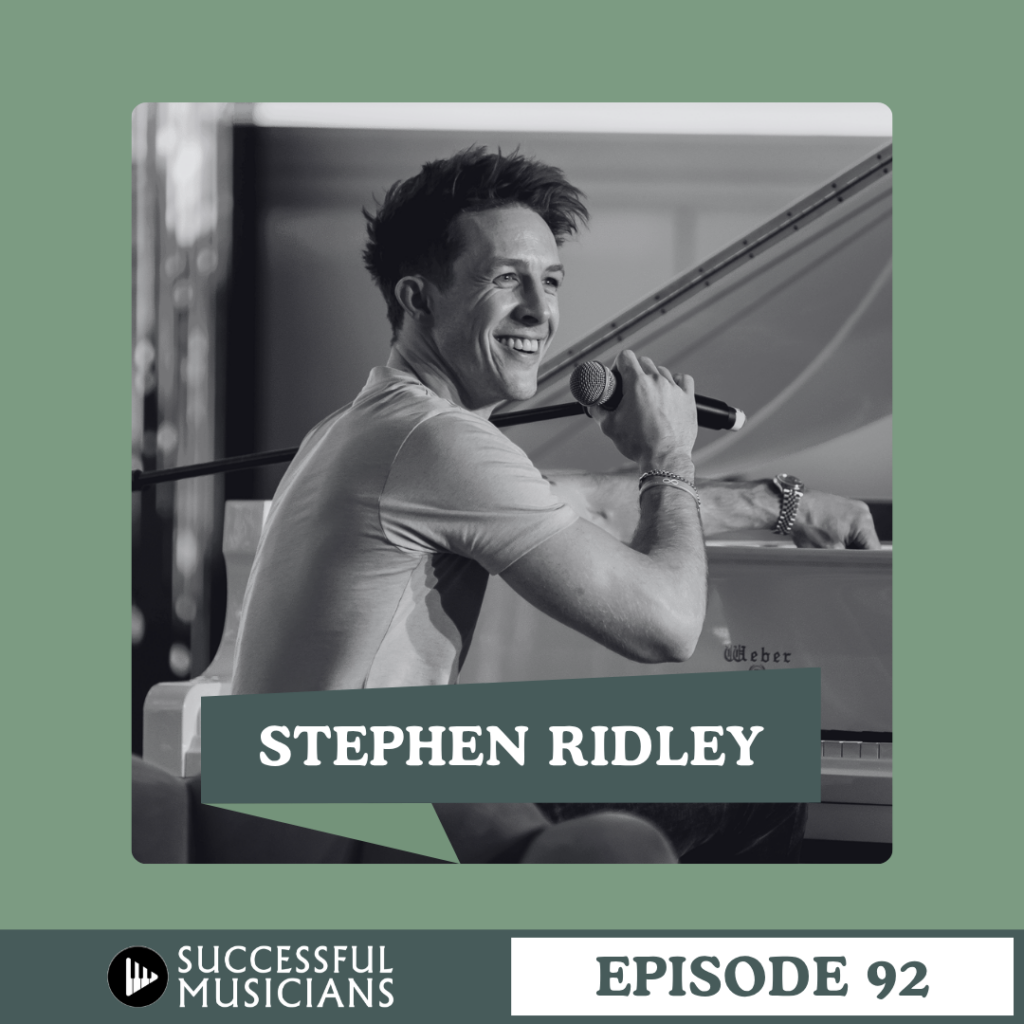
Interviewee: Stephen Ridley
Interviewer: Jason Tonioli
Jason Tonioli: Hey guys, my name is Jason Tonioli. This is the Successful Musician Podcast. And my special guest today is Stephen Ridley. He’s a British pianist. He’s performed on piano all over the world. He walked away from a banking career, which is essentially the same story I’ve got with walking away from banking. Stephen, I know you’ve performed around the world. You started a group called Ridley Academy, and I find I’m excited to talk to you today because you’re kind of this marketing guy. But you’ve not been the traditional piano teaching type of person. I mean, you’re a traditional person at home teaching piano or somebody went to school to learn how to do piano and then maybe teach it as if it’s completely opposite. And I know you know that probably pushes some buttons of some of the traditional piano pedagogy people who like their classical music. But what’s cool is you have been very successful in getting people to come
Stephen Ridley: It sure does.
Jason Tonioli: And try your method, do your method. Just like with any teaching thing, there’s people that probably love what you do and other people it doesn’t work for, and that’s you know true of any education type of thing, piano teacher as well. So I’m excited to just kind of hear your story and share this with others. I love that you’re performing and you were gutsy enough essentially to go out on the street with a piano and kind of in that YouTube land do something that wasn’t the normal, hey, I gotta be up on a stage with an orchestra trying to play piano well. It was something new that I think has been very innovative and kind of a full story. So Steven, maybe just let’s just start at the beginning. Where kind of how did you end up getting started in music and maybe share a little bit about that.
Stephen Ridley: Yeah. Well, first Jason, thank you for having me. And thank you to everyone for watching. I come from a tiny village in the north of England. I was playing piano from a very young age, younger than I can really remember. And for the first part of playing piano, it was just a thing I loved. It wasn’t for any reason. There was no that was what I loved about it. It was a place I could go and just it was my little therapy. It was a place I could go. Be anywhere. I can leave the village. I can be anyone. You know, when I’m playing Frank Sinatra, I’m not this geeky little kid anymore. I am Frank Sinatra. Like I take it on. I can feel the tuxedo and the whiskey, you know. And that was music to me. It just allows you to spiritually travel. It’s the most wonderful thing. Then I went for lessons because I was begging my mom for lessons because I had this huge imposter syndrome. And when we were talking just before the camera, we had a similar experience with that. I hated proper lessons, as you might call them. I had a hard time with it. It was very technical, very overwhelming, very confusing. It seemed like j just so unbelievably difficult. I always give this example of like, you know, an astrophysicist could very accurately describe the vector of the ball that Nadal hits or Federer hits in a game of tennis, but you don’t need to know that stuff to be Nadal or to be Federer. And I felt I was going backwards in those lessons pretty, pretty remarkably. I quit piano so many times, always felt empty when I quit it, always felt totally disappointed with myself when I would do that. My dad died, and that was a huge pivotal moment in my life for so many reasons. It’s the impetus which is everything I’ve done in my life has been from this realization that I’m next and life is short. You’re young, you’re old, you’re dead. So react to that knowledge. And I approached things with a dynamic sense of let’s go. And that informs so many decisions. It got me back on the piano. It took away all of the seriousness. Like you, I ended up working in banking. I worked in a top investment bank in the world, in the top team of that bank. Everybody told me I’d made it. I certainly didn’t feel that way. I felt utterly miserable. And I quit that.
Stephen Ridley: pushed a piano in the street and started playing and that was the start of a music journey and now here I am. I’m sitting in America right now and I’m talking to you. So
Jason Tonioli: Well and w what’s crazy is like I was I was not a good piano student, just to c for anybody who’s not familiar with my story. But it was a rule to live in the house that you had to practice take piano lessons. And my mom, she’ll tell if she was here, she’d tell you she did it because she wanted something hard for me to do because a lot of things in school came easy to me. And so she essentially put me in piano to have a have me have something that challenged me. And one of the other cool stories is my mom, when she got married
Stephen Ridley: Right.
Jason Tonioli: her parents gave her a piano as their wedding gift. And so the goal was is for her to be able to play, but also to have the kids be able to play, which is, you know, kinda makes you know, I didn’t realize that even as a teenager that was, you know, I just figured you had this piano in the house and, you know, it wasn’t it was just a regular upright piano. It was fine. You know, I’m sure it was but I took lessons and I you know, I learned to be I got quite good. I mean I was playing Chopin, Rachmaninoff. I mean
Stephen Ridley: Wow.
Jason Tonioli: I came up the classical path, but nobody had ever told me what a fake book was or what chords were. You know, I’d learned my skills and I had no idea that there were one, four, five, six chords. Like I thought there was no internet back in the eighties and nineties so there were YouTube videos where I could get on and just like see how to play basically any song just with a couple of clicks. And it was you know, I actually did piano lessons up till I was in tenth grade. And in tenth grade, my mom finally let me quit because I could play all the hymns in the hymn book. And then my senior year of high school, I decided to take lessons again because I wanted to, and it kind of changed a lot of things for me now wanting to play versus having to play and being forced to do it. So and so you were in the banking world. So the funny thing is, so I ended up spending two years down in Argentina. And then I ended up coming back and I got an internship. I went to two days at the university.
Stephen Ridley: Hundred percent.
Jason Tonioli: thought I was gonna go to music and they told me that I had to re I’d have to take these music one on one classes before I could take orchestration. My goal, I really wanted to just score films like, you know, Hansimmer of that type of stuff. And so I passed what they called an A P level music class where you learned to. I mean there’s just kind of more advanced kind of music stuff, but the university required you to take all of the basic, you know, theory stuff for two years.
Stephen Ridley: Hmm.
Jason Tonioli: And so I went, I’m like, okay, I can say I can learn stuff. I was a little more mature. And we made it through whole notes and half notes at the university on the first day. And I was dying inside with these other 60 people that were there learning what a whole note and a half note were for the first time. And on the second day I went up to the teacher and said, you know, hey, you know, we made it to eighth notes and you told us we’d get to rest next time. Is there any way I can just help you teach, you know, something? I really wanted just orchestration. I’d actually published through a publisher some of my music. Which was really hard to do back in, you know, turn off the two thousands. And what’s crazy is he’s like, Nope, you’re not ready to do orchestration or learn any of that until you’ve been two years in here. You gotta do all two years. And I’m like, Well, I’m already published, I’m orchestrating. He’s like, No, you can’t do it and I’m like, I just I went and bought I’d already bought the orchestration book, was teaching myself. And it was just like you had to plan to go on this path that you know, somebody that got a degree of some kind, which I love people that get degrees. I think it’s fantastic that people study and do that. But I think there’s a lot of people in the world that somehow feel like that you have to have that piece of paper in order to have permission to do something great or, you know, do something.
Stephen Ridley: Bill Bryson, he’s a famous travel writer and I met him for dinner one time and he told me something. He said, Don’t you yet? I was twenty years old and he said, Don’t let university get in the way of your education. And at the end of the day, the guy that you’re talking to is trying to sell you on university and you just want to go and do it. And you’re probably talking to a guy that would love to go and orchestrate. And you I don’t get any popularity for saying this, but I genuinely feel that universities make music so complicated that you need a university to teach it you. And that’s how the whole thing works. And not just in music. The same dude, I studied philosophy, politics and economics. And they made such a meal out of it that I required years of university to get through it. And in today’s world that’s just well, you study for a purpose at the end of the day. Like I think both me and you are the similar kind of people. Like if we’re gonna study something, it’s to do something with it. And if that’s the case, then I just need to know the information that’s required to do the thing. I don’t need all the intelligentsia. I don’t need all the fluff. Just tell me what I need to get the result. And that’s how I study everything. And that’s you know.
Jason Tonioli: Well I think, you know, and I wasn’t really planning on going into this with this interview, but where you’ve kind of created this piano course or learning, you know, it’s a different method, obviously. You know, using videos and I mean that’s totally new. Where it’s counter to probably the in person, you know, go with this the lady next door to teach piano lessons. I mean, that’s probably one of the reasons, you know, it clicked with some people and some people have like, no, if you don’t have your degree, right?
Stephen Ridley: Yeah, I mean, look, there’s for it started as a purely self-study online thing. Now we have coaching, we have in-person, we have anything you want. But the way it’s delivered is relatively less important. That’s just because some people like having their handheld, some people like having the guidance and the feedback of a human being with them. But the thing that massively works about this method is, well, here’s one option. You’re gonna drive across town, you’re gonna sit for an hour or two. With somebody and they’re gonna give you lunch a bunch of stuff to do. And you know, in the process of that, you’re gonna go over quite a few things that you can’t do. And then you’re gonna go home with a mountain of stuff. You can’t remember half of what happens in the lesson. It’s just this big, heavy cycle of action. And then you don’t really practice ’cause it’s overwhelming. And you show up the next week and now you’re just basically paying to practice. And you, it’s stolentifying. And virtually everybody who’s tried lessons has had that experience and what this method to ultra simplify it is, is it’s based on 10 minute learning cycles and it’s breaking it down into one individual step. You’re just learning one thing. And because it’s only one thing and because it’s very simple, it only requires 10 minutes. You don’t need to remember anything. You don’t need to sit there stressing and worrying about it. And then obviously, as with any skill, enough individual steps can get you, you know, you might not notice the progress in two days, but you notice the progress in two months and you’re like, geez, like. Years and years of doing this other thing where you weren’t really doing it versus just a systematic step by step by step. That’s really the magic of the thing. And it’s you know, it gets attacked because it’s simple. And people who’ve gone a complicated way look at it and they don’t like that. And they’re married to that complexity. And I understand, but I built a career going on around the world. I’ve played for millions of people and what I do is very simple. And music is very simple to me. And I think everything that’s properly understood is simple. And can be explained simply. And I think everything else beyond that, it might be interesting, it might be true, but it’s not necessary to get the result. And that’s it.
Jason Tonioli: Well n so one of the things I found to find interesting with the story is so you when your dad passed away, you said that kind of changed some things. You played by my guess is and this is f really for me, when I started playing music because I wanted to, it was more of how it made me feel. You know, it was kind of an outlet and I have again I came up through the classically trained, you know, play what’s on the page and it wasn’t until I was probably twenty one, twenty-two years old that I was like
Stephen Ridley: Biggest. Huge.
Stephen Ridley: Mm-hmm.
Jason Tonioli: Wow, there’s like some patterns here. There’s some chords. And nobody’d ever explained it to me. And so I spent really the next five, six years figuring out how and I’d done a little bit of this on my own when I was really young, you know, in as a teenager in high school, I would try to play Boys to Men and Green Day, some of these old, you know, I mean I was playing punk rock and some rock, you Metallica type songs on the piano, and everybody in the high school thought I was cool because I could do it. But I’d never kind of clicked with the patterns. It’s like, they’re using almost the same
Stephen Ridley: Yeah.
Jason Tonioli: four chords or five chords sometimes if they’re creative and
Stephen Ridley: There’s thousands of that. There’s thousands of them. Like so many people will spend years practicing a scale and not really know what a scale is or what’s the point of it. And I had a guy, one of my first students was a six time Grammy Award winner. And I was like, Why the [expletive] is this like what do I have to teach a six time Grammy Award winner? But he was very robotic. You give him a piece of sheet music, he can play anything. And he didn’t really understand it. He couldn’t freestyle, he couldn’t play by ear, he couldn’t improvise, he didn’t have any of that. He was he was
Jason Tonioli: Well
Stephen Ridley: really interesting to meet a guy like that. And he’d basically learned by just drilling in and repeating and this disciplinarian kind of just drilling it in. But there was these very simple things that hadn’t clicked with him. And when that clicked, the combination of his like technical ability and then a few simple things clicking, you know, now he’s an orchestrator. He’s a full time orchestrator. That’s what he does. And before he was a studio engineer, he got his Grammys for engineering. And the same thing. Yeah, like just what you said. I mean, you learn four chords, you’ve learned hundreds of songs. You learn there’s seventeen different variations that you can do with those and then you’ve learned pretty much every pop song that’s ever been written. It’s and for a lot of people that’s tremendously satisfying and you can be playing that in a month.
Jason Tonioli: But and I think for me as I was, you know, progressing with piano, I ended up once I realized that, all of a sudden like a whole another level opened up above what was the Rachmaninoff or Beethoven or whatever I’d been playing. And it was like, wait a minute. That’s why this is cool is because my gosh, Rachmaninoff did this thing. And it was just one of those where I really did just add the little bite-sized pieces.
Stephen Ridley: Yep.
Jason Tonioli: the music and all of a sudden the original stuff or whatever I was feeling or if I wanted like so I was jazzing up a hymn, you know, at church, you know not really I mean, there’s like that appropriate amount of like, you know, you’re playing a prelude, you can sneak some fun stuff in there, along with the old the old stuff. But anyway it’s
Stephen Ridley: Yeah. Have you heard that John Batiste recently did an album and I think it’s called Beethoven Blues or something. And he’s mixing these two things. And I played a show with John Batiste in Italy in a place called Ravello, which is on the coast, and I chatted to him for like six hours non stop about how he did that. And essentially what you just said, like he grew up, he’s a New Orleans guy, jazz, blues, all of this, and then he started learning the classical stuff. And he’s like, this guy’s just doing this. And if I just like to add this scale to this thing, the simplest, like two or three little things. And then he’s made an album and a genre that I’ve never heard before. And one of my favorite albums in the last few years. And I highly recommend it. Dude’s a genius. But that genius lied in something very simple. And you know, he understands what he’s doing.
Jason Tonioli: Well and what’s as you’re talking about that simple stuff, I think I’m at twenty six books now that I’ve published and which is crazy. And we’ve sold hundreds of thousands of which again is crazy. I never thought I would when I was in my banking days, you know, I never thought that anybody would buy my music or listen to it other than my mom and maybe my wife. And it’s just kind of been one of those wow, people actually like this. But what’s been crazy is
Stephen Ridley: Incredible. Incredible, dude.
Jason Tonioli: I kept getting asked by piano teachers to do easier versions of some of these hymn arrangements or other songs that I’d done and I was like, I don’t really want to do that. And what was funny is I was I still remember I was about probably seven years ago I was doing dishes and my son was practicing the piano and he had like this it wasn’t a big notebook, but it’s kinda like that in between phase of like, okay, you got, you know, you can play all the hymns of the hymn book versus, you know, you’re doing big notes. So it’s that in between transition.
Stephen Ridley: Right.
Jason Tonioli: process and he’s playing out of this book and it just sounded terrible. He kept hitting bad notes. And I know Ryan, you gotta go back and you gotta hit, you know, that needs to be sharp. You know this and he finally got so frustrated, Dad, I’m playing what’s supposed to be written. And so I came over to the piano with him and I let myself see this. And he and he were playing what was supposed to be written. It just sounded bad. And there was just and there’s just so many of those like that in-between jump phase I found with music was
Stephen Ridley: Yeah, yeah.
Jason Tonioli: I finally had this brick to the head moment from all these piano teachers for years that said, Hey, will you please make music that sounds good for our people at this moment? I was like, you know, it took them, you know, ten years of asking me. I finally was like, Okay, I get it now. And I did a book of these easier songs. And it was an easier hymn book. And if you play piano well, you could sit down and it’s just like a breeze through it. But the difference was I made it sound harder than it was actually to play. And so
Stephen Ridley: Amazing. Yeah.
Jason Tonioli: And when I knew I’d got it right, I actually was playing a musical number in a church one time and I decided I’m gonna play right out of the this easier book and I’m not gonna add stuff, I’m not gonna jazz it up, I’m just gonna play what’s written. I had more people come up to me after that, at the end of the service, and they’re like, That was like the best song I’ve ever heard you do. And I play often and I was just like, my gosh, this is I got it right. Yeah, but it really was easy, be fairly easy if you could read some music to play.
Stephen Ridley: Yeah.
Stephen Ridley: Yeah.
Jason Tonioli: And it and what it was, it’s just people can be successful with it. And I think, you know, people want to feel successful, whether it’s music or whatever it is in life. And so if you can help them feel that, you know, hey, I achieved that thing or I was successful, that’s a lot of what I think musicians need to, you know, focus on how do I make somebody feel, or how can I how can I help and serve somebody? And for me that’s you know, that’s been a little bit of what success is, is if I can have anybody
Stephen Ridley: Hundred percent.
Jason Tonioli: You know, open a book and be like, wow, I sound I didn’t know I sounded that good, you know, when they get done playing. So well let’s l I’ve kind of let’s talk a little bit more about your banking career. You basically quit your job in banking, you know, what because I quit my job in banking as well and went and started a software company to serve banks and credit unions. What made you decide to do that and
Stephen Ridley: Yep. Yep.
Jason Tonioli: To make that jump and was it like okay I’m just crazy and just so mad and frustrated I’m leaving or what’s the story there?
Stephen Ridley: My dad’s yeah, my dad spent all of my life. You tell me these stories about when he was a child, but I wasn’t there for it. I don’t know how embellished those stories were. But all of my life I saw my dad working in a job he didn’t like and making excuses for why he was living that life. And then he died. And the heartbreaking thing was not that he died. It was just seeing how he’d lived. And that all these dreams he was telling me about, he never really went and did. And he had amazing dreams. He would sell me on dreams. Like I was in, I wanted to do that stuff with him. He wanted to ship tea from India to England. And my mum didn’t want all the crates in the garden. He’s No, we’re get and I thought that would be amazing and to go around India with my dad. And he wanted to drive Route 66. And I wanted to do that with him, even though I didn’t, I couldn’t point to it on a map. And he had all these amazing goals and then he died and I’m like, Man, I listened to these goals my whole life. He didn’t do any of them. He died in my arms very suddenly, a very unexpected death. He was having an argument with me and then three minutes later he was gone. And now I find myself a few years later and I’m sitting in banking and I’m miserable and everyone’s telling me I’m successful and I’m working on stuff that I just don’t care about, and there’s no one above me that I want to be like. There’s no one I’m chasing. And they have money, but whatever. Like they’re miserable. And I just didn’t want to. I’m like I’m working for a future I don’t even want. And I didn’t know what I wanted to do. I didn’t know who I wanted to be, but I did know what I admired. And for those listening, it’s just an easy thing you can do. A lot of people come up to me and ask for some sort of life advice, and it’s wonderful. And the question I’ll always ask, I ask a series of questions to people, but the first question I’ll ask is just write down what you admire because that is a blueprint for who you can become. And whilst you might not know what you want to do and who you wanna be, you definitely know what you admire. And I knew what I admired. I admired people that were living lives like the storybooks I would read as a kid. The F. Scott Fitzgerald life, the Hemingway life, life with love and loss and laughter and scrapes on their knees and scars on their face and they really lived. It didn’t all go well. Like the you know
Jason Tonioli: Please stop.
Stephen Ridley: These pioneering dudes and women, but mostly dudes for me, who just went and lived. And now I’m in this safe, very makes sense conservative bubble. And this is not it. And the only people I met who were vaguely inspiring were the CEOs of some of the companies that we would serve. And I realized no matter how long I stay in banking, I’m never gonna be that guy. The highest I will ever be in banking is the [expletive] to that guy. But I’ll never be that guy. And I didn’t know that I would become an artist. I didn’t quit banking to become an artist. That’s kind of what happened really, really quickly within twenty minutes of quitting. But I just wanted to live. I wanted a full volume, total color, high saturation life with everything that comes with it. And I left for that.
Jason Tonioli: Yeah. When and so when you left, I mean, did you figure out you wanted to play piano a bit, maybe. I mean tell us about that journey.
Stephen Ridley: Yeah. I saw a piano in a thrift shop. Yeah, I saw a piano in a thrift shop. I was in total shell shock. What have I done? I didn’t walk into the office planning on quitting that day. I got a bonus every year in banking. I got this big bonus. I got voted number one analyst. That was such a depressing award to win because I didn’t even want to be an analyst. And then impromptu I just quit. And didn’t know what I wanted to do, but I knew I wouldn’t figure it out working 20 hours a day stressed out at this desk. And I left. And then I saw a piano in a thrift shop. I started playing it. A guy told me if you want to play that piano, you’ve got to buy it. It was a hundred pounds, about a hundred and twenty US. I bought it and then he made me take it out of the shop. So now it’s in the street in front of that shop. I was living in a penthouse at the time, although I knew I was gonna be downsizing. And so I just thought, sod it, I’ll just play in the street. And I played in the street with no intention of anything. I just wanted to play the piano. I was having a moment, I needed music. And I played this song. Don’t know if you have this when you play piano, but I frequently have this thing where I lose track of time when I’m playing. So who knows? It could have been five minutes, could have been two hours. But I’m playing, I’m playing and playing and playing. And then I get this sixth sense, you know, my spider senses that somebody is behind me. And then suddenly I was like, wait a minute, I’m sitting in the middle of a pretty dodgy street in East London. And I’m in a Hermes tie and a Prada suit with the stupid Rolex and I’m gonna get mugged. This is so obvious. What am I doing? And I thought, well, he’s not mugged me yet, so he must be waiting to rob me. And then if I did this thing, which has become a career signature move of I like to finish the song four bars early, unexpectedly, punch the piano and turn around. And I did that to try and be scary so that the guy might not attack me. And it’s so funny, that’s like being a part of my show ever since. But I turned around and there were hundreds and hundreds of people standing there in total silence with their jaws on the floor and my jaw was on the floor. And I’d never performed for anybody before. I was very shy. Though I was absolutely hopeless, all I could see was all the reasons why I’m not good enough. And this moment was just utterly defining for me.
Jason Tonioli: Yeah.
Stephen Ridley: And in marketing, you would call that surveying. I accidentally surveyed the public, meaning I put something out there and then I got some feedback. And people then came up for the next hour, these people are coming up to me. They’re asking for pictures with me. I’m like, why do they want pictures with me? This is crazy. They’re telling me stories about their life. They’re opening up. They’re telling me really personal stuff. I’m cuddling these people. We’re hugging. We’re it. I’d never experienced so much kindness and love from other people and I didn’t know what I’d done to deserve it. Other than that, I’d just shared the thing that I love the most. And I couldn’t explain what the heck was going on. I’d lived a very selfish life up until that point. And it wasn’t like I was trying to be selfless in that moment either. I was doing exactly what I wanted to do. I just wanted to unwind on a piano. But somehow these people are treating me like I’ve done something very good. And that was a very, very nice feeling. And that feeling that you talk about in music, I think you’re absolutely correct. There’s a concept in music called resonance. And that comes from two Latin words, which is re, which means again, and sonare, sound. And when you perform for people something of deep meaning, it resonates in them, meaning that thing that’s happening to you happens in them. And I’ve now come to realize that is the gift that you give people with music. If you persist on your instrument and you find that music that really provokes you.
Jason Tonioli: Thank you.
Stephen Ridley: It really moves you. It really heals you. It really creates that emotional impact. And you are brave enough to go be naked in front of a group of people and deliver that to them. It will resonate. They will experience that. And it’s people shun music. People like to pretend it’s got no value. They’re that it is to me one of the most powerful, powerful things. And it’s it instantly became an addiction. I played in the street every single day. I played that night till one in the morning. I woke up at 6 a.m., no alarm. All I could think about was as the police took the piano, would the council have removed the piano? And I bolted down to the street and it was still there, thank God. And I played all that day till 1 a.m. And I did that. I didn’t take a single day off for 11 months. And I went over the next 18 months, I played in over 70 countries, doing exactly that. And then because you’re playing to thousands and thousands of people per hour.
Jason Tonioli: Yeah. What?
Stephen Ridley: Then all the inflow starts to come your way. Hey, I’ve got a bar here, I’ve got a label here, I’ve got this here. Why don’t you come to India? Why don’t you come to New York? Why don’t you come to Brazil? I’ve got an ashram in Kilimanjaro, I’ve got a cocktail bar in Boston. I’ve got what you put out, and then you start coming back. And again, that’s kind of a marketing concept. I was unknowingly marketing music. Didn’t know I was doing that, but I was. With rapid surveys. Rapid customer feedback. Cause if I play a song and nobody stops, maybe I like that song, but it doesn’t work for the purpose. And I got addicted to it. I want a lot of people surrounding me and I want them to feel a lot of emotion. That is what I like doing. I didn’t know that was my thing until I did it. And when I did it, I was like, that’s what I want to do. And so if I played a song and it didn’t resonate with people, maybe I would like it. Good. Then that’s one that I can play when I’m at home by myself. And so I get this rapid, like, you know.
Stephen Ridley: I could have gone out and done concerts. You know, the typical advice, you know, go down to your local club and play a show, and then a couple of weeks later you book another show. That process and that iterative process would have taken me years, and I would have probably given up on music in that time. Whereas in one day, five minutes at a time, I can play to 500, 600 people. And by the end of that day, I’ve done 400 shows. On Brick Lane in London, where I started playing, there were 125,000 people a day walking down that street, which is more than four Madison Square Gardens. Even the Rolling Stones can’t play four Matters of Square Gardens in one day. Like that’s what you want to do. And it was totally accidental and it was an accidentally smart thing I did and it propelled me into this life of being an artist that I would have otherwise never, ever had the courage and persistence to do.
Jason Tonioli: What year was that? I’m just curious, timing wise, how long ago was that?
Stephen Ridley: That was October the twenty second, two thousand and twelve.
Jason Tonioli: twelve. Okay. So right when the streaming platforms were
Stephen Ridley: Yeah. It might have been twenty eleven. I’m thinking twenty eleven or twenty twelve, but I think twenty twelve. And no, this is pre YouTube, by the way. YouTube was not a big deal. There was no streaming, not at all. And but incidentally, by the way, I’ve made a grand total of zero income from streaming. I have a very unusual music career. It’s embarrassing. I’m a musician with no music on Spotify. That’s such a terrible thing.
Jason Tonioli: Right screening
Jason Tonioli: I may know some people to help on that. So
Stephen Ridley: Yeah. Great. But I built a career off performing and anyway, we can go into all of that. I’ll
Jason Tonioli: I find that I love takeaway. I guess if I’m sitting in a college class as a young musician trying to listen and learn, I think the big takeaway from hearing what your story was is you showed up every single day. You know, it’s not that you weren’t intentionally trying to like you, it was kind of a good surprise or mistake, not even a mistake, but you just showed up over and over and over again. And I think that showing up time after time after time, because for any musician
Stephen Ridley: Yeah.
Jason Tonioli: I’ve walked the streets you walk Nashville and there’s, you know, people on the streets performing and they’re phenomenal. But it like most of the time people just walk by and you do learn
Stephen Ridley: Well, I’ll tell you I was just in Nashville. I had my first in person experience with my school. So I went to Nashville with dirty students and I did four days talking only about performance. And they didn’t know this, but they arrived and before they’d come on this trip, we had some coaches in the school, they’d had some one- on-one coaching to learn one song and get it pretty [expletive] good. And then I showed and I was like, Well, the reason you’ve been working on a song is at the end of this trip you’re gonna go perform in Nashville. And these are all people that have never performed before. Their worst nightmare, but also their biggest dream. And everyone’s all hooji booji and nervous and stuff. And we went out and we’d do teaching all day long and coaching and stuff. And then we go out every evening and we go and watch musicians. But we wouldn’t watch it like an audience. We’d watch it with a notebook, noting what they do well and what they are not doing? What are they doing that’s working? What are they doing that’s not working? And then let’s work on that ourselves the next day. It is a professional viewpoint. It’s looking at something like a professional, like, where’s a successful action that I could duplicate? And what I noticed unanimously with these ultra-talented guys that you’re saying that are playing in the street is there is like one quality which so many of them were missing. And it’s like so many of these talented guys, the flow that they’re putting out into the world is: I’m only getting paid $50 for this. I’m disgruntled. Or They’re putting out a flow that’s very selfish. Sadness and struggle is selfish. It’s what I mean by definition, your attention is on yourself. And when you look at a great artist, you kind of see through them to the music. It’s so unbelievably a giving flow. It is a very shared flow. Some of the best music, you mentioned hymns. I love to go to church. I love to go because I live near a lot of gospel churches. I love going to gospel churches. Because their music is an act of service and they are giving music. And you’ve never seen such incredible performances. That’s what made Elvis. Elvis grew up going and learning from gospel. When I see great music, great musicians. I went to a Coldplay concert not too long ago. Dude, these guys are just there to share. It’s a different flow. And the flow that I got in Nashville is everyone, you it the flow is you’re hustling for a dollar, you’re hustling for a tip, and you’re
Stephen Ridley: putting out something that is, you’re just missing this tiny flicker of it’s a s you gotta just change the beingness that you adopt in that moment. Not to say that, you know, I was playing in the street. I’ve been there, made and lost money many times, but the flow, the intention’s got to be right. And you change that and suddenly the whole thing lines up.
Jason Tonioli: Yeah. I think the whole I mean artists in general, I mean a lot of musicians I know you tell them, you know, selling or the word sells is like this dirty word to some musicians. And it’s one of those words but they think it’s a bad word, but really in a lot of ways, if it’s if you think it can serve or solve a problem for somebody, and to not just music, but anything. I mean, the whole idea of trading your time for money or whatever is you know, you’re gonna give somebody money when they solve whatever thing you want.
Stephen Ridley: Sure. I used to hate it.
Jason Tonioli: fixed for you, right? And I think with music, where it is this personal, you know, want to help somebody or it’s helping you, maybe it’s just helping you. But as soon as you come outside of yourself a little bit and say, maybe, maybe a thousand people or a hundred people aren’t even going listen, maybe there’s just one person that day that I’m going to connect with and they’re going to feel like, you know, they’re they were loved or they, you know, just some emotion that helps them in some way. I think, you know, that’s that thing that I think you’re talking about with these Nashville you know, with that experiment you kind of did with your group. And I think as soon as we as musicians can think, you know, how can I help and serve somebody and not focus all on the money or you know what you’re gonna get out of it, that’s when the you call the blessings or the rewards or whatever you want to call it come back to you. I it’s I’ve been around a lot of really high level musicians myself over the years and you know it’s it’s interesting
Stephen Ridley: Yeah.
Jason Tonioli: Where do you think about people who are working on these big movies or like you know, you to talk about cold players of these others. At the end of the day, those people are normal people. And if you knew them in their normal place, they’re just like you and me. You know, they put the pants on the same way, they go to the bathroom the same way. They’re like they’re people. They’re human beings and they want to they have emotions and they wanna but I do think the difference is, you know, yes, they may be talented in a special way, but I almost without fail with this podcast where, you know, I’ve interviewed people who, you know have been seeking success, I guess, as a musician. And it’s interesting to just find that the really successful people, it’s not never about money. It’s, you know, did I help somebody or did I help somebody fill something? And that
Stephen Ridley: That was so interesting because that was going to be my question for you at the end of all of this. You’ve interviewed so many people, you know, what is a commonality of the scene? I’ve been writing about this. I started writing a book, which I think is gonna be called Wise Words. And it’s gonna be called Wise Words, Lessons from First Lessons from First Class. And something happened in my career. I really want to share some practical tips, by the way, for your audience, ’cause ’cause I’ve learned some cool stuff that I wanted to share with them. But I started getting flown first class to shows, maybe about 12 years ago now. And I just was like, it was unreal to me that people would pay eight, ten, fifteen, twenty, twenty-five thousand dollars for a chair in the sky. Unreal. So I would look and I’d be like, what the [expletive] are these guys doing to be here? Not realizing that I was also there, but I didn’t pay for the seat. Normally the person who’s hiring me is paying for the seat. So I’d go and talk to people and Man, some fascinating conversations. And then I asked the same fifteen questions and then I tabulated their answers. And then I’m gonna put that in a book called Wise Words because I’ve got it on my notes on my phone. Got hundreds and hundreds of responses. But what is interesting, and it backs up what you just observed, is the most successful people I’ve met are entirely concentrated on service. I was at a charity fundraiser on Friday. It’s Monday today. Three days ago, I’m at a charity fundraiser and I sat next to a guy who’s worth 14 billion dollars. And I asked him if you could summarize everything up to yourself. He’s in his eighties. I was like, if you could go back and be 20 years old and summarize your successful actions, what would you say? He gave two amazing pieces of advice. The first is to answer the question, what can I do for you on the largest scale that you can possibly think of? And he gave this example with music like you can heal tens of millions of people with that. He’s like, it’s impossible. If you actually go and do that, you’ll have a money problem. It’s just impossible. You can’t deliver that much value to the planet and it will not come back. It’s just if you give people a lot of coffee, eventually you’re Starbucks. Like there is a law of exchange that occurs in this universe and you have to have enough pride in your work that you’re okay with receiving exchange for your music. I know you’ve been playing for free your whole life, but it’s worth something to people and it’s okay to acknowledge that. Like you are there and you’re giving something that is actually valuable.
Stephen Ridley: I stress this a lot because a lot of musicians feel bad or dirty asking for money for their work. I’m like, dude, you look at what people spend money on. It provides nothing to them. Look at your own life. What do you spend money on? Just BS, tax, insurance, chairs, like the amount of money it curtains cost I found out this week. Like it’s giving me nothing versus looking at what Coldplay has given me in my life, or Frank Sinatra or Beyonce, or whoever it is that you love.
Stephen Ridley: And just as much the indie artists as well. We all have a collection of indie artists we love. And I go out of my way to make sure, like I find indie artists are just terrible at sales and marketing and they never ask for anything. And so you’ve got all these people that would love to exchange with you and they never do because you never put something there for them to exchange with. I could really ramble. The second thing which he said, which I thought was very brilliant, is he said, Do you know how you get a billion dollars? And I said, No. He said, You have to be comfortable. He’s like, he gave me the example of a relationship. He said, Imagine you’ve got you’re in you’ve got you’ve got a girlfriend or a wife. Yeah, you don’t really, it’s not really what you want. But you know, time was going on and no girls were interested and this was the only one that had talked to you, and so here we are and this is what you’ve got. He’s like, Do you know how you get the ideal wife or the ideal anything in your life? You’ve got to be comfortable with this, with having nothing in the hand every day. Whilst people come and try to put things in their hand, whilst everybody around you has something in their hand, you have to be comfortable with nothing in your hand for as long as it takes to get the thing that you want in your hand. And he’s like, you know how you make a billion dollars? You turn down hundreds and hundreds of million dollar opportunities for years and years and years and years. And he made his first billion dollars. He was broke and made his first billion dollars at 63 years old. Sold a company, got four point four billion dollars out of it. Prior to that, he would have been behind everybody in his life. And he had to be comfortable with having nothing in his hand because he knew what he wanted to create. Not exactly dissimilar to the thing in music. Like if you’re gonna judge whether or not you should be a musician based on your first year results, nobody would do it. But I’ve had the luxury of meeting some of my heroes in music. Robbie Williams has been chief among them. Sting has been another one, chief among them. And like Sting said something to me, it still haunts me. It haunts me. He I don’t even know if I can say it, but I know what he got paid to do. It was at a private show in Lake Como in Italy. And I thought I was doing really well. And then I found out what he was getting paid to do six to six acoustic songs. No requests. And he’s gonna be back in his bed by that evening, so he needs a private check taking him home. And I couldn’t believe it. I mean he’s a god to me, but still I couldn’t believe it. And we had the same green room and I was chatting to him. And he’d I didn’t know he was gonna be playing, he wasn’t there at the sound check.
Stephen Ridley: Everything was all NDAs and I’m obviously not doing very well with the NDAs here, but anyway, I’d played this show and then the guy put a card on top of the piano and ladies and gentlemen, I’d like to introduce Sting. And I’m like, what? And I looked to the left and the stage is about as big as a double bed, and he’s just standing there six feet away from me. And I watched his show and I came off and I was like, can I just ask you a question? Like just any piece of advice you could give me. And he said, You know the difference between me and you?
Jason Tonioli: Well.
Stephen Ridley: and I thought I can think of fifteen million differences. And he said, No, he’s like, You can play and I can play, and you can sing and I can sing, and you can hold the audience, and I can hold the audience. You can move people and I can move people. The difference between me and you is Roxanne, every breath you take, Desert Rose, can’t stand losing you. I’ll be watching you. And he’s like, You know what you need to do? You need to get comfy with not doing this work and go sit in a room for the years it will take you to come up with those songs. But you won’t do it. And what’s funny is I’ve you ask, you know, why don’t I have I’ve songs on Spotify, I’ve recorded hundreds of songs. This probably to the point of being a character fault to come up with a body of music that I now really, really love. And it’s just coming together. And it’s been six years since he told me that. And it’s been six years of me sitting in a room churning out BS, I mean terrible songs. And then every now and then a bit of gold comes out. And I’ll go on Instagram live and I’ll try it out on my Instagram audience and okay. Yeah. Yeah. I’ll try it at a concert. Wow, yeah, okay. And you know, some of them don’t work, some of them do. And that’s one thing that is rigidly staying in my mind is that is the difference. The difference between the legend and the other differences. They were willing to have nothing in their hand for so long. For so long. You know. And we’ve all heard those stories.
Jason Tonioli: Yeah.
Jason Tonioli: And if I look at my path, you know, a couple of years ago I actually rebranded so the piano stuff I do is a very quiet, meditative type of stuff. And for you know, New Age is the name that Apple and the genres on the streaming all, you know, want to box us into. But New Age, I mean, anybody who’s been around for twenty, thirty years, New Age is kind of like this, you know, it’s not really pianos stuff, but the funny thing is like piano hymn music all gets lumped into this new age.
Stephen Ridley: Yeah.
Stephen Ridley: Interesting.
Jason Tonioli: category, which is fine, which is kinda funny. But a couple of years ago, rather than, you know, calling it new age piano and being like all the, you know, five hundred, eight hundred other piano artists that have stuff on the Spotify and Apple Musics, I decided I’m gonna switch it to call healing piano because of the number of people who’d reached out to me and said, you know, hey, this song helped me get through this thing, or I lost my mother, I lost my son, you know, had one that still to this day is like ten years ago, they reached out and I guess this teenager has his date for prom or whatever the dance was. She ended up getting killed in a car accident and this kid literally just went reclusive and the mom basically told me that was the only thing my music was what got him out of his room and kinda through that grief processing. I mean it’s you know it’s just crazy. I mean it’s very, very cool when you get those moments to realize, you know what? That payday right there and here knowing that I helped somebody is that was better than getting paid million dollars. Like it, those types of things are so good. It’s funny you talk about putting this kind of book together. I had a full circle moment back in May where the artist that I had looked up to for really the last twenty five, twenty six years, not almost thirty years. When I was in high school I went to this little event down in Salt Lake and
Stephen Ridley: Hundred percent.
Jason Tonioli: He it was like at this big concert hall was supposed to be lot of people and there was like ten people that showed up to it. And I was there and this, you know, just brilliant composer, he’s done arranging for Andrea Bocelli, Tucello’s Olympics, I mean just an incredible guy. His name’s Kurt Bester, if you want to him up. But he’d taken his time and he’d served. He could have like, there’s nobody here, I’m just leaving. He took time with the, you know, less than a dozen people and had some advice and, you know, talked to us there and
Jason Tonioli: Ever since then I thought, you know, maybe I want to do some music. And he was now back in May, he came to my studio and we did a songwriting class for about 20 people. And he came for two days and he taught songwriting and like and what was so cool is he was just this normal person, but even at the level he’s at, he was willing to come and just serve. And then we did what we call hot seats at that little mastermind retreat we did, and essentially every person who wanted to had an opportunity to play the piano.
Stephen Ridley: Wow.
Jason Tonioli: and play a song for about you know three minutes or so and then not only get feedback from Kurt but from the group within the room. And it was one of the coolest things. I mean it takes a little bit of time to do that, but how cool is it when you can have a group of your peers give you that feedback and in a loving, you know, supportive way. Where the person at the piano bench probably feels like an imposter and doesn’t feel like they belong there and they’re not good enough. And like the normal thing I think most people do is if you get in that moment or that room,
Stephen Ridley: Absolutely.
Jason Tonioli: A lot of people want to apologize and say, I’m sorry it’s not good enough or you know and it was just so cool to see not only Kurt but others just say, Wow, that was great. I really loved that thing you did here. And I had one other moment similar to that and that’s probably about twenty five years ago. It’s probably the reason I ended up going down the music path. I was at a place down in just south of Salt Lake at a recording studio and I when I worked at the bank, I had we were looking for
Stephen Ridley: Yeah.
Jason Tonioli: To sponsor a concert. And John Schmidt, for anybody that knows John Schmidt, the piano guys, they’re amazing, just some of the best human beings I’ve met. We were having them come and we’d rank like they’d been recording with Chuck at his studio. And Chuck is a guy that has literally stumped doubles for John Williams. Like he’s done Star Wars Eight and Cars Two and Three, did all of the Disney Infinity video game projects. He did Harry Potter, Hogwarts Legacy. Just in it like this, like and then he’s got another like hundred
Stephen Ridley: Wow.
Jason Tonioli: credits like you’d recognize. And I was at his studio and just there to kind of talk with other people, but I sat down at the piano and played something. And it was simple and it wasn’t even that good. But Chuck and I got done and Chuck w he just sat there listening to me. Like, this is the guy that likes doing Harry Potter video game music. Like what the heck? Like I don’t even have, you know, I didn’t feel like I was even worthy to be in the room with him, let alone have him give me feedback. And he, you know, I apologized like, I’m sorry it was not as fancy as some of the stuff that you
Stephen Ridley: Yeah.
Jason Tonioli: And he’s like, don’t ever apologize. He says it’s harder to do simple music than it is to do complicated stuff. And he says, that was, you know, you could feel something. And he says, don’t lose that. And don’t ever apologize for having it be simple and emotional. Versus, you know, when people try to add the frills and the runs and arpeggios all over the place. And I think for me, having somebody like that, whether it was Kurt or Chuck, gives me permission to say, you are good enough and don’t be embarrassed about that and get out and share your gifts with others. And my I’m just curious for you, as you’ve had students come through, do you have any moments that I guess stand out to you where people have said, you know, I’ve been told I c you know, my I flunked out of piano school, you know, teacher told me I that you can’t teach me or I flunked out of music school, kinda like me, I guess. I’m just curious if you have any of those moments that have really made a difference for you.
Stephen Ridley: Dude, I’ve I have the wealth of my I say this all the time. The wealth of my life is one, you can drop me in any country on earth and I’ve got friends who will mean real friends, they’ll take me in, they’ll cook me a meal, you know. That’s entirely from music, playing all over the world. I’ve got thousands and thousands of friends all over the world. From it just as a natural side effect of putting out beauty into the world. With no other intention than putting beauty out into the world. On the student thing, I’ve actually got something I’ll just show you actually. Watch this.
Stephen Ridley: Any harder. I’d like to tell you the story of what this is. I also do these in-person experiences. We just started doing that at the academy. We did our first one in Nashville. And 31 people came and as I said, they’d never performed before. They had all kinds of self-invalidation and they didn’t know it, but I was going to be taking them from where they were to really performing and nailing it. And they did that. And of the people who came, four of them had a terminal illness. All four of them told me how I’d announced this like nine months prior. There was a lady who came, she’d had she was a very senior air commander in the military and told me that she was thinking about dying because she was laying in hospital and they’d taken out a huge chunk of her lung and she was like, What is what’s going on with this? I think I’m gonna pack it in. And then she heard about this thing, she said, You know what? I think I’d like to go to that and then make a decision and then the treatment started working and then she was there. There was another lady who had gone through her own things and she’d recently been diagnosed and she came, she’s like, I just this is my therapy. Like everything that they want to put in me is a poison and this is something I can feel it healing me. I can’t explain it. Lovely. There was a guy called Jack. He was caring for his wife and somebody who works for me who was doing sales for this for this experience called Danny. Danny had called and she’d said, you know, there’s this guy, Jackie, really wants to come, but his wife’s very ill. And I was like, just tell him to bring his wife. And he’s No, his wife’s really ill. I said, Okay. Jack’s wife, unfortunately, died two weeks before this Nashville trip. And he came. And on the welcome dinner, I happened to be sitting next to him and he told me this story. And death really gets me. And I was welling up. I was welling up because he talked, he was talking in such high terms about his wife. And he said, but crazy though this is, he’s like, I really wanted to come to this and I’ve been caring for her for a couple of years, and of course like I didn’t want her to die, of course I didn’t, but you know, there’s a little part of me when she went, I was like, Man, it’s very serendipitous, and I’m so happy to be here. I really need this. And he played the most minimal version of Desperado, and he has a very high voice. Desperado, why don’t you come?
Stephen Ridley: And he played it with so much like longing and love. And the group knew about this. Another student who was there called Victoria, who played she joined Ridley Academy so she could play in her church. She now plays in the church. She wrote a hymn over this weekend for Jack’s wife. And then on the farewell dinner, she played it to him. And he got on his knees next to her. The whole room was crying. But then there’s this lady.
Jason Tonioli: Hmm.
Stephen Ridley: This lady, her name is Susan. She’s from Diamond, Oregon. She showed up in a wheelchair. And I had no idea that anybody was coming in a wheelchair. She showed up with her husband and it was lovely to see you. And she was visibly in a lot of pain. Her face had a lot of discomfort in it. And through a lot of the activities that we were doing, she’d kind of be in the back of the room, kinda grimacing with her leg up in the air and the husband kind of looking after her. And I would check in on her from time to time, like is everything okay? She’s like, No, no, there’s nowhere I’d rather be. And it came time for the performance. She performed the song You’ll Never Walk Alone. You know the whole room in pieces.
Stephen Ridley: Then we did the farewell dinner. At the farewell dinner, I made the impromptu decision that I wanted to kind of give everybody a certificate. But the reason I wanted a certificate is because I wanted to be able to make a speech about each person and then give them something that they remember that speech by. And so I spent five or ten minutes acknowledging each person and what I really loved about their music and what they accomplished. And these people have a lot of admiration for me. And I wanted them to know that, you know, they’re a peer. And it was very, very wonderful. And as I went to give Susan her certificate and talked about how inspiring I found it that she came here and that choice of song and she played it with so much passion and what it must have taken to make it go right to come here, just showing that persistence on a given course. And as I go and give a certificate, she hugs me really tight and she says, I’d like to have a one on one moment with you sometime this evening before it’s all over. I said, Sure. So then there was a piano in the room, and all the students got to like taking it in turns and they’re playing on the piano, having a good time, and she’s just in the corner. So I went over to her and I was like, Hey, you wanted to chat with me? Yeah. I want to give you this. And she said, you don’t know me. And it’s true, I didn’t know her. But I got your piano course three years ago. And I’m from a little town called Diamond, and there’s 70 people in this town, and we’re all ranchers. We’re all I didn’t even know what a rancher is, but we call them farmers in England, but ranches. And they’re four hundred square acres or miles or a lot of land, and everybody’s working on these different ranches. And she’s the teacher for the 12 children that live in this village. And she said, So I got your course because there were no piano teachers and I’d tried a lot as a kid and it didn’t work out. And I took a leap of faith in you. And I started learning and I was having a great time. And so I asked the class who would like to learn piano.
Stephen Ridley: And nobody put their hand up. Nobody was interested. And the kids in this school, they learn English, God, and ranching. This is what she said. And they weren’t really interested in piano. But she started learning, and she gets to this bit of the program where you’re doing chords. And so when you’re doing chords, you’re doing songs. And a little girl heard her and she said, I wanna, I wanna come and learn with you. She said, All right, well, you’ve got to come before school then. It’s like before sunrise. And the little girl says, Okay, little girl comes.
Jason Tonioli: Yeah.
Stephen Ridley: The parents of the little girl see her playing, so then the parents decide that they want to come and have lessons. And then some other kids start coming in. She basically said, Look, I’m only here to give you this. I don’t need anything from you. I just want to give you this. And this is everybody in our village now who plays piano. And before we never hung out because we just worked. And now we come together every Sunday. We sing worship music. We do performances. We just did our first ever show where everybody was playing. And they’ve all learned and I’ve got all these beautiful notes from these incredible kids. I’ve got the concert that they did. They’re there and then this is where they’re from. And then they wrote a song, which they asked me like if I died tomorrow I know I did that. There’s a place I’ve never been
Jason Tonioli: You made a difference. I think that’s the cool thing with the more we give back. I mean those mo you wish those moments came more often, but it’s sure nice when somebody appreciates you. It’s made me think a lot about, you know, just going back to people who made an impact on my life and just, you know, reaching out and saying thanks. It you know, people from thirty years ago growing up you know, tracking down a high school coach or an old piano teacher. I mean, one of my happiest
Jason Tonioli: moments was when we did a sh little show here at my recording studio, you know, forty, fifty people for Christmas and my piano teacher who barely can get out of the house anymore at her place, she was able to come and, you know, just kinda sit back and enjoy and hopefully have that proud teacher moment, you know.
Stephen Ridley: I’ll share with you something that I did recently and I and I challenge you to do it, Jason. It’s one of the most fulfilling things I’ve done. I went to a really pretty place in Tampa, and it’s this store with loads of cool artifacts in it, but like niche things, you know, candles and pillows and stuff like that. And they had really beautiful cards. And they were very cute and very well designed, and they looked kind of Parisian French and stylish. And it was a generic Thank you card, but it was so beautiful as a little object. And I thought, God. And I was racking my brains like, who could I send a card like that to? Because I want to buy that card. It’s five bucks. I want to buy the card. And then I got this really bright idea. And I bought them in the back of a box of a hundred of the cards. And I bought a hundred of the cards. And then I gave myself the challenge to come up with a hundred people to send them to. And it challenged me to go and find this gratitude that you’re talking about. And then find their address without them knowing about it. And send them a handwritten card. And I did that last Sunday. And took me a couple of weeks of going through and writing them all and I sent them all out. And the messages I’ve had back, some of these people I’ve not spoken to, by the way, for a long, long time. One was my teacher at school. I’ve not talked to him for over twenty years. And the messages that I’ve had back, ’cause I put my I my address on the bottom, and I’m sure more and more and more are gonna come. It costs you very little and it’s one of the reasons to just imagine receiving that. And greatly inspired by, I get a lot of, you know, my first thing I do when I wake up in the morning, we have we have comments on our school course and the first thing I do is I refresh the page and I read all the comments that people are leaving on all the all the things. And we have an internal chat within our team. A lot of people who work in the team don’t ever get to meet the students because they’re doing like
Jason Tonioli: Yeah.
Stephen Ridley: systems or marketing or something. And we have an internal chat called Student Wins and it is constantly pinging. And there is a lady called Roxana and I pay her. I should probably get an AI to do it, but I love Roxana and her job is to copy and paste student wins and put it on this group chat and then we share it all internally. And it’s the most inspiring thing. And we don’t have a problem. A lot of people who work in my company work seven days a week. I don’t tell them to, I don’t ask them to, they just do it. And we all have this sense of purpose that is quite large. And there’s been many times where the school made no money or it was losing loads of money. There’s been many times where it made loads of money. It’s just never the same in the music career, the same in everything. Like there’s been times where I’ve been paid obscenely for thirty minutes work. You know, many times the national average salary. And then there’s months where I wake up and I sit in my underwear and I work on a song with a cup of tea on the piano.
Jason Tonioli: Yeah, okay.
Stephen Ridley: And I basically feel unemployed for weeks. And I’m either overpaid or unemployed. That’s the life of being a performing musician. And after doing it for a while, you start to learn. Like you take care of the work and the work takes care of you. You take care of living in service and it takes care of you. It does and it’ll come back in ways that are so much more powerful than you can measure.
Jason Tonioli: Yeah. If you used a word when we were talking about success earlier, the word fulfillment. And I am one of them so it’s back when Kurt Bester was at my studio and I just had this like full circle moment of like I just hosted my dream composer person that helped me get on this path at the stud at my studio. That night I did a little journal entry. And I just started typing just like thoughts that I was having.
Stephen Ridley: Right. Mm.
Jason Tonioli: thought I’d just do like a half page or, you know, page of notes in my Google Doc. And the next thing I know, I’ve got twenty pages of stuff I’ve written out where I was just trying to like point back to all these other, you know, connect the dots of moments of what I you know, I felt like that was a small success. But what was funny is that at that moment I helped twenty other people be in that room. And I was more excited about seeing these other people having that experience, you know, than, you know, me being able to sit at the piano and have that experience for myself. It made me feel more full and fulfilled than anything I’d done. And it ended up I ended up staying up till like three in the morning and I ended up starting to write a book. And within two weeks I’d put a 15 page book together. It’s on like the ninth revision now. But what I did is I took all of these nearly hundred interviews now that we’ve done on successful musicians because I’ve interviewed some just really amazing people. I mean, everybody from like the guy who was the last audio engineer for Elvis and found Dolly Parton, worked with or he didn’t find good Dolly Parton, he recorded Dolly Parton, Kenny Rogers, founded the Juds. That story’s amazing. If you want to hear a cool story about music to just the kind of people that you would think of, you know, successful musicians. These are piano tuners, piano tuning guy that play well, but he’s got a very good business doing music. To a person who was just not even doing music for his career he’s a psychologist helping people, you know, working mostly with teenagers who are dealing with
Stephen Ridley: Wow. Yeah.
Jason Tonioli: Suicide thoughts like working in the hospital. And he was one of my favorite interviews I’ve done. But I took all of these like little moments and advice and I chunked him. I basically have chunked him into this book. And as I was going through that, you know, helped me process a lot of what I’ve been through. But the title I think is going to be Success You Can Live With. And I think for any of us, whether you’re trying to teach piano courses or anybody listening, I think it’s important for you to
Stephen Ridley: Mm.
Jason Tonioli: You know, whatever you’re doing in life, there’s times where you need to work hard and you need to go work in a job. I learned so much from being in the bank, but eventually I did choose to walk away because it wasn’t worth becoming that person that I knew they wanted me to become. And, you know, that’s a success I’m able to live with now. And yeah.
Stephen Ridley: You y you won’t believe this. I don’t Grant, are you here? Grant, come say hey real quick. Grant’s a really good looking friend of mine. We’re about to drive to Savannah in Georgia. He was sitting on my balcony, and we had a cigar. I’m doing a podcast, but just come say hey. Yeah. Hello. Hey. So you he can’t hear you, but he’s saying what’s up but
Jason Tonioli: Subgrant.
Stephen Ridley: So Jason just said something. We were just sitting on a balcony yesterday having a cigar, saying exactly what you just said. If you can’t hear me. I don’t know why I called you, but it’s okay. He’s talking about success, but success on your own terms. He’s writing a book called Success You Can Live With. Yeah. I’m talking about like it’s not the thing, it’s the fact that you postulated that you want to create this effect in the world and then made that successful. It’s not the money.
Jason Tonioli: Yeah.
Stephen Ridley: It’s what I wanted to do and build this. And then you went and did and built it. And it came with money, or it didn’t come with money, or it came with applause, it didn’t come with applause. It came with whatever it’s the fact that you postulated something and then made it happen. That’s the game. And why, you know, if you don’t have to squat. Thanks, Grant. But you know why I don’t feel like it doesn’t eat me alive that I’m not the Russian primo national ballet dancing champion and there’s a guy. Somewhere in the world, his name’s Jo James Forbat, a brilliant British ballet dancer who was a good friend of mine. And I hope he won’t mind me sharing this, but we had some cocktails in London about 10 years ago, and he got really upset because he wasn’t the primo. And I thought to myself, Why don’t I feel utterly miserable that I’m not the primo? Why does that not eat me? And equally there would be you know, in banking, win or lose, it all felt the same to me. I just didn’t give a [expletive]. I didn’t care. Win or lose felt the same. And why is it that I get stage fright before a performance? And I do, whether it’s twenty people or thirty five thousand people, I get a terrific stage fright. But I never got stage fright with handling you know, trillions of dollars of traded revenue. And it’s because why does it not eat me alive that I’m not the primo of the ballet? Because I never decided I wanted to be. I never wanted to be that. It was never my decision. It was not a game that I chose. It’s not an effect that I wanted to create. And why do I have stage fights? Because I deeply care. The outcome of this matters to me. Might not matter to other people. It matters to me. This is something I care about.
Jason Tonioli: Right.
Stephen Ridley: And when you’ve got something that scares you like that, when you’ve got something where the outcome matters to you like that, when you’ve got something when you’re like, man, I’ve got skin in the game on this. Whatever that is, good lord, hug it, hold on to it, and pour everything into it, because that’s your magic, that’s your juice. And all of those negatives are the seesaw of when you accomplish that stuff, that’s fulfillment, that’s success on a chosen path. And my only I think what we’re both saying on this, the only advice I would pay forward to somebody who might be listening to this, you know, a decade younger than me is just pick something that’s gonna serve a lot of people because I promise selfish success is linear and empty and it we will it’s it is nothing to it. It’s just not success, it’s just numbers, it’s nothing, nothing will change. You’ll be you know, but when you do stuff and you’re making the world a better place, you start to like the world more, you start to like yourself more, you start to admire yourself.
Jason Tonioli: Yeah.
Stephen Ridley: And there is no quantity of Ferraris that can trick you into admiring yourself. But when you really earn your own admiration, you earn your own respect. You earn your own, your own I mean, I can’t use a better word than admiration. When you earn that, nothing can take it away. It is richer than anything. You don’t need approval from anyone from that point. You don’t need anybody to clap for you. You don’t need any applause. You don’t need likes. You don’t need comments. You don’t need any of that [expletive]. Because you know, you know what you’re doing, you know who you are. And it is just the most wonderful, wonderful, wonderful thing that I wish for everyone. And it doesn’t get talked about enough. ‘Cause it’s hard to take a photograph of. It’s hard to quantify. It’s hard to put a statistic on it and brag about it, you know. And it’s the realest, most important thing I’ve ever discovered, at least.
Jason Tonioli: Yeah. Well, Steven, I know we’re way over time, but thank you so much for sharing your story. I think it’s been interesting to kind of just talk through several of these things that you know we’ve been fortunate enough to be part of. I mean this is the first time I’ve ever talked to you. I mean, this was really done on the fly. You didn’t even know who I was when you got on the call here today. So
Stephen Ridley: We are.
Stephen Ridley: Ha. True, and it’s been such a nice surprise. I feel like I owe you money for a therapy session here. I really appreciate it, Jason, and I really hope people get value out of it. And if they wanna reach out, I’m on Instagram. I respond to most DMs as much as I can. And if anyone has any questions or they’re going through some stuff or they wanna talk through whatever, I’ll be there as much as I can be there, I’ll be there.
Jason Tonioli: Well and the beauty of these interviews is I literally have not made a dime. I mean, it’s just been me with the original starting this podcast was to give back and it continues to be that. I probably should someday look to monetize this, but I feel like I get as much out of it as the audience does. So it’s just been it’s been a beautiful thing to share and help and kind of give back to I mean, there’s just been so many people who’ve helped me get to where I am with my music career and you know, in a small way, hopefully I’ve made a difference for at least a couple of things.
Stephen Ridley: It’s amazing.
Stephen Ridley: Dude, the world needs this. The world just needs content like this. You know, there’s so much my YouTube is just flitted with division and arguments and this versus this versus that. The world needs this. This kind of conversation, dude, it’s truly priceless. And I really hope you continue and do it more and do it enthusiastically and I will be a listener from this point on. You it’s a wonderful thing that you’re creating. So thank you very much for doing that and for having me.
Jason Tonioli: Well Steven, thank you. It’s been great to get to know ya. Hopefully everybody feels like it’s been a good use of your hours to listen to this podcast. So we’ll catch you guys on the next one.
Stephen Ridley: Hope so. Thank you.