
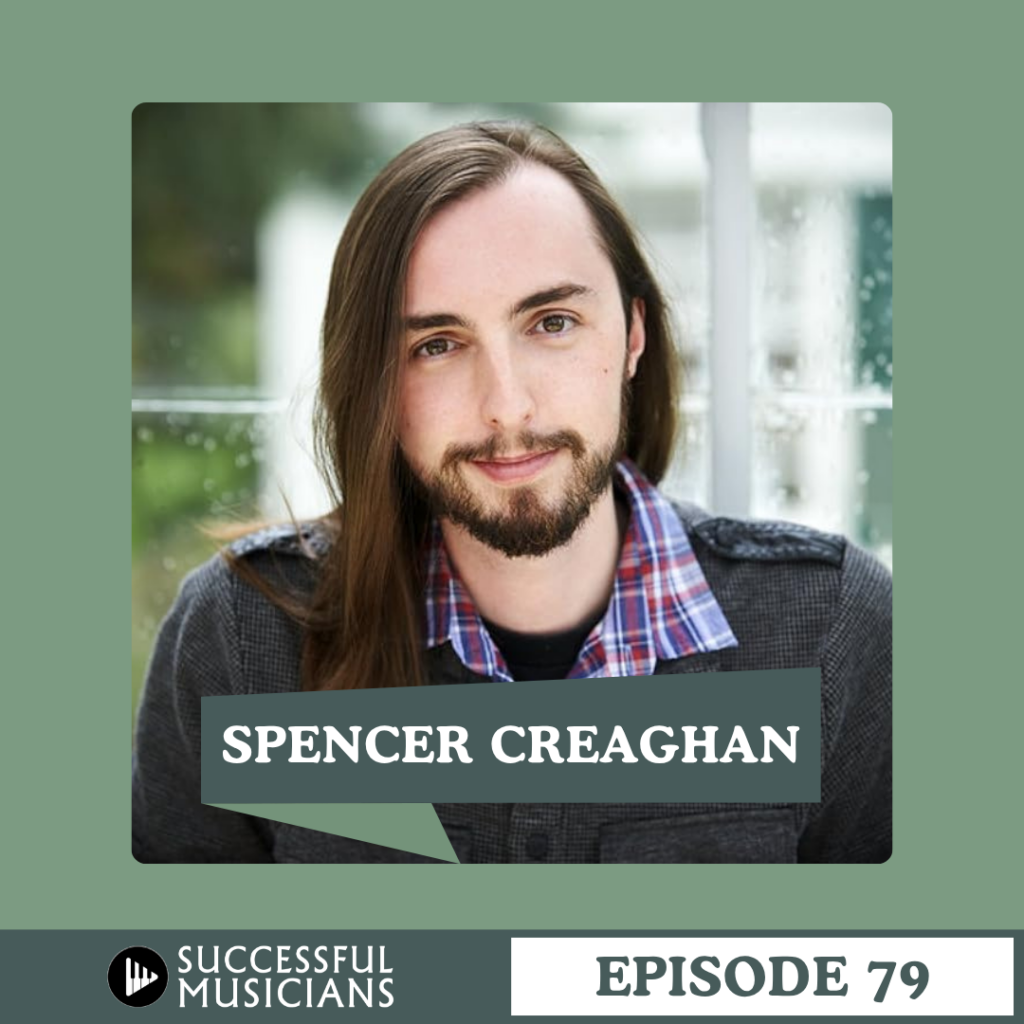
Successful Musician Podcast Episode 79
Interviewee: Spencer Creaghan
Interviewer: Jason Tonioli
Jason Tonioli
Well, welcome to the podcast today. My name is Jason Tonioli and I have a special guest Spencer Cragan all the way from Canada hanging out with me today. Spencer has done a ton of very, very cool projects for film and TV. I mean, what I find so unique about Spencer with you is you’ve done, you’ve got kind of this mix of genres that I think is very interesting where you do piano or crestral, but heavy metal.
You love metal as well, which is absolutely incredible because I love all those genres and I see a lot of similarities in the kinds of our styles and genres that we love. But you are working on a ton of just amazing projects. Some you can talk about, some you can’t talk about, but I’m just excited to have you here today to share some of your journey to get to where you’ve been. You know, a lot of people are wishing that they could work on TV film type of stuff and you’re doing it and doing a phenomenal job with it. So thank you for taking some time to share some of your wisdom and experience with others.
Spencer Creaghan
Thanks for having me, man. I’m really excited to be here. Just even just to chat about like, I mean, we were talking about this earlier, but like how different it is for everybody in this industry and I think there’s no one path to do this so I’d love to just share the path that I did. When I was growing up, I listened to podcasts like this, I guess it was more interview videos on YouTube but it was just interviews with people that I loved that I was like how did they get into this industry and it’s just the amount of you learn really quickly there is no right way to do this. You just kind of stumble along and somehow you look back and 15 years later you’re like I’m.
I did it, so hopefully, whoever’s listening to this can find the same thing.
Jason Tonioli
Right. Absolutely. So I know you’ve a lot of your signature style is kind of like having these building characters with the music that you do, but I’m just curious if you’re running the clock back to, growing up, how did you end up getting into music and kind of learning to love music to start with? And how would you say that who you were growing up and, and that journey, how did that end up making you realize, wow, music is a character.
Spencer Creaghan
That’s a really good question. I’ve always had a balance between wanting to be a film director and wanting to be a musician. Forever I wanted to be a film director until I was about 13. It was always like movies, movies, movies, movies, movies, but always playing music in the background, like playing piano, playing guitar. And then it wasn’t really until I hit about 13, 14, 15… honestly it was probably even closer to 15 when a buddy of mine showed me some metal bands and I got really into that genre. I know I was already listening to mostly film music anyway like a lot of like the Star Wars and Lord of the Rings music but I never clued in that I could do that as a job. It was always like I just like that music and I like to make movies and I like to listen to that music but then my buddy showed me a bunch of metal bands and through just the path of listening to metal and finding different bands I stumbled upon a band called Nightwish they were of Finnish like big, loud, epic kind of symphonic metal band.
Just because I like to find out the influences of all my influences, I always find that just really interesting. Like who are my inspirations? What are their inspirations? So from listening to Nightwish, kind of, I discovered Hans Zimmer, James Newton Howard, those types of people essentially from listening to the Pirates of the Caribbean music through Nightwish I was like, I want to do this. It was like I can do big loud epic music and in a way that I’ve never really heard it done before. So yeah where most people will say oh was this movie that introduced me to music or was this album that introduced me to wanting to do music or was this whatever? For me it was that I became a film composer because of heavy metal bands and sort of like discovering a love of big loud epic music and big orchestras and telling a story in the imagination without having visuals or even lyrics. A lot of the music that I listen to the lyrics don’t tell the story. It’s the music part that tells more of the story but the lyrics are kind of more poetry images kind of thing. They’re less of a narrative. They’re more of just like an abstract so even that’s like finding a way to connect that image to the music and funny and through that type of music realizing that like the music that I like is music that paints a picture in the mind beyond anything else. And so a lot of the music that I write to picture, like a lot of the movies, music, I’m trying to create another character within the film, absolutely. But I find that that is achieved by trying to create an image in the mind of the audience beyond what’s on the screen. So they’re seeing one thing, but they’re subconscious, whether it’s memory, whether it’s the dream mind, whatever it might be, is picturing something else. And I don’t think they’re totally conscious of it happening, but there’s something, there’s another kind of element sort of happening there where then they’ll put the two together and then the brain does the rest of the work and then the emotions kind of take over from there. But I’m always sort of chasing that aspect that those bands I listened to. Can the music paint an image in the consciousness, in the subconsciousness of the individual that then adds on to whatever they’re seeing. So both things work together.
Jason Tonioli
You said you dabbled in piano and some other instruments. I mean, were you just that kid that mom put you in piano lessons and you want you love practicing or not so much?
Spencer Creaghan
Mom put me in piano, hated playing piano, picked up guitar in segs, it was way cooler, then realized the guitar is a limiting instrument to write on, at least what I was finding. It’s not at all that way, but I was finding it to be that way. Picked up piano again, and then piano became my instrument of choice. But it’s funny how it loops around, right? The thing that you think is lame in your head, it turns out to be awesome for the rest of your life. And now I don’t really play guitar anymore. I use it occasionally for whatever I need to use it for, but I don’t really play it.
Jason Tonioli
And you probably regret not practicing or spending more time learning some of those instruments, As we get older…
Spencer Creaghan
Yeah, honestly, there’s a lot of instruments I regret not learning as a kid. I wish I had learned cello as a kid. I wish I had learned violin. I wish I had learned drums. It’s like language. It’s way harder to learn a language when you’re older. It’s way harder to play an instrument when you’re older. There’s just no time. It’s not so much the fact that you can’t learn it. It’s just the time of the day. You just have less time of the day. So I’m learning cello and violin on my own and I use a lot of cello and violin in my music professionally. I get other people to play it.
But then also more and more I’ve been playing it myself. I’ve been finding with the advent of how much midi and samples there are out there, do sometimes you just want to get away from it. So like you just want to get away from the sort of digitalness of the music. You want to be born a bit more organic with it. So I mean, I do a lot of horror, so it probably helps that I do a lot of horror. But yeah, picking up a violin and seeing what happens that day is sometimes a really interesting way to kind of just get out of your just to kind of get out of your
your standard playing or your standard practices and just to sort of get out of the machine a little bit like you can sort of see what you might do which I find really really inspiring.
Jason Tonioli
So from a career path, you ended up, as a kid you took some piano lessons and guitar. Did you end up going to college to learn how to do this? Did you end up having another job?
Spencer Creaghan
The funny thing about me is I didn’t do music, I didn’t get into the music school that my parents tried to put me in when I was a kid. Like we tried to go to the prestigious one in London, Ontario, I didn’t get in. I tried to go to the prestigious school when I was in grade school, when I was in high school, same thing, tried to go into the big music program, but didn’t get in.
I didn’t do music classes until grade 11 when I joined the jazz band and I was brought into the jazz band because I was the only piano player that auditioned and I was a crappy piano player. I only knew how to play with my right hand and the piano. The music teacher came up to me after the audition and said, you’re in because we don’t have anybody else but you have to learn how to play the piano otherwise we’re gonna all suffer. You have to. So I’m gonna connect you with five different teachers, have an interview with all of them and please pick one. If you can’t pick one by the end of week, then you’re out and we just don’t go with piano. I was like, okay.
So by that point, I knew that music was something that I wanted to pursue a bit more seriously. So thankfully I already kind of knew the goal in mind a bit more by that point. This would have been grade 11. So I met with different teachers. The teacher that I went with is actually the piano teacher who taught Trevor Morris, who’s most known for doing the Vikings TV show. He’s also from London.
So that piano teacher and I really connected and he taught me eight years of piano in 18 months. And I just put my brain to it and said, okay, I have to do this a lot because I had to go to university and universities expect a prowess. So yeah, he taught me eight years of theory, technique. By the end of it, I was playing Bach, Fugues and things. I can’t play those anymore but at the time I could. Yeah, within 18 months, ironically, the irony is the school that I went to, York University, I would have gotten in even on like two years of that stuff anyway. They were just, they were fine with people not needing that. Yeah, but I went to York in Toronto, which excels mostly at contemporary music. So jazz world music, rock pop, that kind of stuff. Which is the real reason why I picked York was because the Film building was in the same building as the music building. We were in the same building. So I figured I could meet people that way. I kind of had this idea of like why wait until after university to start working. You can might as well start day one
which I did, so I met a bunch of filmmakers kind of online. This was at the beginning of Facebook when Facebook wasn’t just ads and memes and stuff, and it was really, you really could meet people. So I met all the future people at York, sort of on Facebook, a couple of them, we connected to right away, and literally the first day that I moved in to university, I had a short film, and I scored it that week, and we wrapped it up that week, and I still work with people that I met that week of university, I still work with them to this day.
We have a movie coming out later this month called Son of Sara, which is our 10th collaboration, our second feature film together. It’s a horror film, it’s awesome, it’s weird. And that’s 12 years of collaboration since day one of university, right? So it’s just one of those, like you just sort of do it. Yeah, cause I had this idea of like, I didn’t want to get a part-time job. I sort of kept thinking like, well, if I have a plan B, I’m just going to fall on the plan B. So I just won’t have a plan B.
So everything was plan A. My dad and I made a deal of having to pay for university with music. But at that time, the cost of living wasn’t as bad as it is now. So it was a bit more doable to play music and make a living than it is now. I can’t imagine the kids that are beginning now. But it’s nuts. But I think it’s still possible, right? Like it’s still, it’s all possible. Cause even at that point, like I had no other income. It was just me and music. So yeah, I made it work and here we are 13 or 14 years now.
Jason Tonioli
So I mean, I’m hearing from you that the people that you meet are kind of that key thing. And I think that’s a recurring theme that I’ve heard from a lot of the film composers is that they literally have tried to reach out and whether it’s at school or other places, those relationships that they build and just kind of becoming friends in a lot of ways and it is just absolutely key. I’m curious from a director’s perspective because you wanted to kind of be a director, but you’ve worked with a lot of them now. What advice would you have to a music person and also for a director, how do you find that happy balance where you’re working so well together? Meaning, for doing 10 plus projects or more than a dozen years of doing this, what do you think is key for that relationship to be successful?
Spencer Creaghan
Get rid of pride, just get rid of the pride. I think pride kills so many relationships on both sides, not just composers, also directors too. I found the most successful projects, like bumping heads is gonna happen, you’re gonna have moments where you’re like, this is so co-awesome, and they’re gonna be like, I don’t know man, or they’re gonna have an idea and you’re gonna be like, is it cool enough though, is it more, that’s gonna happen?
But if you come into that honestly and want to make the movie better, then everybody has a much more fun time. If you come at it from a sense of like, well, this is what I want because I’m the artist, that’s never going to, like, it’s just not going to work. No matter what it is, like some, it’s going to start to create some type of a conflict. So I’ve always found the most successful relationships are the ones where you go in honestly with, look, I have a really cool idea. I would like to do this really cool idea. But I also, because I think it’s going to be the best thing off of the project, but I’m also open to seeing wherever it takes us. Like doesn’t have to be this idea, but this is sort of what I came with and we’ll see what happens. So I find that’s the best way to do it. Otherwise, you’re just going to end up yelling at each other by the end. And that has happened to where like if when like when the pride does get in the way too much, it just starts to kill the relationship and no one’s having fun. And I like to tell my assistants and my mentees and stuff like we got in this job to have fun every day. Like if we’re not doing that, we have to rethink how we’re approaching this.
Are we in the right job? But just are we approaching this properly? Because if we’re starting if it’s really starting to lag on us, sometimes we are the problem. Sometimes we are attacking things differently. Sometimes it’s just who we’re working with like there’s all kinds of things. But sometimes maybe we’re being a bit of a jerk and we have to rethink how we are assessing this relationship? And I’ve definitely been there where I just pushed too hard on something. I’m like, okay I need to step back. This is not okay. One of the best lessons that I ever learned was and I didn’t even really learn it at this moment. It was more kind of a sort of accumulative, but I remember sure, when they were telling me this and I was like, he’s right. I should have done that. Why did I do that? Which was always, write the email, send it and send it, send it, in the morning. Likely by that point, you won’t send it. It was always sort of the best kind of, was like, he was like, whenever you’re upset about something, just like take a day, come back the next day. If you’re still upset about it, then it clearly bothers you. If not, then it was just the emotional reaction of being wrong or being dismissed or whatever it might be. And that’s more of an emotional moment. That’s not a logical moment and he was so right. He was so chill. I wasn’t even that angry. I was just like dude, the directors were so wrong like we should do this and he was like maybe but sleep on it. Come back tomorrow. He’s like you might be right, but let’s take the day to think about it, man. Let’s not do anything rash right now. It’s like cool sounds good. And he was right like it’s so it’s just funny how yeah just having that moment of like it happens like sometimes. Sometimes you just love something so much because of time that you were writing it’s like it’s like you loved writing it more than you really maybe loved it and that’s a really big thing that I sort of helped me like sort of recognize is even when I’m writing something during the day, am I loving the experience of writing this piece of music or does this means before or do I actually love this piece of music and there’s been so many pieces that I’ve lost in the process of collaboration that I thought were the best things which that I ever wrote that’s just got cut and I’m like oh they’re so wrong this is the best piece ever written and then months later I’ll go back and listen to it again I’m like they were right, that was not right, that was a bad piece of music. It was either a bad piece or just wasn’t right for the picture or whatever it was, but it’s just that distance away from you being the person that wrote that, you being in the mindset of you writing the piece versus objectively is this good or bad, just having that day, week, month, whatever it might be, just to separate those two is really interesting how much clarity you get. So that’s why I say take the pride out because pride is the thing that we’ll get in the way of some new relationships and just once you…
Don’t remove the confidence and don’t remove the ideas and don’t remove the excitement or don’t remove the creativity but just remove the idea that you’re the smartest person in the room. Like you might not be. So work with people to really kind of make sure that it’s awesome and cool and I find from there you’ll make really awesome cool music that you might even like to surprise you going like I never thought I could do this. It’s kind of like all my favorite relationships are the ones that I thought I was going to be fired because I didn’t think I could handle it. I didn’t think I could do it. I thought that I was in the wrong pit and they all turned out killer and they’re all stuff that looked back and I’m like, I can’t believe I wrote that. That’s not what I do, but it’s so cool to see that I wrote that because of that collaboration.
Jason Tonioli
Well, and I think, you know, when we look back on those things that were like, wow, did I really do that? Yeah. A lot of times it’s when we’ve been pushed or there was a lot more that went into it. And I almost forget what went into it because it’s kind of like a baby, all the pain of growing that kid, but then they do something else. I was like, you forget all about all the pain that you went through, to get there. One of the things that I think was awesome that you just said is, you know, not just like you remove yourself from being about you in the music and have it be what’s right for the project. I think it probably goes both ways for the director as well. You probably worked with people and when they’re about like, well, this is what I want. And if both parties or everybody involved can just step back and say, okay, well, what’s right for the project? All of a sudden it’s like this shared thing where you’re trying to find, it’s really a journey of discovery to figure out what is the sound of that character? It’s almost like you’re a chef in the kitchen and like, okay, do we want to do a little bit of jalapeno? Because you do too much jalapeno, it’s going to ruin the dish, but you know, maybe a little bit is right for the moment, right?
Spencer Creaghan
That’s a real, I like you just said there too, that’s the path of the discovery. Cause I work on a show called, Surreal Estate. It is kind of gothic, real, it’s sort of like Buffy the Vampire Slayer, but like with realtors. And I pitched the music with a kind of quasi metal, Evanescency kind of thing, which they loved and it worked really, really well.
But as we started doing the show, I started noticing that like that kind of sound wasn’t necessarily going to work all the time, because it’s just not, like the show just doesn’t have those opportunities to really do that type of music all the time. So I started writing music that was almost more Celtic inspired, like it had Irish instruments and things because they shot it in Newfoundland and Newfoundland has a big Irish base. They have a lot of Irish music. And I just, just sort of just to take my hat to that, be like, well, they shot it in Newfoundland. I love Newfoundland. I loved Newfoundland music. That’s just a little wink and nod to the fact that this is shot in Newfoundland, I just started putting in Irish instruments to kind of capture that sort of just the majesty of what this place was. And they loved it. They thought it was so cool. But to a certain degree, if I went too far, it started sounding not like what our show needed to be. But they loved the idea of putting in these instruments just to give us a bit more of a supernatural sort of quality, like a more ethereal, kind of like otherworldly essence combined with the Gothic strings and the pianos and the like Latin percussion and like the more like metal things. It was a combination of all those things that kind of worked, but it was the discovery of like, okay, this is really cool, can’t go too far with it, but now let’s blend that with some of this other stuff. And like the show sort of found itself by the end of that first season, but it was really a team effort to sort of find what that might’ve been of everybody kind of sending in some ideas of what if we did a little bit of this, what if we did a little bit of this? And then me taking those things, combining it with my own, I just want to do a cool blend of all those things that I like and sort of meshing that together into sort of became the show. And I think, as you said, it’s discovery. Like you kind of like, I think you have an idea of what you want to do, but you like, if you do that too much, it sort of clouds the excitement that can come by just figuring it out as you go also.
Jason Tonioli
I think that collaboration is absolutely key. I’m curious, cause I know you’ve worked with a lot of other artists other than yourself, with the variety of projects you’ve done. What do you look for in people to collaborate and help you on projects? mean, you’ve got stuff where you’ve done pipes. A lot of these Celtic instruments, I mean, you’re not an expert on those instruments. So I’m sure you’ve brought in some people that are unique and special to those or other metal instruments. You’re probably good on a guitar, but you’ve got some guys that can really slay it too, that you’ve probably worked with. I’m just curious, what, what do you look for or what advice do you have for those individuals who want to work in the music world with somebody like you?
Spencer Creaghan
My biggest thing that I’m looking for is just do we jive as people? Would we wanna hang out together? Like, we don’t need to be best friends. But would I at least enjoy spending a couple hours with you? Or will my energy kind of fade over time? Because you don’t wanna be in a session and then a couple hours later you’re like, I’m so beat. What is happening? I don’t even know if takes are good anymore. Man, like, you don’t want that, right? Like, you want it every single time, be excited by what’s sort of happening.
So I’m looking for people that are always in that way and I find that most musicians are like that. It’s very rare to find the other on MassMet. But when it comes to me, I work with a lot of metal bands and I kind of like being loud like orchestral parts off for a lot of these bands and for those I’m often trying to find bands that are trying to do orchestral metal in a way that hasn’t been done before. Like I don’t want to just do Nightwish again. I don’t want to just do Flesh God Apocalypse again. I don’t want to just do Aseptic Flesh again. What can we do differently? And thankfully, a lot of the bands that I’ve worked with are also looking for that as well. And the bands that I’ve worked with, the other thing that I’ve noticed from my aspect that I had to kind of learn was I had to also trust that the band knows their music. I’m not going to be the guy to come in here like, I know how to make your record more awesome. I just need to be here. I just need to come in to say like, here’s what I’m going to give you. Hopefully it’s awesome. And then you use whatever you like. A lot of it, which I find is interesting versus the film world where everything has to be perfect before the dub. Like every note has to be exactly right.
In the metal world I find I give them a lot of different options and sometimes it’s just like here’s a bunch of different variations on something, use whichever one you think works better for your music and sometimes that allows them the flexibility that I’m still going to take over because I find with metal especially with metal and I’m sure it’s the case with with other genres as well but I find metal the bands are very protective and they should be but they’re very protective of like of their music so I find even just being I view myself more as like I’m gonna come in I’ll do my thing and then you take it and do whatever you want with it afterwards. And I find that’s created a much more unhealthy relationship with these bands that just want their music to sound good, but they want to be the ones making the music sound good. They don’t want to have producers telling them what to do. They don’t want to have the record label telling them what to do. And I learned, it took me a while to learn that one, but maybe in the last eight years or so, I’ve really gotten very good at that. I’ve just been like, it’s their music. I want to do the best job I can to make the music as awesome as I would want it to be, but they’re the final say. So let them do what they want afterwards. I find even just having that mindset and I find the same thing is true with musicians. Like I’ll bring people in that are going to do really awesome stuff, but recognize it’s his music. So whatever he does at the end, he’s going to use it. Like I had a pipe list over about a month ago and we recorded five hours of music, just a whole bunch of different experiments and things like that. I may have used 20 minutes of it. We just couldn’t use the rest of it. And it’s not that they weren’t awesome. They were so cool and I’m going to use them for something else but it just didn’t fit this project, right? They were awesome things that we’re gonna have and I’m gonna tap into them, but it was that discovery. The guy gets it. Even during the session, the guy was like, you’re probably gonna use the five minutes of this, aren’t you? And I’m like, yeah, I’m probably gonna use five minutes of this. But like, we would never have that five minutes if we didn’t have this session. Like we would never find that five minutes if it wasn’t for the session. And so a lot of the bands that I work with and like the artists I work with kind of see the same thing . Yes, I might only use 20%, 50%, 80 % of what you do, but I wouldn’t have that if it wasn’t for you having that in. So it’s that kind of collaboration of knowing people brings different things and kind of in the process and allowing that to happen. I think that’s why you see pop records have like 20 writers because everyone brings 10 % but you need that 10 % otherwise it’s not the same song.
When I was a younger musician I used to think like oh like they’re all working with each other and they’re not like these songwriters aren’t writing their own song, but as I got older I realized they want that collaboration. They want that 5 % that the one person brings to make their song better, to make them look better, to make them sound better. And that’s how I work a lot of the time, both when people hire me and when I’m working with other people. Do they understand that this is a collaboration that we are gonna work off of one another to make the best art possible? And…
understand that it might be 5 % but it also might be 90 and who knows but finding that is the way that we go even in movies like you might have 10 minutes of music in a movie or you’ll have 75 and understanding that like that is you’ll kind of discover that as you work on the film.
Jason Tonioli
Yep. I’m curious when it comes to working with some of these film projects that you’ve done in the perfect world and every project I know is super, super different. Every director and all the people that are involved in there are always different. If you could set up like the ideal workflow from when you originally get offered a project or brought in to work on a project, what would kind of that ideal workflow look like between the the composer and the director in the perfect world and just knowing that that probably has never exactly happened just because of the nature of the stuff. But what do you envision as being that ideal scenario?
Spencer Creaghan
I love having big long meetings with my director before I even start writing a note of music. I want to understand, I want to make sure that I understand their movie. Sometimes I don’t always understand their movies, which isn’t really an issue for either them or me. It’s just sometimes you just don’t quite understand what they’re trying to go for. So I want to make sure that I understand what they’re trying to go for. Sometimes I know right away, sometimes I know most of it, but not all of it. And so then also understand why this music, like if the temp is a certain way, do they like the temp, do they not like the temp? Why do they like it? Why do they not like it? Things like that. What can we grab? What can we not grab? And then sort of I take a lot of notes. I take so many notes on understanding the themes and the philosophies behind the film, like the character arcs, all the story stuff. Like it’s pages and pages and pages of notes. And again, just so you can find that one line, right? So I’ll take all these notes and all these notes and all these notes to find like the one line that I go, that’s the movie. That’s where the music’s gonna be.
And then I grab that and that becomes sort of like where the score leads. My adage that I sort of mantra I guess that I try to grab always is what’s the thing in the film that’s not in the film and then that’s what the music is going to be. So to give an example of that every movie is about something or every movie has something in it that might not physically be present that no actor, no set piece, no thing can really really capture. Like The Lord of the Rings is a big opera but you would never know that by watching the movie but it’s Howard’s music that makes it very very an opera so his music becomes the opera that then you go this is an opera right? This is a Wagner, this is Mozart this is all that stuff right, but the movies itself could have gone different ways, but it’s his music that tells you this is Wagner right so I Tried to do the same thing can I find something in the in the picture that is maybe not represented maybe not like not represented as a physical object that the music can then be and that’s where I try to go from there. That requires a lot of meetings, a lot of notes, a lot of thinking, a lot of sitting around doing nothing, but you’re kind of thinking about what it might be. And then you finally start to write and hopefully you’ve done a lot of the intellectual work that the subconscious kind of takes over from there. And it’s more emotional work after that point. You’re less trying to logically think about it and more trying to sort of instinctually roll with it. But hopefully you’ve understood it so much by that point that your instincts take over and it might take you still a couple weeks to a month to find for the thing for those instincts totally lock in but hopefully you’ve done enough of the work beforehand that you can that you’re not sitting at a blank page because the blank page sucks so can you sort of do enough work beforehand that there’s no blank page you sort of just like this is what I’m gonna do and then from there you might be wrong but at least you’re wrong in the right way not in the wrong way. Does that make sense?
Jason Tonioli
I’m curious, what advice would you give to composers or musicians who are wanting to break into this kind of scoring or just into the music industry? What advice would you give?
Spencer Creaghan
I got a couple. One, don’t worry about this AI thing. I’m not worried about this AI thing. I think it’s a fad. I wouldn’t worry about it. So if that’s at all something that people are worried about, I wouldn’t worry about it. Artists like working with artists. It’s that simple. We like working with other people. People like working with people. I wouldn’t be bothered by it. So just get that out of your brain first off. I just wouldn’t worry about it. Secondly, don’t worry too much about having a unique voice. You’ll find it like you will. I think everybody has a unique voice and it took me ten years to discover what that was. It was always in the music but I was not focused on what’s my unique voice, I have to be unique. Well this is, like this movie reminds me of this other movie so I’m gonna see if I can capture that sort of sound and maybe that’ll help the film in a certain way or maybe it won’t but like those things. I wasn’t so worried about having to be a unique special artist. I just wanted to just make really cool music that the people liked and then from there I discovered sort of who I was and like what my voice was and now I know what it is.
But sometimes that’s a detriment where my voice has gotten in the way where I’ll write something and it’s to me that it’s not working for the film and I have to rethink how I’m going to approach this. There’s so many of my favorite works that don’t sound like me but it’s because I had to kind of push the voice. It still is me and you can hear me in there but it’s not that you wouldn’t… If you put the slasher stuff besides Austria, the state besides… Hot Wheels.
People that know my music will go, yeah, that’s the same person. People that don’t know my music wouldn’t know. And I think that’s okay. I think that that’s almost valiant, almost in a way. So I wouldn’t worry too much about having your unique voice. And then the other thing is to treat the person like a person. Like we’re all trying to live, we’re all trying to be people. We all wanna have lunch together. We all get up in our pants the same way, right? I wouldn’t worry too much about, like don’t make the relationships transactional, make them human.
Yes, we have to get paid. Yes, you have to be treated with respect. But respect comes from treating them with respect and the payment comes from treating them with respect. So treat them like a person. And I find that that matters. Like don’t treat a project as what can you get out of it for the next time. Treating it like this is a cool project. These are cool people and I want to work with these people. And I find that something that I do find some composers miss only because I’ve seen some composer code emails and I’m like, bro, you’re just trying to be a transactional man. It makes it a bit more human.
So just get rid of the transactional aspect of this like yes, we need to get work. Yes. We need to get gigs. Yes. We need clients, but they’re not clients. They’re humans that we want to work with and they’re humans that we want to make art with that we that we’re all trying to make art with and I think of when we think of it a bit of that way as they are another human being that is trying to make art and we are contributing to that person’s art. I find that being healthier than this person will make me successful. This movie will make me successful. This project will make me successful because it might not. I’ve had so many films I’ve worked on where I was like, this is the one. Nothing, it just didn’t do anything, right? It just doesn’t go anywhere. And then the projects that I thought nothing of became massive. And I’m like, right, because any project could have anything that could have that happen, right? So it’s just like, you never know. So treat every project like it matters and treat every person like they matter and you’ll kind of have a good thing, which kind of, yeah, it’s just, yeah.
Jason Tonioli
With so kind of one last question around the creation process. So I’m curious why creators struggle often to finish things. I mean, musicians and artists. I mean, we’re guilty of chasing squirrels where you have this idea like, know, we’re all over the place sometimes. What advice do you have for that creator person who struggles maybe to finish the things we get up to 90, 95%. I mean, I know there’s the perfectionist and that holds a lot of us up. There’s the I have too many ideas and so I never finish anything. What advice do you have to kind of help develop that habit of completion that is absolutely critical if you’re ever going to do a film score? Because otherwise, I mean, there’s deadlines that are just brutal sometimes with these TV shows and movie scores.
Spencer Creaghan
I mean, the idea that the joke in film and TV is that nothing’s ever done. Nothing’s ever perfect. It’s just on time. Like you just have to get it done. So you have to just, it’s just like it’s over. Like you just have to move on. So I often will schedule my days in a way where I’m like, I have to move on after a certain hour. I have to move on from a certain thing, which kind of gets me thinking a bit smarter. I find when I have more time, I overthink and double think and triple think, and it just doesn’t really work.
You end up sort of getting caught with that like, man, I don’t know if this is any good. I’ll come back to this later and then you never come back to it later. So building a schedule, I like the idea of even though we don’t have a nine to five job, make it nine to five, begin at nine, have a lunch break, be done at five, work from Monday to Friday. It kind of creates a semblance of a bit more of a structure. Know how much music you can write a day, focus on writing that much music every day, kind of be done. Like these days because I have a baby, I’ve been writing closer to a minute to two minutes of music a day it just is what it is right now but I can do but I used to pump out six minutes a day just like I could get it done that way because of the circumstance it’s changed now but it’ll change again I’m not worried about it but knowing that though, was able to schedule, okay, I’m a bit slower these days. I’m working a bit less. I have less hours in the day. I’m all the more tired. So I’m not gonna overdo it. Let’s just do two minutes every day. Make sure that that is a good two minutes and I don’t have to be done. The next day I’ll check it and then I’ll send it off. It’s knowing, like having a bit of that kind of connection.
The other thing I would say is just that I actually did recently as I worked on a passion project for the last sort of six months that had originated way back in 2021 and I’ve only now finished it just recently but it the only reason why I finished it was I created a deadline. I was like I have to be done by this date because I’m not gonna because projects were coming and I didn’t want to not have it done before the project was coming so I knew that a light and that a new life event was going to happen so I like have to have it done by this date because if I don’t it’s never getting done so I’m going to spend these months just working on it only with whatever time that I have knowing that I don’t have to write 10 minutes of music a day, don’t have write six minutes just like a little bit every day and but it has to be done by this date so that it kind of helped me again I use my Monday to Friday my this is the deadline kind of brain to kind of get it done that way and just took a piece out of it every single day and came back to it. I generally like rewriting more than writing so I find that’s a really helpful method as well. I will write something, know it’s bad and then come back the next day to make it better. I find that’s the way to do it just to get something else and you’ll inevitably make it better over time. And then the other thing that I found that my assistant asked me about the other day and this is the answer that I gave her and I think it’s true is when you like when you hate what you’re writing, step away and go for a walk or get something to eat or go to the bathroom something like that.When you love what you’re writing, Step away. Take a break whoever because you will inevitably think it’s so awesome But that one bit you’re like this one bit sucks though, and then you’ll spend two hours on one bit that inevitably becomes bigger and bigger and bigger and bigger and bigger and then you’ve just messed up a piece that six hours ago you thought was amazing that now you think sucks. because you might have not loved it, you might just love the experience. So I always say if you hate what you’re writing, step away. If you love what you’re writing, step away. You need that sort of separation to know if it’s good or not. And so having even five minutes, grab a glass of water, grab a snack, do a walk around the block, whatever it might be, come back, listen to it again, go, this is good actually. And then you can move on or you go, this is bad actually I’m glad I stepped away because it’s yeah so like either way and it really is both it really is do you love it or do you hate it I find that is really really important for me
Jason Tonioli
What, so, so kind of as we’re winding down here, I’m just thinking, what advice would you have for somebody wanting to break into the kind of film scoring? I mean, there’s lots of people that are, I want to be like Hans Zimmer and do that. What, if you were starting brand new in this, knowing what you know now, what advice would you give to that person who’s kind of fresh starting out? What things should they be doing or, you know, where do they start?
Spencer Creaghan
Again, don’t see it as a transactional relationship. See it as a human relationship. I think it is the big one I would focus on. Like it’s not about you. It’s about the art that you want to do and you’re a part of that ecosystem. The second thing I would say is, honestly, I would do the same thing that I did when I was younger. Just connect with filmmakers. Like literally just meeting filmmakers. I know that that seems easier said than done, but there’s avenues for ways to do it. A lot of towns have their own local moviemaking thing. Like a lot of major cities do for sure, but even some smaller cities do and a lot of smaller towns that might be closer to the smaller cities see if you can get in with those communities and go to the networking events if you have a university.
When you’re choosing the university, maybe don’t choose it for the music program. See if they have a film program there that you can maybe meet some of the filmmakers in. Things like that. Again, try to see if you can connect with filmmakers. And then at the end of the day, make sure that you really love movies. I’ve met quite a few composers where they just are kind of in it because of the money. And I’m like, it’s not really here. It is here, but it takes about 10 years before you see it. I equate it a lot like a restaurant. You really don’t start making money in a restaurant until about five years. It’s a lot of deficits for a while.
You know, then you don’t start making a profit in a restaurant until about 10 years, right? Like it really is similar to that. So I would say kind of the same thing. Like don’t worry too much about whether you’re not going to make a lot of money right away. So worry more about like, do you really want to do this job? Do you really love movies? Do you really love the art of it? And if you do, then just keep at it and meet the filmmakers, like nerd out with them about all the Again, my favorite collaborators are people that we just nerd out about movies. That’s half the time. We’re just like, had a meeting recently, the movie started and we were both like, so weapons, And we just talked about weapons for like an hour, before the meeting started, just how much we loved it, right? So then that helped us. And like the same movie, we were sort of beginning, we didn’t really know how to start, we both kind of had ideas. And then he had just seen one battle after another and he was like, dude, you have to see this movie, let’s chat about it. We’re not gonna do that, but I think it gave me some ideas. So then I went to go see it and we talked about it afterwards. And just like that love of the art kind of helped us kind of figure out the language a little bit more to help us find what we wanted to do. We didn’t end up doing anything like that, even like that conversation but it built such a strong bond that even as we were discovering it over the last month and even as I thought my god this isn’t right it was those conversations that helped him know like yeah I mean we didn’t land it on pass one but I love the guy because I like to hang out with the guy so it sort of it really built that relationship that like even if we even if we messed up it wasn’t like man I gotta go find somebody else now it was like okay well he messed up like whatever like he’s gonna find it so it was it was sort of like it really built that because we just both love this job and again that comes from just meeting people on that
at who they are. Be the human being that they need you to be and they’ll be the human being that you need them to be and you’ll make really good art together.
Jason Tonioli
Well, Spencer, I know we’re about out of time, I’m curious, you, you’re totally fine. This has been super fun. Some really great value. Just some amazing advice. So I think it’s one of those people who are going to need to go back and listen a couple of times to catch some of the, the, the nuggets you’ve thrown out. But if people want to find out more about your music and kind of what you’re doing, where should they go? And then is there any future project or, mean, you’re under NDA with some of these projects you’re working on.
Spencer Creaghan
Cheers, yes, sorry.
Jason Tonioli
But are there any projects you can hint that people should go check out as well?
Spencer Creaghan
Sure. Well, you can find me on all platforms that I’m still on. You can find me at a Spencer Composer. Just that simple. I don’t think there’s any capitals and it’s just a Spencer composer. In terms of projects, I mean, you can find my music in Australia states on sci fi, slasher and Helmutel on AMC. And if you have little ones. There’s Hot Wheels Race Reverse on YouTube and if you’re a book reader, particularly if you like the Mistborn books, I have a cool Mistborn sort symphony coming up probably in a few months, hoping by the end of the year it might be early 2026. But it’s all done, we’re just waiting for the right time to release it.
Jason Tonioli
That full symphony you did, that’s like you went, there’s Bulgaria, orchestral choirs.
Spencer Creaghan
It is an Indonesian choir and Bulgarian orchestra solo cello, the cellist is a metalhead and the piece has a lot of metal kind of inspirations which is apt for a book all about metals. Yeah it’s a really cool piece of music I’m really proud of and it’s again coming out in a few months. I love those books and it’s kind of a love letter to what those books are and I frankly just needed to get it out. It was one of those things you do for your kind of projects. I just had some time off. It had been in the process for about since about 2021. It’s the thing which I alluded to too earlier and I had some time this year that I just figured let’s work on this and it was just a why not and hopefully Sanderson loves it hopefully the fans love it we’ll see if they don’t well I love it so we’ll go from there.
Jason Tonioli
And I think some of the least projects that I’ve been involved in when you, you love it. Yeah. That’s what matters. And hopefully other people do. But if you, as I’ve approached sometimes projects, I’m like, you know what? If nobody else listens to this other than my mom, it’s okay. You know, I enjoyed the process and it’s, and the funny thing is some of those projects end up being the very best ones. Right.
Spencer Creaghan
Absolutely.
Spencer Creaghan
I’m seeing this project particularly as a very expensive demo reel, but I don’t care because I just really love the music and I love those books and I just want it. I don’t normally hear music, not normally, I don’t ever hear music in my head when I’m reading books. It’s part of why I like reading books because I can get away from music and I can get completely away from that world, but it’s still kind of a story land, but I never hear music.
But I heard a bunch of music when I was reading these books and I was like, I gotta get this out. So it was really just a sense of just I was gonna go crazy if I didn’t write something. And my wife, as my wife says, would you regret it if you never released this? And I would say, and I said yes. So I said, okay, let’s just get this done. So it’s coming out, yeah, hopefully by Christmas, if not a little bit later. And it’s kick ass, man. It’s really cool music. I think it sounds like the books. I think it sounds like the characters. I’m really proud of it. And it’s, we recorded it all over the world and I yeah hopefully the fans like it hopefully Sanderson likes it and if they don’t well I like it so there you go
Jason Tonioli
Well, know Sanderson, if you’re listening to this, hopefully this is the seed of something pretty awesome. I’m going to have to ask to go get some of that music, get a sneak peek maybe behind the scenes. So we’ll have to tease that out to people and kind of build the excitement around it, well Spencer, thank you so much for sharing. Just some great advice for people today. I’m really thrilled for the success you’ve had and thank you so much for just helping to kind of pass the torch and kind of give us some advice for those that are coming behind us too. So thank you so much.
Spencer Creaghan
Thanks so much Jason, this was a blast. Amazing questions. I really love being here. Thanks so much.
Jason Tonioli
Well, thanks Spencer. We’ll see you.