
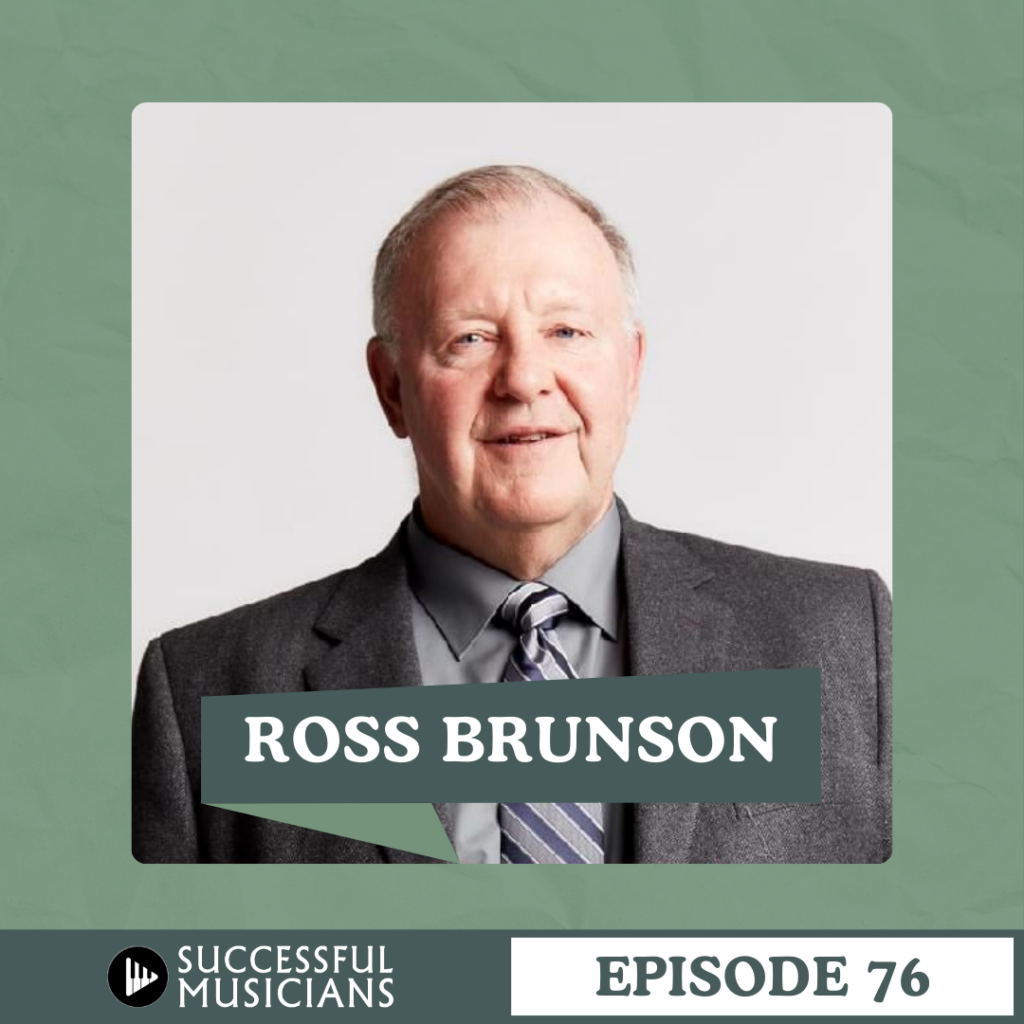
Successful Musician Podcast Episode 76
Interviewee: Ross Brunson
Interviewer: Jason Tonioli
Jason Tonioli
Welcome to the Successful Musicians podcast today. My name is Jason Tonioli, and my special guest today is Ross Brunson. Ross, you and I have chatted multiple times over the years. I feel like we’ve become friends. You actually got to attend a concert at my house just the other day, which was so much fun to have you come and be able to play piano for you. You are a business guy, I would say, that has spent your entire career learning how to do systems and processes but specifically helping other business owners to be able to implement and avoid problems that oftentimes, I would say almost all business owners have these problems if they’re trying to be an entrepreneur. They’re gonna go through bumps and bruises, but you’ve essentially been coaching and helping people go through everything from business structure to bookkeeping. All of the things that creative people like me absolutely cringe about and think we don’t have to do but are probably the most important thing we actually could be learning about and doing. So welcome to the podcast. You are also Russell Brunson’s dad, for anybody wondering if I heard this guy. So, I’m sure we’ll get into that later. But I specifically want to talk with you because of your background. I think the things you’re going to be able to share today are things that musicians and businesspeople in general just need to hear. So welcome.
Ross Brunson
Thank you. Thank you.
Jason Tonioli
Well, Ross, Ross, let’s dive in. I’d like to kind of get a background of where people have come from. How did you end up becoming a business owner? I mean, let’s do a quick story there. And then, you know, what was it that specifically helped you decide, hey, I want to help business owners.
Ross Brunson
Okay, good. Yes, I started my career back in 1977 basically as a claims adjuster for a farmers insurance company. So, I would be involved in if there was an automobile accident and there were injuries, I would be involved with negotiating with the attorneys as far as settlements for the injuries if our driver was at fault. And I also was involved with doing a lot of property damage claims. If a person had a fire or a flood in their homes, contacting contractors and bringing them in to help restore the home back to its prior condition. And I did that for probably three years. And then I got to the point where I was realizing that I was paying these contractors and these attorneys a lot of money, much more than the insurance company was paying me. And I thought, well, I’ve got a young family just growing and I need to be able to make additional money. It didn’t look like the pay raises that were in the system were going to move me up very fast. And so, I thought and I’ll do it. The next time I get a fire or a water damage claim in that person’s, I’ll just ask the contractor, let me go out with you so I can look it over on behalf of the insurance company to get a feel for what was wrong. But my ultimate goal was to go out there and figure out what it was he was doing to see if that was really something that I could get involved in and do.
And so, the first guy, once I decided that I got a situation of water damage and then I called this company, it was called SERVPRO. Some of you may have heard of that. It’s becoming a much larger company now. And so, I said, well, can I go out with you and look this over? And as we were driving out to the place and talking, I was, of course, really interested in what he was doing because I was interested in maybe doing it myself. And so, I started asking him, well, how do you like the job? Oh, I just love it. Does it pay very well? goes, oh, last month we bought $11,000. And I thought, wow, they were paying me like $1,000 at the time, but of course back in 1977, $1,000 a month. I had a wife and some kids, and I’m thinking, well, I can really live on $11,000 much easier than I can live on$1,000.
So, I thought, tell me more about it and it turns out that he was a salesman for SERVPRO that I didn’t realize at the time and he says yeah I’m the marketer here for Utah and he was the only one he was in Provo and he says we’re looking for an operator that can open up in Salt Lake. If you’d like we can talk with you about that and I was like, I am very interested, but kind of a quick backstory was that we had been living in Reno and I was a claims adjuster there and we were managers of a 12 unit motel as well, which gave us free room and board and well free room. I mean we had a house we could stay in, and my wife would clean the rooms and so she got paid a couple hundred dollars a month for doing that. As working with farmers, I had a company car, and they paid for my gas. So, 100 % of the money I was making working for farmers, I was just putting in the bank. And our idea was to buy a house at some point in time. And so, I had this money saved up and we had a lot, we had gotten a hold of it in Springville, Utah. And so, we wanted to move back to Salt Lake here, to the Provo area. And so, we made a transfer with the company from Reno up to Provo, Oren area.
And this is when I got in contact with this guy. We had saved $15,000 towards the purchase of our house. And I said, well, what does it cost to get into this? He goes, well, it’s $30,000 for the franchise, but you have to have 15,000 upfront. And then they’ll lend you the other 15,000 and give you the equipment you’re buying. They’ll hold that as collateral. And I thought, wow, I got enough money to do that. So, I went to talk with my wife. And she, by the way, was pregnant with Russell at the time. Our son Russell Brunson and she were just happy. We’re good with the job, we got a steady paycheck, we don’t need to do anything else and I’m saying, well, no, we’re not making much money, we need to do something else and it was no, no and finally she said, Russell was due in like another month or so and she finally said, I don’t want to hear another word of it until Russell’s, until the baby’s born, not another word.
Okay, okay, so I wait and I wait and we finally go to hospital, and she delivers the baby, and the next day she’s recovering and I’m going to the hospital to see her and well, dear, I’m buying a business. That was about as close as I came to being divorced. She still hadn’t come home with the baby yet. So, yeah.
Jason Tonioli
She still gives you a hard time about that probably still, right?
Ross Brunson
So, we took the money and we bought the SERVPRO franchise. And so, we started from scratch and then we started in Salt Lake. There’s an area called Holiday, which is kind of a richer area. I thought we’ll get our little group, our area up there by Holiday, Utah. And so, we started and we ran that business from about 1980 to about 1985. And we were quite successful. My brother was working on it with me and we were quite successful in it, but it was a lot of hard work. You’re washing walls and you’re lifting wet carpet and pad out and you’re re-stretching carpet and all the hard labor work. We thought, we’re young and we could do this, but when we’re 60 years old or 50 years old, we’re not gonna wanna be doing this. So, we need to do something else. And so we started looking around and we had a state farm agent who we would sell to in Utah and every time we’d go in to see him or if we’d bring him a bill to pass for the work we’d done, he’d say, he’s talking to me and my brother, you guys need to be state farm agents. And we were just like, yeah, yeah, but over the years he kept hitting us with that, you gotta be state farm agents, you gotta be state farm agents. So finally, we got to the point where we said, okay, we’re ready to move on. So, we went back to him, and he said, yeah, let me show you, talk to you, let me introduce you to my manager.
And we were able to get introduced to the manager and we were able then to become agents with State Farm. But the story, while we were still with the cleaning company, this is kind of really what got me going in this direction was we had a business and we had it set up and we thought, well, okay, I’m going to hire a CPA to do our accounting for us. And so, the accounting…
I found a CPA and I would then give him our check register every month, and he’d balance it against our statement. At the end of the year, back at that time, business returns were due on April 15th, just like personal returns were. And so, on April 14th, he showed up with our business return. Boy, you guys did great. Here’s your return. And by the way, you owe $20,000. It was like $10,000 in taxes by tomorrow. Send it in with the check, with the thing. went, $10,000? This was back in like 70,1978, 79. Even then, that was a lot of money.
Jason Tonioli
There was no funnel to solve that problem yet, right?
Ross Brunson
There was no funnel at that moment. So, I had to go out and get a loan really fast, and we paid it and got that done. I got a hold of them and I said, now I don’t want to go through this again next year. I can’t do that. I can’t come up with this money in one day. So, he said, OK. I said, can you come over and we can work on a plan, do some planning? And he says, OK. So, we came over and sat at our kitchen table. My wife gave him cookies and milk and we chatted. He was there for an hour or two and then he got up and walked out and didn’t say one word about our business. And I’m thinking, well, he’s a CPA. He must know what he was looking for and he must have got it. Well, the next April he shows up at the 14th and again, he hands us our tax return. And this time he says, oh, it’s $20,000. You know, you guys did twice the business of last year and now it’s 20,000. I said that’s why we had you over so we wouldn’t have this problem.
And so, I realized at that point in time, one, that he didn’t care about us, and he didn’t worry about us, and he wasn’t looking for any way that we could reduce our taxes. I say, what can we do to reduce our taxes? Really nothing, just pay them, just pay them. So that got me thinking that I know that there’s got to be a better way. And so, I did something that probably most people wouldn’t do, but I bought copy of the IRS codebook and a code of copy of the code of federal regulations that deal with income tax and I started reading the IRS codebook to find out what it is that I can do to start saving some money and then I started reading some other books that would kind of give me some ideas and so by the time I got with State Farm, we would go to conventions and things and the state farm agents would be saying to me, well, man, we just went through taxes. It was terrible. This is what we had to pay. How much did you have to pay? I would tell them and it would be substantially less than what they are paying. And they were going like, what? How come you’re paying so little in taxes? And I just said, well, I understand the rules of the IRS. You know, there’s a rule book. This is a business, it’s a game. This business is really a game that we’re playing with the government. And there’s a rule book and that rule book is the IRS code. And you have to understand the rules. And if you do, you can reduce your taxes. If you don’t, just like me, I was getting hammered and hammered and hammered. And so I told them that’s what I did. And they said, well, who set up your business? And I said, well, I set it up myself. They said, well, can you send me up a business? And I said, sure, I can help you set one up with the state. So I had them set up their business. And then they said, well, who’s doing your accounting for this business? And I said, well, I’m doing my own accounting. Will you do accounting for me, too? Sure, I can do your accounting. At the end of the year, they would say, well, who’s going to do your tax returns? I want to get this good deal like you. And I said, well, I’m doing my own taxes. Will you do mine? Sure.
And so, even though I was a State Farm agent, all of a sudden, I started developing another business inside my State Farm office. I started helping people set up their business. I started helping them do their accounting and I started helping them do their tax returns at the end of the year. And because of the fact I was using a lot of the same principles that I learned for myself, and I put them into play for them. I was helping them reduce their taxes as well. And then they started telling other people about me and other people about me. And before I knew it, I was getting all kinds of people coming to me and saying, I understand you can help me save on my taxes. I understand you can help me set up my business properly and that you’ll even do my tax returns for me. And I said, yeah, I can do that. So that’s, it just kind of grew from there. I had accounting experience. I knew how to do accounting, but I didn’t have any tax experience, but I got it from self-education. I probably bought $10,000 worth of books on how to do your taxes, how to, you know, save money and that. So that’s how I got into the business. And it’s just been growing ever since. And it got to the point where I had so much work, I couldn’t do it all.
And fortunately, after a while, my nephew shows up and he says, just got my master’s degree in accounting. Can I help you with your accounting? And I just said, here, take it. You do the accounting because I don’t have enough time. And then a little bit later, my sister shows up and she says, I just got my CPA license. Can I help you with your tax returns? Here, take that, that’s yours. And so, then I just started ending up helping people set up their businesses and I changed my business name to Business Structuring Secrets and that’s how, and I did that for a lot of years, set up hundreds and hundreds of businesses, all different types, depending upon what the type of person needed. But that’s where I got my experience and that’s how that particular business grew. And when I retired from State Farm, I still kept on doing my accounting and tax businesses and structuring businesses up until just about a year ago.
Jason Tonioli
One thing you said was interesting right at the beginning, when you had that guy sitting at your table was that he didn’t do what you thought he was going to do. And you said he didn’t care about my business. Like you probably enjoyed the cookies and milk, but I’m almost certain that as you were creating this business or helping people, I think one of the big differentiators that you probably didn’t even realize at the time was the fact that you cared about those people that you were helping. And I think, as I look at successful businesses and just people in general, it’s when they genuinely care about doing what’s right and advising people in the right way. That’s like the game changer that helps people grow. so, anyway, that very, very cool story. As you continue to grow with that, I’m certain that you had more than one business that would come to you. Even at the first one, they’re like, well, can you set up my business? They didn’t know what they were doing and they just wanted to save money. But I’m sure you had some doozies of stories where people would come to you owing probably multiple years even of taxes and just in such a mess that you probably learned some big lessons. I’m curious, are there any specific things about the game that you play when you go into business that you see big mistakes made, maybe even on the music side where there are podcasts specifically for, you know, for musicians, do you see any big problems that most businesses make.
Ross Brunson
Well, I can tell you about one story that I had right off kind of early on is I had this guy who was an artist. He was a painter and was painting and was doing well and was making pretty good money. And he got into this idea that, hey, the government doesn’t have the right to tax us. These wild theories out there and he was following that pretty heavily and so he didn’t file his tax returns for about three years, and the IRS started knocking on his door and saying, you haven’t filed your tax returns, where are they? And he started saying, I don’t believe you have the right to tax me. They started telling him this and they’re going, well, yeah, I think we do. And so, they started putting some pressure on him until finally he contacted me and he said, look, I haven’t paid in three years. Will you do my tax returns for me for these three years and get me caught out for the IRS? And I said, OK. So, we sat down, we did all of his accounting and did all the three years and we got everything. And he hadn’t submitted them yet, but for the three years, what it looked like, he was going to owe about $3,000.
He had expenses and different things like that and so I gave them all to him and I said now you need to send these into the IRS. You know, they may hit you with some little penalties and interest but you’re going to have the taxes that would have been around three thousand about thousand dollars a year. And so, you need to understand that that’s coming. So, I gave him the returns and then all of a sudden, he just again got this feeling that I don’t have, you don’t have the authority to do this to me.
So, he wrote a letter to them and said I’m not going to pay you. Sorry, I’m not going to do it. And so, they came after him and they chased him. I mean, he did everything he could possibly think of, and they chased him for years. I mean, he went to court and in court, he tried to battle saying the government doesn’t have the authority to tax me and all this stuff.
I think we’d actually sent the tax returns in, and it showed he owed $3,000 and the IRS had come back and said, okay, we’re good with this. But then when he says they wanted him to send the money, says, no, I’m not going to pay you. You can’t collect it from me. I don’t believe I owe it. So, they sent him back a notice immediately saying, well, okay, we’re disallowing all your deductions. So now you owe us $30,000 in taxes. And that’s when he started fighting him and going to court and everything. Anyway, they put him in prison for like a year, they put his wife in prison for half a year. I mean, all this stuff and that was a good lesson to me that, you don’t want to mess with this. It’s better to understand the rules of the game, you know, be compliant, but take advantage of every rule you can possibly take advantage of to reduce your taxes, but stay on their good side because you don’t gain anything by going to prison.
Jason Tonioli
Right. Well, I think a lot of the time the creative people just don’t want to think about that stuff and they figure if they ignore it, it’ll go away. And then, some of us are more stubborn than others. And obviously this was probably the most extreme of all. And maybe, maybe they’d ever got their money. Who knows? I’m sure the IRS did get their money in the end, even with him going to prison.
Ross Brunson
They got their money and they had them in prison for a period of time. I guess the point I just wanted to make is that, and this is, you I think important, is that you have to look at this almost as if you’re playing a game and there’s rules in the game. And if you live by the rules and you understand them, you can be very successful. But if you just say, I don’t need to worry. I don’t want to worry about it. I want to think about it. You’re going to find yourself paying a lot of money in taxes. Just for an example, let’s just say you have a straight LLC and you made, let’s just say you made in profits, let’s say $175,000 in profits for the year. Just the self-employment tax alone would run you almost $27,000 just for the self-employment tax. Then you have your income tax on top of that. But if you understand the rules, you can legally and lawfully reduce that by 60%. Instead of paying $27,000, you can end up paying $16,000. So that’s a tremendous savings just because you understand the rules of the game. Unfortunately, most people don’t know the rules of the game, and they don’t want to study the rules of the game. They assume that their CPA knows the rules of the game, but the thing is, the CPAs, if they do something wild and one of their people gets audited, well, they come in and they say, well, you did this for them and you did, and so this was wrong and these people should have paid a lot more in taxes. So, we want to know how many other people in your agency you’ve done the same thing for. And so now that CPA gets audited, every one of his clients starts getting audited. Well, that CPA doesn’t want that problem and that’s why like this one that came to me he doesn’t want to do anything. He didn’t want to come up with any ideas. He wants to find the most amount of tax you have to pay so that the IRS will never come and audit you or him or his book of business either.
Jason Tonioli
And I think just by nature, an accountant type of person that loves to just have everything in order, that type of person is not a risk taker. They’re the least risky type of person you will ever meet, and amazingly, they’re the ones that we look to as entrepreneurs to help us. And I think with the IRS tax code, there’s absolutely reasons behind all of those reasons why they structured things the way they did. I mean, in a lot of ways, they want to incentivize you to do things that will grow the economy and help things. And, I see some people out there want to vilify people that are they say avoid taxes, but the reality is the reason those taxes probably got avoided, it was because they did things that the governments decided, hey, if we do housing or we have different types of things that are going to benefit and help other people, then yeah, we’d love to have you spend money on single family housing that’s in low income areas. I mean, it’s a crossword. There’s a book bigger than the Bible that the IRS has. But a lot of those things that have ended up in that book are specifically to do things that will help grow the country.
Ross Brunson
Exactly right. They want to promote certain things and if you understand what those things are and you focus on those things then you’re going to get the very best tax treatment that you can possibly get through the IRS code and that’s what I mean you need to understand the rules of the game you need to focus on what those points are that they want you to be looking at and specializing in so that you can get the very best tax advantages you possibly can. And there are some great tax savings in certain areas. As you mentioned, housing, real estate, because they want you to be building homes. They want you to be providing homes for people.
Jason Tonioli
Well, business owners, especially whether it’s a musician or just any business owner, if you think about creating the business, the government wants to have things that are going to grow and create more revenue. So, as a musician, if you’re going out and going on the road and you’re doing concerts, I mean, you can write off your guitar, your piano, I mean, all these things that are helping you produce something that will then allow you to be taxed more because you created more revenue, obviously.
Ross Brunson
Right.
Jason Tonioli
I know with when you talk about this game and understanding the rules, I think of, whether it’s a board game, you’re playing with your family or whether it’s, Peewee Football League and you watch, these games or, you know, get into college or NFL level, there’s rules to the games. And oftentimes those rules and understanding how it’s played make all the difference, right? I mean, so I’m curious about the rules. If you were to apply that to a football team, how could a musician apply that to a football game, I guess?
Ross Brunson
Well, let’s say that you’re a musician and you decide to see some kids out there playing football. Let’s say they’re junior high school or maybe even junior varsity at high school or whatever, and they’re playing and you think that’d be fun to go out there. I think we could take them on, and you get a bunch of your friends, and you show up there and you say, hey, let’s play a game. They say, well, have you ever played before? Well, no, but you know, how hard can it be? I could see you guys running around and we can do that. Well, if you don’t know the rules and they do know the rules, how successful do you think you would be?
Jason Tonioli
Right, who’s going to win the game?
Ross Brunson
Think about it as a chess player. Let’s say you’ve never played a game of chess before, and you sit down with a guy who’s spent years and years protecting his chess game. How many moves would it take him to beat you? He might do it in three or four moves and you’re done, because he understands the game. He understands the rules where you’re just flying by the seat of your pants. So, if you know the rules, you’re going to be successful and if you look at football, the NBA or the NFL, those types of things, those people that know the rules the best, those coaches that know the rules, those are the ones that are winning the Superbowls. The ones that don’t understand the game as well, they’re the ones that are also run each year.
Jason Tonioli
Yeah, it’s interesting as you’re explaining that, I’m thinking back to my time when I went to Weber State University and I thought I wanted to do music for a career. And I thought, oh, and I think a lot of times people growing up think, oh, you play piano, so I guess you can go teach piano lessons. But if you’re really stepping back and be like, well, gosh, that’s not a very, it’s going to be a really rough road to support a family on and try and do that. As I’m attending my second day of class up there at Weber State in the music program. We got to half notes and quarter notes and I was dying inside. I just want to learn how to do orchestrations for film and TV and that type of thing, that’s what I wanted to learn how to do. I’m writing, I was already writing lots of music, but they wanted you to learn all of the rules to the point where, and they basically told me you can’t play the game, or you can’t even write music or do anything until the end of your third year before you can do orchestration. I’m like, I’m already published. I’m already doing this. And so, it was one of those where I wanted to play the game much faster. And so, the best decision I think I made for my music career was at the end of that day, the second day of class, I walked over to the business department, and I learned how to do marketing. I learned how to do accounting. I learned how to do all of these. You know, I learned how to play the business game, and little did I know in working a dozen years in the banking world as in doing marketing, that experience would actually lead to me having a successful music career, which is kind of ironic that all these people that were much better musicians than me ended up doing that. And yet I learned how to play the business game and marketing game. And all of a sudden, wow, I guess, if you want to look at financial success, I run circles around a lot of these musicians that I know are so much more talented than me. And yeah, I mean, I’m not sure you saw that all the time with, with business owners that would come in if they knew the game, the difference in the success they would have. Right.
Ross Brunson
All right. That would be what we would do if we would sit down with them, and we would analyze it and say, where are you? Why are you doing this? What’s your reasoning behind it? If we were to suggest a change, maybe to something a little different, would you be opposed to that? And if you did make that change, I think this is what the results would be. And so, we have to kind of educate them as we go along, teaching them because they don’t, for the most part, you don’t learn business in school, how to run a business. Sometimes maybe if you were an MBA or something like that, you might learn some of the mechanics, but for most people that come out of college and they say, I’m going to go into business, they haven’t learned how to manage money. They haven’t learned the core principles in business, how to run it, how to run it smoothly. But they get an idea, I’m going to sell this product. And maybe they have a little bit of success, and they have a little bit of money coming in. But then they started saying, man, I’ve been eaten alive in taxes. What can I do? What should I do? I don’t know what, how to, how to take care of myself. I know people who don’t pay as much money as me. My friend over here makes more than me and he’s paying less than me. How come? You see that all the time. And so, it’s just, we’ve got to change things in your structure around so that you are more aligned with the rules of the game so that you can take advantage of those benefits that are built into the rules.
Jason Tonioli
Yeah. Well, and I think as a musician or just even a business owner, I think it’s super important to watch what other successful people that are doing the things you want to be doing, what are they doing and implement those things. Because I know, if you’re not learning from those around you, then you only know what you know. It’s almost like you’re playing a video game, and you don’t get a chance to level up until you realize, my gosh, there’s 32 levels to this game and I’m on level three and I thought I was something special. Sometimes we need to have those moments in life too, to be humble. Hopefully it’s not an IRS type experience, but I know there’s a story. So, you coached wrestling for a lot of years with Russell. And I know you did a lot of wrestling things with him. I know Russell was a very good wrestler, but I have no doubt that there were a couple of those moments where he thought he was something special and found out not so much, right?
Ross Brunson
Right. Yeah, he talks about this story a lot and you may have even heard it, but it was his junior year. We started him in middle school wrestling and so he’d had several years of wrestling. So, it wasn’t brand new to him, and he’d gone through his freshman year and his sophomore year and he had almost qualified for state and a few things like that. His junior year he was coming in and he was feeling pretty macho, I’m going to win the state championship. That was his belief. I’m going to win the state championship. And so, we had our first dual meet and the school, Hunter High School here in Salt Lake Valley showed up and got on the team. Nick Fresquez was there. He was a senior and he was a pretty good little wrestler, and he was right in Russell’s weight. And so, the first match of the year, he went out there against Fresquez and Fresquez just whipped him pretty good. He lost by eight or nine points in the scoring, and he came off the mat just like, I can’t understand it. I thought I was going to win the state championship. I thought I was going to go undefeated. I thought this was going to be my year. He was just, he just couldn’t hardly believe it. And so, fortunately we had filmed that match.
So that night I went home and I watched the film. In fact, I had a scholarship to BYU Wrestling myself. And so, I had a lot of wrestling experience. I thought, well, I’ll watch these. And so, I watched it and we watched it and we saw just exactly what it was that he was doing to him that made him successful. And so, we worked together on counters to those techniques that he was using and every day after practice at that time, I was working with State Farm and I would come in after practice was over and I would work with him, him and a bunch of other wrestlers for another hour or two. So, they got the regular time, but then I would spend some time with him, and we would work on those counters for those techniques that he was using. And we drilled them and drilled them and drilled them all year long.
Then it came down to the state tournament, and the brackets were set up, and they were on opposite ends of the brackets, and they just kept working their way closer and closer and closer together. And sure enough, they were going to wrestle for the state championship. So this first match of the year was against Fresquez, and the last match of the year was going to be against Fresquez. And, of course I was just, you know, biting my teeth and…
My wife and I were up in the stands, I had my camera on him, we’re just like, and he goes out there and he starts beating them and he’s getting further ahead. I got through the first period and he’s ahead. He threw the second period, he’s ahead. The two minute rounds, he got through the first minute of the third round. Hang on, buddy, hang on. He’s still ahead and he’s taking it to the match to him and sure enough at the end of the match, he won the match and stood up and raised his hand. And that was one of the happiest days in his life and my life and my wife’s life. My wife’s life because that was his goal. That was his main goal in life at that time was to be a state champion in wrestling. And he’d won it. He’d made his goal. And it was through a lot of work that he put into it during that season to be able to go back and beat that wrestler.
Jason Tonioli
When we achieve those big moments in life, we can all probably think of a couple of them, of moments like that for ourselves. What I think is interesting is you get your hand raised up in the state championship wrestling moment. My guess is Russell had thought about that and dreamed about it, and it happened. And all of a sudden, your hand goes back down, and you walk off the mat, and I think there’s one of those meanings, yes, you felt great then, but you have that next moment. And I think as musicians, same thing. We have that moment. We got to perform. If somebody films or does something for a film or a TV score, you thought you arrived. And all of a sudden…
One of my friends, he’s done movie music and video game music for Hogwarts Legacy. It is one of the big ones. He just was up for a Grammy for, and he’s done all these just ginormous video games, and I remember about 15, 20 years ago, he says, wow, my friend asked me, how do you get fired at the end of every job you do? You do this amazing job. You’re working for Disney and Sony and these, these just big-name people. And he says, well, I don’t know how you live in a world where you go to work and you could get this pink slip and be laid off and have no control of it. At least I have control of what I’m doing. And, when you achieve that success, as you work with these business owners, what do you recommend they do to find that next success or really achieve that fulfillment and being, being full. I speak Spanish and I was thinking about the word success, and exitus is what the word in Latin is. So, it’d be kind of like an exit. So, I’ve thought, okay, it’s almost like this moment where you walk through the door and you exit. How do you find that lasting fulfillment?
Ross Brunson
That’s a good question. And that exit concept is very good in my philosophies of winning and whatnot. I keep mentioning that business is a game and you have to know the rules of the game. And if you know the rules, you’ll be successful. But how do you know when you won the game? How do you know that you’re going to get your hand raised? What is that success point? Well, why is it that we work in the first place? We work so that we can enjoy life but unfortunately work gets in the way of life. We can’t always just be on vacation every day of the year. We have to keep going back to work, but we work hard so we can get enough money so we can have some free time. And everyone wants free time. And if you think about someone who’s wealthy. What is it that that wealthy person has? That wealthy person has unlimited free time. If he wants to work, he can. If he wants to go on vacation, he can. If he wants to spend time with family, he can. If he wants to do charitable work, he can. If he wants to pursue hobbies, he can. Why? Because he has this free time. And what gives him this free time? Well, the free time comes, has to come through some source of money. And so, when I look at wealth, I don’t look at wealth as a function of money. I look at wealth as a function of time. How much time do I have? The more free time I have, the wealthier I am. And so how do you quantify that?
So that you know that you’re on the track to becoming a winner. Well, the way I did it, the way it made sense to me is that I would sit there, and I would say, okay, I know that I have a certain amount of bills. Let’s say I had $4,000 in bills for the month. I know I have $4,000 with bills. Now, if I didn’t go to work, but I just lived on the money that my money was earning, how far into the future could I live? Well, at the time I started thinking about this, I had all my money in a savings account, and it was making, I don’t know, half a percent interest, you know, and I thought I could live maybe an hour or two into the future on what my interest was making. So, this is not going to be satisfactory. I got to be able to live further. And so, I realized that I had to change my mental outlook. I had to start saying, I have $4,000 worth of bills every month. How do I get $4,000 worth of residual income coming in every single month? And for me, it made most sense that I said, real estate is very good for doing that. If I had real estate, let’s say I bought a house and I got it paid off, and let’s say it brought me in after whatever expenses I had to run, let’s say it brought me $1,000 a month. Well, if my bills were $4,000 a month and I got $1,000 from this rental, I could live one week into the future. But then I had to go back to work because I still had $3,000 more to go on. So, what that allowed me to do is I thought about it, now I can plan for this. I understand what the end goal is. I know what my bills are and I know how to generate or get this visual income. I just have to focus on that and focus on that.
In fact, Robert Kiyosaki said it really well. He says, most people look at what they do for a living as their job, and he says, well, that’s good. You know, a painter says, well, I’m a painter. Musicians say, well, I play music. He says, well that’s a job, that’s not your business. Your business is earning residual income, making residual income. You need to have an investment business. That’s your true business. Your job just creates the money. So, you can now move it into your investment business so that you can invest it to get residual income so that you can create opportunities for more free time. And so, I took that very seriously when I read that in Rich Dad Poor Dad. His concept there was just like, yes, that makes so much sense. I need to understand the rules of the game so I can run my business and make it as efficient as possible. But I need to then be moving as much of that money out of the business and not spending it on houses and cars and boats, but taking it over here and putting it into my business, which is my investment business, and I need to be investing it into, in my case, was, felt right, rental real estate. So, I started taking all my excess money from State Farm, and I was then putting that on rental real estate. I would do all my accounting, my tax work, everything I got from that, I would put on.
I took the money that I was making a little bit of interest on, and I put it down and I actually did this crazy thing. I bought three homes in one day. Two, four plexes and a duplex. I closed in one day, which I would never recommend to anyone else to do that. But I was sold on this idea. I’m going to start making passive income somehow. And so, I did that and I somehow managed through that and I started taking rents from, know, as I got one paid off, I would take the rents that it was making and put it on the second one, along with my income from State Farm, along with my income from my accounting, pay that off. And then I had two policies that had rental income and I put that on the third one, again with my State Farm. And it was amazing how fast you could pay things off. In fact, I did a little thing that I think might be interesting to you if I said, okay, let’s say that I wanted to borrow $100,000 and I wanted to spread it out over 30 years. I just assumed I could buy with that $100,000, I can put a down payment on a house, and I could rent that house for $1,200 a month. I think it was like six or seven percent interest. Well, the monthly fee was like $530 and that would if I paid that every month it would take me 30 years to pay that off and I said, what if I just took that full $1,200 and put it on that loan not just the amount of rent? Not that the loan was supposed to give but I took the entire rent and put it there. What turned that 30-year loan to a six-and-a-half-year loan? Just by putting $1,200 a month on it instead of the $530 a month.
So, you can see that as you start adding not just the rental money on it, but your other sources of income as well, you could pay down these loans. And I got to the point where I was buying houses and paying them off in two to three years because of all the different sources of income that were being applied to that particular loan. And so, my discretionary income grew from a thousand dollars a month to two thousand dollars a month to three thousand dollars a month, to $4,000 a month, and when I hit $4,000, in my opinion, I was rich.
Jason Tonioli
You’re good.
Ross Brunson
I was rich. I was wealthy because of the amount of money that I had to pay every month in bills I had coming in with my rentals, and so I could live into the future as far as I wanted to without having to go back to work. That was the winning of the game. That was how I won the game of business. That was the winning.
Jason Tonioli
Well, I’m thinking of how to apply this to, just for a musician. And I think one of the oftentimes musicians aren’t thinking into the future and they’re just happy to eat and pay their bills and do their gig or get their song recorded. And I think the big mistakes I see are, and this is all business owners don’t recognize or even think about the long-term. And I was just talking to a guy recently and they’re doing shows. And I say, well, do you know who your people are? That your fans that are there at the, at the performance. He’s like, yeah, we do these shows, get hundreds of people there. And I say, well, do you, do you know who any of them are? Well, no. And I just, well, that’s great. You did a good show, but I guarantee you after a week, they won’t even remember your name. Probably. mean, you’re yes, you entertained them, but then what? And, and, and I guess the question I posed to him is, could you have served, how could you better serve that person who you.
In your mind, you want to do this music that makes people happy or entertains people, well, could you do more for that person? Is there more that you could have done to serve and help that person be happier? Because they heard us another song that you did. And I see the mistake oftentimes is by not looking into the future and you’re just very short sighted, you don’t realize what’s all around you. So, as a musician, you’ve got, hopefully you get streaming revenue with songs getting played and get some money from Spotify and Apple. But oftentimes that list of your fans, the people other than just your mom who listens to your music in her car. How do you find out who those individuals are and how do you connect with them?
I look back to my banking days, and I remember there was a situation where somebody at the bank said, gosh, I wish we only had one customer, and we could just do an amazing job for that one customer. I thought, that’s a terrible idea. I have thousands of customers and how could you even say that? But if you really as a business owner could step back and say, if my life or death and success of my family depended on me doing such an amazing job for that that one person who was going to buy my thing is going to come back and buy again and again and again and again, what is it that you could do as a business owner to make that happen? As a musician, would you go show up on their doorstep and sing them a song, would you write them a thank you note and mail it to them after they came to a concert? If they bought a piece of music from you or they commented on your YouTube video, would you, you know, seek that person out and do everything you could to find that person’s email address? I’m going to send them a thank you. I’m going to just make sure that they know I care about them. And, and, and, and those types of little things, I think of as thinking long-term and not just looking at us as a short-term relationship.
And I’m sure you saw that when you were fixing houses with bad carpet. Hopefully those people hoped they never saw you again. But if you did a good enough job when somebody that they knew would have the issue, they would absolutely call you first, even though they really didn’t want to have any relationship at all with you. And we’re just mad that you were even there in the first place, right?
Ross Brunson
ServPro at the time, not only did insurance restoration, but we did an in-home cleaning. And so, we would be brought in because of the insurance claim, but we would do a good enough job that they would be on our list of clients, and we could send them out like you’re mentioning a little flyer or something like that in the springtime. We’re doing carpet cleaning or furniture cleaning in your home, would you be willing, interested in having us come back and helping you? That’s how you build a repeat business. Build a customer base so you don’t have to always go out every single day. Be going out and trying to find a brand-new person to serve.
Jason Tonioli
Yeah. Well, as you’ve talked, I mean, maybe even let’s talk about Russell’s experiences. I know he’s had kind of a roller coaster of a ride, with the business side. What’s some of the things that you noticed as the dad and then also kind of the business coach will call it that was watching along the way. Are there any good stories that we need to know about Russell that he can be like, dad, why’d you say that one?
Ross Brunson
Yes, Russell was a unique young man. He was driven. He was going to be successful. Ever since he was a kid, he would go to these bookstores and these magazine stores. He would buy these magazines, business magazines, and on the back, they had all these ads for all these things, and he’d apply for all these stuffs. And we started getting these thousands and thousands of junk mail pieces coming to our house. He’d have him hanging on the walls and his hat in the bedroom and he had boxes and boxes of these things. Every day we’d come in with a stack of these flyers from all these places that he’ll send his head soon. I mean that was his personality. That’s what he wanted to do. He wanted to make money in this way and so when he got a scholarship to wrestle at Boise State. And he was up at Boise State. And when you’re wrestling, you have to go in the morning before school and lift weights. Then you come in after school, and you wrestle. And then you come back for a night practice as well. And so, you don’t have time to work another job. And he got married.
He’s sitting there thinking, well, I need to support my wife. She was working kind of as a secretary someplace, but he felt bad and they weren’t making a lot of money and he just couldn’t go and find a job and work someplace. So, what he started doing is he started coming home at night after wrestling practice and he would get on the computer, and he would just start trying to figure out how to market something on the computer. And he would do that until two or three o’clock in the morning. And then he would go to bed and get up at six o’clock to go back to practice. And he just tried all kinds of little things and some other things started working. Some really crazy little things that he had come up with. And then the school year ended and he would then go and actually get a job during the summer and then he would go back and so through a year or two he did that and then one summer he was starting to do a little better on the on the computer with sales and the summer time came and his wife said, well aren’t you going to go get a job? And he’s like, I don’t know and the next day he got like $1,100 in checks in the mail and his wife looked at that and she thought if you can do this, you don’t have to go to work. Just keep doing what you’re doing. So, he just jumped in. He didn’t get an MBA. He didn’t have an accounting course.
He just jumped in and he just did marketing. And so, he was doing marketing and he started having a little more and more success. And one day we were running the river together and we were in a bus, and we were just going up to where they were going to drop us into the boat down this river. He’s telling me, I said, well, tell me about your job here. And he said, this is a wonderful thing, Dad. It’s so great. He says the best thing about it is you don’t have to pay any taxes on the internet business. There’s no taxes. I’m like, what? No taxes. I’ve been doing tax returns for a lot of years at this point. No taxes, no dad, it’s so great. You don’t have to pay any taxes. And he’d been doing this for a couple of years. And I said, well, tell me about this. And then he started telling me, you don’t have to do it, and I said, well, have you been keeping track of your checks and things like that? Yeah, yeah, I got it all down. So, I said, well, maybe I had to come up, I was in Salt Lake. Said, maybe I had to come up to Boise, and we can kind of look things over just to make sure you’re in good shape here. So, he said, okay. So, I came up and I said, well, let’s see your checkbook. So he handed me, it was just a checkbook where you just rip out the check and that little stub. And so, in this, there are a bunch of stubs in here. And if you looked at these stubs, there would be one with a date and nothing else or a date and a name but no amount, or a name but no date or amount.
Jason Tonioli
No wonder there’s no taxes.
Ross Brunson
Russell, how do you even know how much money is in your bank account? I just look on the internet, and I see I got money there, so I just spend it. So, I said, well, I think you do have to pay taxes on this. And so, we need to get this in order. So, I had to spend almost a year going through and finding every single check he wrote, finding out the date he wrote it, how much it was for and who he wrote it for and what type of business expense it was for. And so, I started creating like in QuickBooks, I started creating a set of books for him and we went through and we went through and we found out that he’d made money in certain years and he hadn’t filed his tax return. So, we had to go in, and we had to file back taxes and get him caught up. But, you know, he was the typical businessman. He didn’t know the rules of the game. All he knew is I can market. As long as I have money in my bank account, I can keep going.
Jason Tonioli
I can sell enough stuff. I can stay ahead. As he was doing that, I think most business owners, when they start out, it’s like a one man show and then you’re by yourself and then you add somebody to come help you and then another person. Just like your experience where you had family members come in, hey, what advice would you have for business owners or musicians about hiring, because I know for me personally, you max out at a certain amount. You can only work so many hours and then all of a sudden you have to come to this realization that like in Russell’s case, okay, I am not the accountant guy. I got to hire, I got to either get my dad to come in and help me, or I got to hire help. And I, and I think as a musician for me, when I was finally willing to say, I’m willing to invest in myself and spend money to have somebody do this. I’ve realized somebody else is probably better at that thing than I am. And I should have let it go long, long ago. But oftentimes as younger business owners that haven’t gone through hard parts of the roller coaster ride, we kind of overextend ourselves and get into trouble. I know that that’s not a fun experience. So, I don’t know if you’ve got any advice for people as that happens or good stories on that.
Ross Brunson
Yes, you know, if you are a marketer like Russell is a marketer and you know how to market to take time away from what you do best as a marketer and try to do something with it that you don’t know how to do, you don’t want to do. It’s just a headache for him to sit there and try to keep track of his books. I mean, that was just, I mean, that was just like suicide to him. That’s not something I want to do. I thrive. This is so wonderful. I can come up with ideas. I can figure out how to market them. I partnered up with other internet marketers, and we’d put our products together and we would sell packages and we would, all these things. He would make so much more money focusing on that end of it that he loved and he was good at, then he would have had to pay to hire just even a bookkeeper starting out. Somebody that doesn’t have to be a CPA or anything like that. Somebody who can do books, knows how to deal with QuickBooks or train up your wife to do it or teach, put your kids in a course to learn it. And then that’s good too because especially if you start bringing your kids in and you start teaching them parts of the business, you’re teaching them. I’m going to teach you how to fish as opposed to giving you a fish. You’re teaching your kids how to fish. You’re teaching him how to run a business. You’re teaching them how to market, how to keep track of your bills.
The amount of money he makes in sales is so much greater than the amount he has to pay or ends up having to pay to get an accountant to come in. He had me doing it. Of course, I did it for free for a couple of years for him while he was getting established. After a while, his business started getting bigger and bigger and bigger. And I was in Utah and he was in Idaho. So, he had to start bringing people in in-house because there were just so many transactions.
I had my own businesses that I was running. And so, he just kind of worked his way in and built up his support team as he went along. But he realized that it was more important for him to do what brought the most amount of money into his business, specialize in that, and then turn these less important duties over to somebody who’s skilled at it, could do it fast and can keep you out of trouble.
Jason Tonioli
Well, and I think musicians oftentimes they cringe when you talk about the business or the marketing or they feel like it’s almost like a dirty word and you know, it sucks the life out of them. But I see so many people that don’t believe that they can. I think oftentimes the success measure and breaking through that success barrier comes from believing in yourself and believing what’s possible.
Believing in that, you know, that four-minute mile or, you know, watching somebody else, my gosh, I can’t believe they sold $10,000 or a hundred thousand dollars, a million dollars or, or $10 million. And all of a sudden, I, for those that aren’t, if you’re listening and you’re not familiar with Russell Brunson, Russell, for me as a musician, it was interesting. I’d been a marketer for 20 years, pretty much. And I’d been to school. I’d had advanced degrees in marketing. I was actually on a bank marketing committee that essentially wrote the test for what was considered a bank marketer that knew what they were doing. They’d fly me back to DC. I was what I thought was a good marketer and then I left and started my own software company. When I left that, I thought, okay, I’ll spend some time on music. In my idea of like, what was possible with music was, you know, $10, $20,000 a year selling piano sheet music.
And then I went to this conference and this guy basically said, hey, you need to get this book. And I’m like, ah, I’ve got lots of books. I don’t have room in my bag. And they’re like, no, seriously, you need to get this book. Just trust me. And finally, I twisted my arm and did it. I came home and it was a book called DotCom Secrets. And they had this little program called the One Funnel Away challenge and Clickfunnels, the software company that he’d started.
There’s lots of softwares. I’ve been in the software industry. I’d helped innovate that world grow. But what I thought was interesting is he brought this whole idea of doing a website. And essentially if you could take somebody by the hand and take them through an experience without having them get distracted, like you have with the shelves at Walmart with too many products, which happens on every other website. And I thought, that’ll never work with music. And because I’d had like 12, 10, 12 books at the time. And, and I’ll, but I thought, yeah, I’ll, I’ll try it. And the next thing I know is I built this little landing page funnel thing. And I tell people, I want to give you one of my piano books. And all of a sudden, I mean, what happened with that is I, I literally was going to lose money on it, but the things that were taught in that book about selling and then serving and helping over deliver more than what, you know, people are expecting all of a sudden.
Yes, I lost $8 on the first book, but they bought more on the backend. And then I was able to sell them another book and another book. And all of sudden they started listening to my music and then they brought it. They wanted to know more about it and so, so my story as a musician, really my success comes because of that. In those little moments where Russell luckily was a business owner that was willing to do good things in that, also failed many times, I’m sure. But because of that moment, I was able to be successful as a musician financially, which I didn’t think…
Going back to why, why that matters, I didn’t believe it was possible. And I see so many business owners and musicians and creative people that they don’t realize that they are great and the value they have, whether you want to call it a child of God, you were born to be something awesome. And for whatever reason, I think, as we look at little kids and they believe they can do anything. And then somewhere by the time you get to be a teenager or you grow up, you get told that you can’t do it. And somehow, I think most people believe that, that they’re not capable or they’re not good enough, or it’s just not possible. And then they get stuck in that job. What are you going to do for your job? Like you said, Collette or I mean, your wife is like, you’re not going to do this, and luckily there’s people that do, decide they will do it. But then believe in themselves. And I think for my musician people listening, I hope the takeaway from you that you’ll take from this is believe in yourself and your abilities and, focus on what you’re good at. Like you were talking about, like do what, like just lights your fire and you love to do. And when you have those things that just take the life out of you recognize like investing in yourself and your greatness so that you can have somebody do the bookkeeping or somebody do those other things.
And the longer you put that off, the more I think you hold yourself back. I actually think in a lot of ways that’s what kind of makes that belief in yourself die when you have to do the things you hate doing, you know?
Ross Brunson
Right. They build up on you and build up on you and then you have to take away from what it is that you really want to be doing and spend time on this other and you get resentful and then you just say, ah, forget it, I can’t do it. And you walk away and you just instead of being able to focus on what you really love and then giving that everything you’ve got and then, you know, hire out the stuff that really… it’s not that important and not very exciting to you.
Jason Tonioli
Absolutely. Well, and I think, like you talked about earlier, success is, you know, measured a little bit and is by like the time that you have. I’m curious. I mean, I’ve got this magazine right here. Russell is right on the front cover of success magazine, which I think is awesome. I mean, that probably was one of his dreams as well. I mean, I think it’s ironic that he’s right on the back cover. You’ve got Tony Robbins. How cool and ironic is that?
I’m curious from the dad of Russell Brunson, your kids literally on the front cover of Success magazine, what would you define, if you were defining success to your posterity or others, what would you say is actual success?
Ross Brunson
Well, it’s nice to have your picture on the cover. That’s just kind of a reward for your hard efforts. But I look at success as somebody who has come up with a dream, has organized that dream, has brought it to fulfillment. And that dream is not only helping him, but that dream is helping hundreds and hundreds of people, maybe even thousands of people out there. And to know that because you were on this earth, and because of what you did, you have improved the life of thousands and thousands of people. I mean, what better success than that is there? Knowing that you’ve helped people be successful themselves and help people be able to support themselves and their families and then teaching other people how to be successful. I think that’s really the true meaning or the true feeling of what success is. How many people have I helped? And how well have I helped them to be successful in their own lives?
Jason Tonioli
I think as I look at when I was younger, you measure this, you think of success and it’s more of this self-type of thing where are you, you know, personally successful? And I think as we age, we realize that the impact and the true success is on others. It’s almost one of those where you recognize that the happiness, I the happiness I bet you felt watching Russell when he was wrestling and winning that state championship was probably way better than any moment you ever had with getting your hand raised wrestling in college. You obviously were a good wrestler if you did that, but I guarantee you that was a hundred times better. For anybody listening to this, just kind of pause and think about what is it you can, what impact can you have on others and I think the more we focus on helping and serving others and the impact we have on whether it’s the younger generation, the older, that’s where you become full or fulfilled as you, the word you used was fulfilled and I think that almost maybe should be the word for success is being fulfilled maybe.
So, Ross, thank you so much. This has been awesome. I think there’s so much wisdom in just hearing stories from other people that have kind of blazed the path. And you did it yourself. And I think what’s so awesome is you actually have coached so many business owners and helped them achieve that success and be fulfilled in their life. But what an awesome legacy to share. And thank you for taking your time to share with the people on the podcast today.
Ross Brunson
I’m happy to do it. Happy to do it. Yeah, we’ve set up over many thousands of businesses I’ve set up over my years in business and many of them – many, many, many of them are quite successful still to this day. So yeah, that’s kind of my legacy that I kind of left behind – that I’ve been able to give service to a lot of families and have made their lives better.
Jason Tonioli
Well, and if anybody wants to find out a couple of things that we’ve talked about for me, if anybody wants to go check out Russell’s stuff, you can go look up ClickFunnels. The book I would say that made the biggest difference. And I would say the best purchase of a book I’ve ever had was DotComSecrets.com. I’m sure the book is still there. That book was an absolute game changer for me even as a 20-year season marketer, on that, mean, there’s, there’s all. Once you get it down, you can go down a rabbit hole with ClickFunnels and all of that. But I would say that for me was the game changer that led me down a whole lot of other paths, which have been great to kind of watch and be part of. Ross, if people want to learn about the stuff that you’re doing, you’ve retired now. But if somebody wants to go and kind of research and find more, where should they go? What website should they check out?
Ross Brunson
My business is still going, I’m kind of an Emeritus status, I guess you would say. This businessstructuringsecrets.com and I have a gentleman by the name of Braden Chase whose kind of manning it for me for the most part but I still kind of give it direction and advice to him. I trained him up and he’s worked with me for a lot of years and so he does a very good job. But yeah, if you wanted to chat and maybe get some ideas as far as how to maybe structure yourself, your company better so that you could take advantage of some of these winning rules from the IRS Codebook. BusinessStructuringSecrets.com would probably be the best place to go.
Jason Tonioli
Well Ross, thank you again for your time and I think I know there’s been a lot of little golden nuggets dropped all throughout this interview so it might be worth other listens for sure. Thank
you again for joining us today.
Ross Brunson
You’re welcome. Happy to be here.