
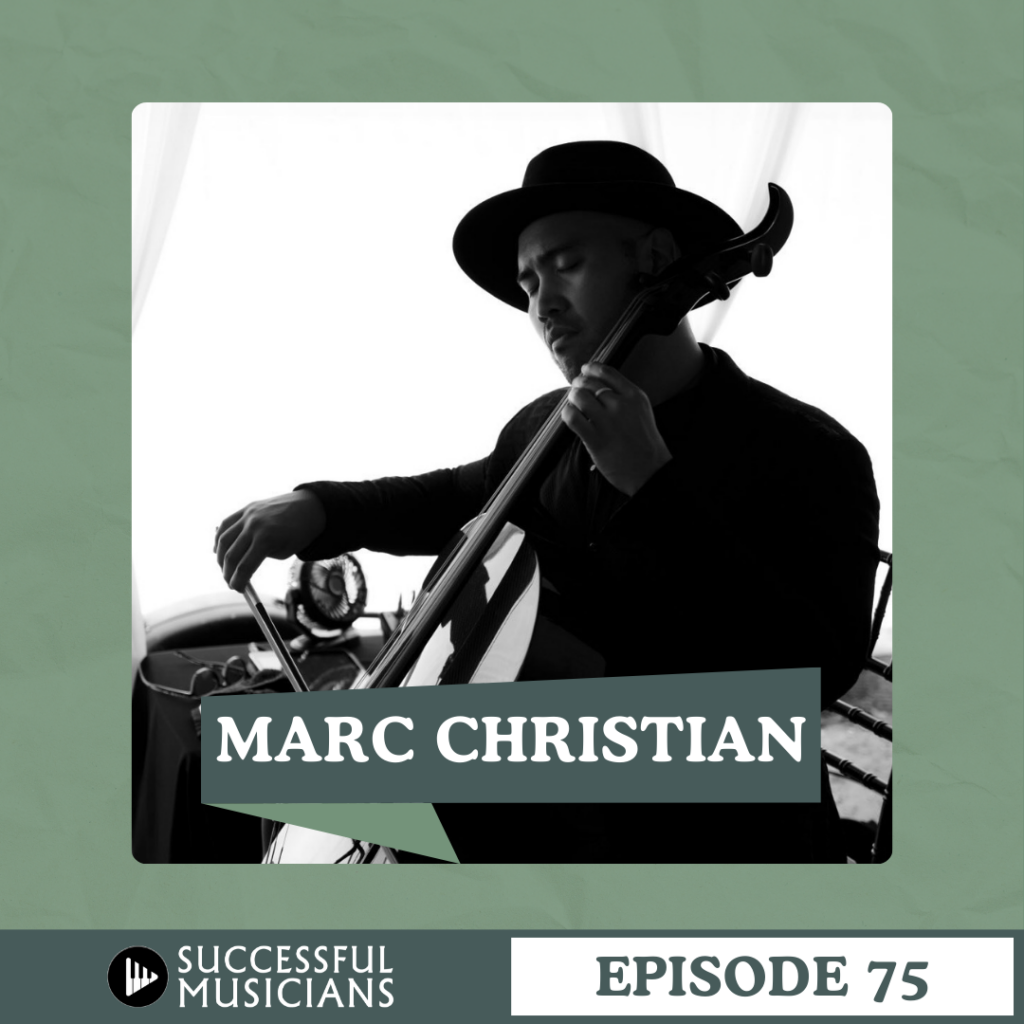
Successful Musician Podcast Episode 75
Interviewee: Marc Christian
Interviewer: Jason Tonioli
Jason Tonioli
Welcome to the podcast today. My name is Jason Tonioli and I have a special guest, Marc Christian with us today. Marc is a very, very talented cello player and musician. I know you probably have a whole lot of other talents other than the cello as well, Marc, but you have some phenomenal music, and you have been able to make a living for several past several years in the event space. I know you go and you play at a lot of weddings.
But wanted to bring you on the show today and just kind of share a little bit of your experience. I know some people think I want to go perform at concerts and do that but you’re making a very good living doing smaller gigs that sometimes people would think can I make a living doing smaller shows. And I think it’s very cool. So, Marc, maybe you’re down in Southern, California. Tell us a little bit about your kind of journey, how you ended up where you’re at and, how did you end up playing cello, I guess, in the first place? Let’s start there.
Marc Christian
Yeah, yeah. Well, thanks for having me, first of all. Yeah, I started when I was nine years old. I’m in my 30s now, so it’s been like over 20 years. I grew up playing cello. My older brother played viola. My younger sister played violin. So, we did a whole trio thing growing up when we were kids. I’m kind of the only one that stuck with it. I actually have eight siblings, you know. I’m the second oldest, but I’m the only one that continued with it after high school. So, I went to college for music, to Cal State Northridge up in LA County. I went there for a cello performance, and I did the whole classical training. So that was almost like the original plan when I was younger, just like maybe play an orchestra or something. But, you know, when I was playing in orchestras in college, I realized it just wasn’t for me. I wanted to do something more creative. So, I started getting into like, I started playing in bands and stuff. I started playing different singer songwriters and started writing my own music. I did that for a few years.
I guess my career really started in Los Angeles. So, I did the whole LA scene for a while. I did stuff like; I did some work for the Grammys. I worked for her, us the duo, DJ Deorro, some movie guide award shows, stuff like that. That was really fun and all and it was great, but I really wanted to, those are all booked through different agencies and contractors. And I really wanted to be more in charge of my schedule, my life in that sense.
So I started my weddings and special events business about five years ago. And I kind of took all that experience, I guess, on big stages and doing those bigger gigs out in Los Angeles to like the intimate setting of weddings. So I want to bring all that stage presence and that charisma to people’s weddings and really make it a special atmosphere for them. So I did it. I started about five years ago and it kind of blew up really quickly. And I’ve just been grinding ever since.
Jason Tonioli
You’ve got the brides zillas and weddings. I just think of weddings can be really challenging. When you do a wedding, what is it you’re looking to do? Or do you ask them like, hey, what music do you want to have? How do you cater that? So, there’s like just an incredible experience with whatever you’re doing for that wedding.
Marc Christian
Well, it’s all about like, it’s all about tailoring it. So, I try to stay away from the whole, I’m going to play background music on the side over there and it’s going to be some music on the side. You know, I really want to make it in Smith and them. So, we go over the exact like playlist they want, like the exact artists and vibe they’re going for. Usually it’s kind of a romantic, elegant vibe, but some people want more of like a R &B set or something. So, you know, make that happen.
It just starts off with me playing guest arrival music. So, as people are trickling into the venue, I’m in front of the of the aisle and I give them like a show for about 30, 45 minutes, which is really fun. So, it’s just a solo cello show, which like no one really sees, you know? So, it’s that unique experience and it sets like a really cool atmosphere too. And then all like the ceremony songs as well, which are very specific. like, we get the timing down to a T. So, you know, we want the bride to like…and her entrance down the aisle at the climax of the song. So, we time everything out. I send them recordings usually beforehand so they can be rehearsed with it. It’s very tailored and very personal.
Jason Tonioli
Yeah. So, I mean, with the weddings you’re doing, I know some people spend crazy amounts of money. Some people have really tight budgets. I know for musicians, oftentimes we undervalue what we’re worth. I know there’s a lot of musicians will do gigs on the weekend and if they can get a hundred bucks or 250 bucks, that’s worth playing a bar or whatever it is. There’s just limited money. how do you take that conversation where…I mean, you’re charging thousands of dollars to do some of these shows or as much as five or a thousand or more. How does a musician kind of approach that price conversation with the client essentially to overcome that, think?
Marc Christian
Well, I didn’t start off charging like four or five grand. That’s more of recent thing. I started off charging, like you said, like few hundred bucks, mostly because I didn’t know that, I didn’t know like how much people spend on weddings, but I guess over time, and I’m always like pushing it better at it, I’m bringing like at this point, probably like $20,000 worth of music gear to the event and everything. 05:40 I’ve done hundreds of weddings at this point, so there comes a certain point where you kind of just feel confident in asking for those prizes because if you know you’re doing like a much better job than most other musicians at it, you know, if you really focus on it and really hone in your craft in that specific niche. So yeah, I mean, I graduated over time. As it became more in demand, I’ll just turn down anything that’s like, you know, below a couple grand really.
Jason Tonioli
When you turn those away, would you say that’s one of the harder things to do is be like, my gosh, this person wanted to give me money, and I just said no to it? Or how do you come to terms with that? I guess mentally as a musician.
Marc Christian
Well, that’s how I used to feel. I used to feel like I had to take everything. But now there’s so many inquiries coming. Like basically every day I have people contacting me to play their events. So it’s easier to turn down if it’s not within the rate I’m asking for. Because I know if I don’t do it for there, I’m going to get another event that day.
Jason Tonioli
So, in the wedding industry, mean, is to find those gigs, just getting in front of the right wedding planner so they know you exist. I mean, are you doing like Facebook ads? Are you doing Google ads? I guess what’s proven effective for finding those gigs and getting that steady flow of people coming through?
Marc Christian
I mean, I know people do it different ways. I haven’t used any ads yet. And I plan to eventually when I learn how to like really hone in on that. But I’ve had success not using any of that. I have social media, but you I think we talked about a little before off camera where I’m not even like that big on social media at all. I don’t have like; I’m not going viral or anything. So, I basically just played a lot of weddings.
I did it for cheap at first, it built a reputation. I have tons of planners and coordinators vouching for me and different venues vouching for me. I’ve become preferred vendor for probably over 20 venues at this point. So, there’s just a lot of traffic coming in.
Jason Tonioli
That’s amazing. When you have those referral partners, the wedding planners or the vendors that have the facilities, what advice would you have for somebody trying to break into that world? What advice would you have for, if you could go back and give yourself advice, what would you tell yourself to do?
Marc Christian
I guess I would say, it sounds super cliche, but actually do your best, regardless of how big you think this gig is. I have a few stories. For example, I remember when I was in college, I think I was 19 or something, and I was looking for any kind of child work. I took a gig, I recorded it, that I found on Craigslist. There’s this guy named Scotty who he needed like cello on one of his original tracks. And he was paying like 40 bucks. And I know I drove to like an hour to go to go to his little studio in LA. And it was just me and him. And then, it was great. But then I found out he was he was Jordin Sparks music director at the time. And he was like starting his own like his own original music. And I was paid like 40 bucks for it. But that was fine. That was like one of the first recording sessions I did.
Through him, I ended up doing more shows with him and I met a violinist named Chrissy and she, like three years later, she booked me for some Grammy work, I am working for the Grammys, and it all came from that like first like $40 gig and I could have BS’d it because it’s 40 bucks. And I probably spent more on gas going back and forth and actually, you know, what I earned. But yeah, so guess like the advice I would give is just 09:45 do your best no matter what, even if it’s like, even if you’re recording for a singer-starrer that’s recording out of their garage, you know what I mean? You want to build a reputation of really giving it your all and treating everybody respectfully and just doing the best you can, you know? And it’ll lead to good places.
Jason Tonioli
It’s interesting. So, I have my recording studio here and we’ll bring lots of people in and you can, you can tell when somebody’s, it’s, really fun to watch somebody when they’re in that moment and they’re just loving it. But then there’s some, there’s some gigs or some jobs that it’s like, I don’t really want to be here, but I’ve seen different musicians where even though you can tell this is not their genre, this is not their thing, but they will give so much attention just to make sure it’s great.
It’s like leaving a piece of yourself and it’s so apparent even when you listen to the final song you can almost tell when somebody gave their heart and everything they had to put into it and then somebody who’s just like it was just a gig and job and they’re like punch in and punch out and you wouldn’t think you’d be able to hear that but you totally can and the other thing I would say is when you can tell somebody’s not really into it as much, you don’t really want to work with that person again. It’s one of those like even though may not have been their favorite thing, gosh, it’s, you want to work with people that give everything they’ve got to the project, no matter whether it was for the littlest thing that did an insignificant type of recording project or whether it was the Harry Potter type of video game project, right?
Marc Christian
Yeah, 100%. Yeah.
Jason Tonioli
I’m sure you’ve got some other stories as your kind of looking back. If you were sitting in front of a classroom of students at the university that are all kind of pondering, man, do I want to go into music or not? What’s the one or two stories you’d have to kind of teach a lesson to that group of people if you were trying to help them be more successful in their future music life?
Marc Christian
You know, let me see. I mean, a few things. Like, I’ll definitely tell the Grammy story, because that was a big one. I would say, maybe, I don’t know if it’s appropriate for someone super young, but I really believe that everyone has an obligation to serve the world in the way they’re meant to. So, if you’re talented in music, you don’t necessarily earn talent. Talent’s a spark, and then you work hard, and then you get somewhere, right? But you don’t earn talent, you are kind of born with it, and then you do what you need to do from there or do what you’re supposed to do from there. So I would say like, 12:20 If you’re gifted in music and you want to serve people through music and you really feel like that’s your calling, then go for it, But if it’s not, maybe do something else because honestly, like the music life is, it can be very tough and like most musicians, they can be great musicians but they end up like making a living off of it and they, I don’t know, at a certain age, you once you start reaching late 20s or late 30s if you’re not making any money off music and then that’s what you’re doing. Like that’s all you’re focused on. It’s a scary place, you know? Yeah, and it kind of holds the rest of your life back. So yeah, I would say if you really felt a cone towards it and there’s different ways I guess I’ve determined that throughout my life. I guess one time when I really like discovered the impact music has on people was it wasn’t like any big shows or anything like. I remember years ago, I was playing for this memory center and it was like this kind of retirement home for people with dementia and stuff like that, now when in there like not really knowing what it was I just know I just trying to get paycheck really when I first went in there but then everyone there was kind of just They were so like they’re sitting there quiet not alive at all. I set up and it was the same thing. I started playing and then all the residents there, there’s probably like 50 or so, just came to life. Some of them that were in wheelchairs started struggling to stand up so they could dance and stuff. I had this one guy, this older gentleman at the end, he was like crying to me and he was saying that one of the songs they played was a song they played at his son’s funeral and it just really…He said he needed to hear that, and it was just, it was impactful. This is a memory loss center. And I went there more than once, and when I came back, keep in mind, these are people that sometimes can’t even remember their family members, but I came back and like, oh, that’s, that’s a cello guy. It like really stuck with them. So yeah, I mean, experiences like that for me really, really made me feel that, you know, I’m talented in music.
And I think it’s right for me to work hard and to serve people through music. So as far as advice, if you find out that’s way you’re meant to serve the world, then go for it. As far as making money off it, just need to somehow figure out how to make it a product, package it up in a way that you can monetize it. But I think it starts with that calling, worth anything.
Jason Tonioli
I think it’s so interesting you share that story. Everybody thinks, I need to make money. We measure success oftentimes in just the world today with financial dollar signs.
Marc Christian
Yeah.
Jason Tonioli
I can tell as you’re sharing that story about the Memory Care Center, that those comments from somebody who frankly probably may not even have known their name that day, you may like the music connected with them and then they were able to connect with you on that emotional level. I think there’s, however somebody wants to describe it, I think there’s that spiritual connection somehow that when we serve others and we kind of just do it out of the goodness of serving and making a difference in the world, those types of moments tend to stick with us more than any paycheck. Maybe you had a $100,000 gig one. I think that moment you had with that old person that may not have known their name probably means more to you than any paycheck you’ve probably even gotten. And you’ve probably got several of those.
Marc Christian
Yeah, exactly. I’m not even sure if I even got paid for that. I’m pretty sure like I never received a check. It was only a couple hundred bucks anyways. That’s something that stuck with me like that was years ago, you know, and still think about it. So, and I try to keep that in mind whenever I’m playing because I don’t think of, you know, weddings or any type of event as necessarily small gigs because there’s because like I said, that memory care center that was like maybe the smallest of a gig you could do, you know? But it was one of the most meaningful for me. And I don’t know, I played on big stages and it’s fun and everything. There’s a lot of hype around it. But even playing for someone’s wedding, it’s, I mean, I remember when I got married, that was like the one of the most, that was probably still my favorite day of my life, you know? So, being a part of that and elevating someone’s day like that, it means something, you know? I don’t care if it’s on a big stage or like I really think it’s important to do and its meaningful work.
Jason Tonioli
Yeah, but I think music in a lot of ways, I you think about movies and movies have soundtracks and frankly, the soundtrack with music during that movie makes, without a soundtrack, it just doesn’t have that emotional thing.
The fact that we as musicians, we should remember we’re literally the soundtrack to some of those most meaningful moments. I mean, even if it was somebody going through a hard thing, you know, maybe I’ve with my music, I play piano and, there’s, and I have a lot like 20 books and I get people all the time that email me and they go play piano with my music books at the hospitals. And, if anybody’s ever been in a hospital, you know, you realize, you know, some of those moments you have in those hospitals or some of the most difficult stress inducing, know, hardest days of somebody’s life, you know, or even when, mean, just this last year I was in the hospital with my son who had surgery and, you know, he’s asleep and, you know, I’m there, but, you know, you just feel vulnerable and helpless in a lot of ways. And I think, you know, having music around in those types of moments.
Marc Christian
Yeah.
Jason Tonioli
The soundtrack literally sticks with you for your life. You probably remember the song you were listening to if you lost a loved one or when you asked your spouse to marry you. There are just these little moments in the soundtracks we can provide. Whether it be on the radio or whether it’s live performance with a cello or a piano, I don’t think we realize as musicians how important those moments really are to, you know, literally like ingrain in somebody’s brain for the rest of their lives. They will always remember that moment and the sounds.
Marc Christian
Right. No, hundred percent. I mean, I think like we start out knowing that and that’s what we get into it. But then, you know, if you choose music as a career path, you become so money focused because you needed to survive, right? That your kind of, start forgetting that. But then like for me, there’s always like those moments that make me remember like what it’s, what the real part of music is for. It’s not, it’s not for applause, you know? It’s like, like nothing wrong with like going big stages and you can make a big impact that way for sure. yeah, like I was saying before, there’s like small events and everything, with quote unquote small events. Those aren’t small to me at all. are like the special event space. You’re playing for weddings. First, someone’s getting married, you know, even like baby showers. If someone’s like having their first kid, funeral sometimes, like the death of someone’s parent or loved one. It’s like these are the…They’re called special events because they’re the most special events in people’s lives. So, it does mean a lot to be there for people in that way.
Jason Tonioli
Yeah, I think funerals. Fortunately or unfortunately my music gets played at lot of funerals but when you start realizing oh my gosh, that was so impactful to somebody or they tell you know that that made all the difference and you talk about getting that applause and you know, there’s times where Absolutely, you want to jump out of your seat and clap and shout for joy, whatever you want to call that but there’s other moments where I’ve had with music where Like you just don’t nobody even says a word. It’s just you know, got tears flowing from people.
And I think of my dad’s, it’s been more than a decade ago, my dad passed away, but I can still, we had a, he was a firefighter and we literally had like 80 or 90 firefighters lining both sides while we were pushing the casket out. And there was, as we were getting to the cemetery, there was a bagpipe player there. And I still can’t hear bagpipes and not get shook up.
Marc Christian
Yeah, yeah.
Jason Tonioli
You know, I think it’s just one of those I think as musicians. Measuring success with, I yes, we need to make a living, but I think, you know, if we can, you know, step back and measure that success with the emotional touching of people and really serving, you know, there’s so many people, I look at all these, you know, people that go and serve at the hospitals and play piano, like they don’t get paid anything. But the fact that, you know, they’re there serving, they’re probably getting more out of it than the people that they’re playing for in a lot of ways, you know.
Marc Christian
Yeah, yeah, think so. Also, I mean, I think it’s also a misconception where people think if I’m doing these kinds of events, like this special event space that like, it’s very fulfilling to your soul, but like not to your bank account, like it could be both. And like the better, like the more you put into it, the more you make yourself stand out in that space and really understand that you really understand service to your clients. Like you will be financially successful.
I’ve done a lot of stuff with music. This is the only thing that got me to like six figures, know, is this special event space. I know people making half a million plus doing this. it’s not, it’s not, you don’t have to be broke doing it at all. It could be fulfilling and you can make a lot of money. so don’t know. There’s both, you know.
Jason Tonioli
I’m curious if you, as you think about success, so the podcast is called the Successful Musicians. What would you define as success for a musician now? Because if you rewind back when you were coming out of college and you’re like, oh, I got to make money, you’re a seasoned musician now. You’ve found success financially, but what would you define success as now that you’re more seasoned?
Marc Christian
I would say just truly being in service of people. When I first started music and playing in front of people, I didn’t realize it at the time, but it was more to feel validated or seen or something. You get a lot of compliments performing in front of people, know, there’s just a lot of praise in it. Even like small shows, it’s big shows, you still get lot of compliments and praise, and it feels good. I realized that was my main motivator for years. I didn’t realize it. But I also didn’t make money off it because I didn’t understand the service part of it. I think, yeah, for me, success would be both financial and being in service to people. And financial because if your finances are in order, you eventually, you’re have to have a job as well, right? And I’ve seen it happen so many times where there’s these really great musicians and they’re killing it at music, but they have to have a side job because they can’t support themselves with just music. And eventually, not all the time, but most of time the job wins because they need a paycheck and your time’s just split too much. So, you can’t work a full-time job and just focus on music on the weekends. It’s tough. So, I would say both – to make a good living and serve people and make an impact on the world through your music.
Jason Tonioli
Yeah, like I’ve heard some people talk about, you have this success, but being fulfilled is almost that more important word that as I’ve kind of studied it. when you talk about service, I feel like I’ve always felt like me, my energy has been filled back up for sure. When I serve others, I’ve never thought of it, how, service really corresponds to the fulfillment side of things, whether it’s mentoring or coaching or teaching somebody, you know, people always talk about how, how they’ve, you know, they did the thing, but then when they helped other people learn the thing or do the thing, um, was where they found that fulfillment. And I, I think the serving really in a lot of ways, think serving others is where that filling up of, you know, fine that your own cup is filled up because of that, and you feel much better about everything you’re doing when that’s there.
Marc Christian
Yeah, I think that’s the only way for fulfillment actually. I don’t think you’d be filled without that. yeah, that’s the main focus.
Jason Tonioli
Yeah. Yeah, no, this has been great. Gosh, we’re about out of time. You’ve got some amazing music online. Way more people should be listening to your stuff. I’m thrilled you found such success in the wedding business, but I think if people find your music online or in the streaming, they’re going to fall in love with you. Where should people go check out online to kind of learn who you are and check out your music?
Marc Christian
I guess I’m most active on Instagram. it’s, my Instagram handle is Marcchristian.cello, and it’s MarcC. So Instagram, and I post on YouTube and TikTok as well, but Instagram is like where I post mostly everything. You’ll see a lot of music stuff and some of my wife outside of music. I have like tons of pets and stuff to see them, pets and all that.
Jason Tonioli
Awesome, awesome. they want to hire you to go play a cello gig or they’re getting married and they’re like, man, I got to have this cello guy come, where should they find you there?
Marc Christian
Same thing, Instagram or my website. I have an inquiry for them there. My website is Marcchristiancello.com.
Jason Tonioli
Awesome. Well, Marc, thank you so much for taking some time. I always feel like I get more out of these interviews maybe than, than anybody, but I think you had some really profound deep stuff today. So, thank you for serving and kind of helping, you helped me kind of step back and be like, wow, that’s, that’s what it’s all about. So, thank you.
Marc Christian
Thank you for having me, I appreciate you.
Jason Tonioli
Awesome.