
Jason
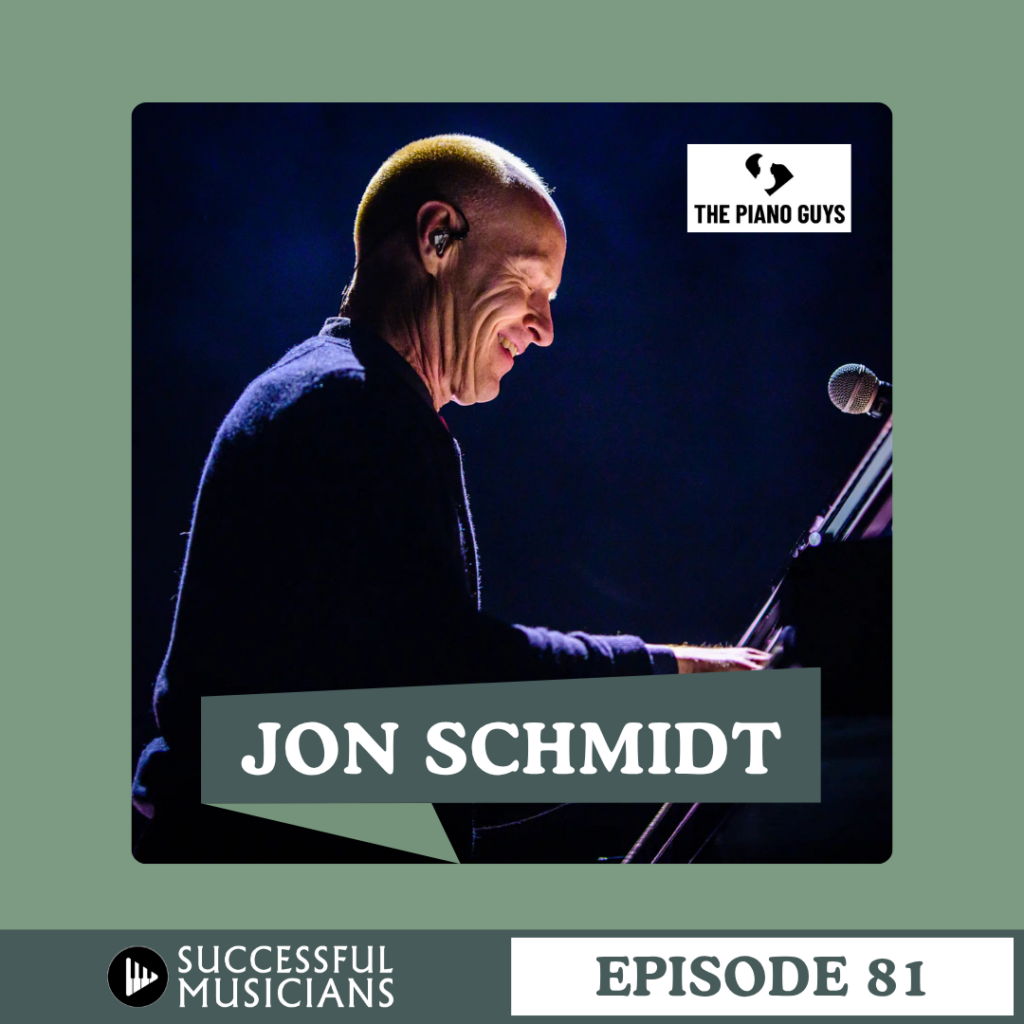
Welcome to the podcast today. My name is Jason Tonioli. I’m your host and we are joined by one of the people that I will consider a very close friend that I have looked up to for years. And frankly, I am in the music business for a lot of reasons. But one of the biggest reasons is because of Jon Schmidt sitting here with me. And it’s just interesting how life happens and things kind of interweave to get you to where we are. Jon, welcome.
Jon
Thank you.
Jason
So, Jon is, for those of you who aren’t familiar with Jon, Jon is what I would call the piano guy of The Piano Guys. You guys have had incredible success over the years. I don’t even know how many millions or billions of streams you’ve had with the videos, but I feel like I’ve had a front row seat in watching your career take off over the last 25 years and can still remember the back when we were recording at your studio and you hijacked my sessions to record things. I’m super excited to kind of talk with you and just share your story.
Jon
I know I feel so bad that we couldn’t change the name of The Piano Guys because it makes me sound really narcissistic. But we did try to change the name because Steve obviously is not a piano guy. Well, he does play the piano. He’s actually so good. He’s actually really good.
But we were named the Piano Guys because we were trying to help Paul Anderson out, who’s our buddy down in St. George. He owned a store called The Piano Guys. We were trying to help him out because he was my friend. And he asked me to make a video to help market his stuff. And then we made a few more. And then they started to take off. And then, we contemplated changing the name of the channel, but we would have lost millions of views at that point. So, poor Steve.
Jason
The cello guy. For those that aren’t familiar with Steve, he gets to play his cello and he’s even done lightsaber cello playing I’ve seen on some of your videos. That’s pretty cool.
Jon
Yeah, and sometimes the video doesn’t even have a piano in it and it’s just Steve playing solo. And the funniest comments are thumbs up for the guy that doesn’t even know what instrument he plays. It’s good stuff. We have fun with it.
Jason
Yeah. Well, it’s been incredible to watch the trajectory. Really, you’ve been at the music thing for, gosh, 50 plus years now. I’m sure growing up, even in high school, you were doing music. The first time I ran across your music was actually when I was in Argentina. And there was some missionary playing on a piano and he was using his whole arm. I was like, what in the world is he doing? That was where I first was introduced to your music, which is kind of crazy. And then, came back and when I was working at the bank, had an opportunity to sponsor your original concerts.
Jon
That was amazing.
Jason
Let’s like rewind the clock back. I’m not sure that a lot of people.
Jon
…and thank you for your help at the bank.
Jason
Well, it was great to see great talent and recognize. Let’s rewind and like start at the very beginning, though, with you as growing up as a kid playing piano, I think a lot of the times when we start this podcast, I’ll just have kind of people share their origin story, how they ended up as a musician. But I think we need to rewind way back. And how in the world did you start out with the piano as a kid? And then when did you finally reach that first moment where you’re like, maybe I can do this as music instead of having a stuffy career as a professor teaching English or something random like that.
Jon
Yeah, I was the youngest in a really musical family and it was just something that I had seen my older brothers and sisters do and it just was a given and I had a German immigrant mom and dad actually but one thing is a fact of life is that you don’t argue with German immigrant moms. You have to practice, you know.
But she was so great. She was so great to make sure that I practiced, and the first few years was not fun. It’s not fun at all. But if you have somebody helping you to do something every day, then if you have half a talent, you start to get good at it. And when you start to get good at it, then it starts to get enjoyable. And then you…It’s sort of like a kid with a Nintendo game and we didn’t have Nintendos back in my day. So, all I really had in this little house was a piano and it was my outlet. So, I’m really thankful for it.
Jason
Well, as you were playing through high school, when did you start writing songs and deciding, oh my gosh, I can improvise? Because even back then, YouTube didn’t exist. Even exist the fake books or you didn’t know what that was probably even as a kid either.
Jon
Yeah, I just studied classical. That’s the only thing that I felt like I, or that my teacher let me feel like I could do. I, if I wanted to play anything else, I had to learn it by ear. I didn’t know, I wasn’t smart enough to go to the music store and buy sheet music and all that. And if I did see sheet music, it seemed like the arrangement was always not great. It was too changed. I had a great friend who challenged me to learn Billy Joel’s songs that were coming out. Billy Joel was just releasing albums, and he would put a lot of solo pianos. Well, not a lot, but he would always include a track or two of piano songs, just him and a piano. And my friend thought they were so cool.
And the eighth graders, I was in seventh grade and the eighth graders, there’s two eighth graders that learned how to play Billy Joel’s songs by ear. And Mannheim Steamroller was just coming out with their very first musical endeavors. It wasn’t Christmas music. was just their first albums. If you look at their first albums on iTunes, they’re so freaking cool. Like they’re crazy. And like our high school got obsessed with Mannheim steamroller. It was at every dance concert. It was all the walk-in music rage when we’d go to the assemblies. And it was something that my brother, I had a brother 12 years older than me, and he bought their records. And I remember one day, and I think I was still in junior high, just sitting in his car and listening to his cassette tape that had Mannheim steamroller on it.
And I was so intrigued by this blatant mix of classical and rock and instrumental. And I was just totally captivated and inspired and Billy Joel. But then again, I wanted to learn how to play these things. I had to figure out how to do it by ear. And so had a friend that was just kind of my cheerleader and challenged me, let’s try, just try learning this like the eighth graders. If the eighth grader can do it, you can do it. And so, I would try to hear all the lowest notes and try to find them on the piano. I’d try to go back, try to hear all the highest notes and find them on the piano. And then I’d go back and try to hear the low notes in between. And I’d take it in little literally 10 second chunks like that all the way through finally learned, but it taught me so much about theory and I don’t have perfect pitch I think I am a really good example of somebody who has a smaller degree of talent that has been able to compensate or get it make it work.
You see that Jacob Collier guy? I mean, like, holy cow, you know, perfect pitch. It’s like I’ve heard of sometimes artists have what’s called the fourth cone or something where they can see extra color. He’s a musician that has the equivalent of that. He has extra musical capacity. It’s called perfect pitch. And he literally can learn whenever he’s listening his whole life. He’s been learning just because he’s been able to imagine the notes as he hears them. And it’s insane. It’s actually another level. It’s like a whole different level. So, you know, but I would say that most people in music are not Jacob Collier’s. They are just less talented than that.
Jason
Well, as you say that, I heard the analogy the other day that there’s not a lot of people who can be a racehorse. You might feel like you’re a pig and it’s that pig’s never going to be a racehorse, right? But you can certainly teach that pig to run really fast if you work hard enough with it. Right. And so, I, when I heard that, I’m like, oh, I feel, I think being willing to be somebody who needs, who learns, puts you in a place where even if it takes you 50 or a hundred years, you can continually learn and get better. I’ve loved as I’ve shared my piano music, I’m sure you get the same thing as people love working at a song and being able to learn to do that. But if you come into something with the attitude of, I can’t do that, or I’m not a piano player, I can’t, you know, when you say or decide that you are or are not something all of a sudden, you know, it kind of frames who you are. But if you take on that attitude that I’m a learner, well, if I’m a learner, I can learn learn anything.
And no matter how long it takes, I one of these days you’re going to take a piano up, I’m sure, and stick it on the moon and you’ll do the first music video up on the moon. But people would think you were crazy, but you know, the attitude of, know, I can learn to do this or that attitude is going to take you a lot further in anything you do in life, whether it’s music or anything in your career. Right. So, well, that’s, that’s amazing. So, so through high school.
Jon
That’s so true.
Jason
You started writing some stuff out. Did you start like using pencil and manuscript paper to write the music out? I mean, that’s how I started was on paper. I didn’t write any music out on a computer program for years. So, I’m curious how you learned to do that.
Jon
Yeah, I just memorized it, and I had to write something out for a reflections contest once and that was crazy. I needed help.
Jason
Did you whip?
Jon
I got the help of the school music teacher. Yeah, what really taught me a lot about how note reading and music works is when I started to teach piano at age 16 and then especially when I tried to start to transcribe one of my piano students was a computer whiz and he’s like there’s this thing you just if you just come over to my house play it into my keyboard there’s this thing on my computer that just prints it out and I’m like, holy cow. That sounds cool. He finally talked me into doing it and I think a month later we had my first book and it’s all thanks to him and you learn so much as you’re taking what at first is just the dots are kind of put in the right place and then you have to fix all of the problems. Like it doesn’t know what hand played it, for example, it just puts it all, it just gets it all. And then you have to go through and tell, tell this thought goes up and this thought goes down and timing on this is wrong. And that’s, that’s where I really learned so much about theory and stuff like that.
Jason
Well, as you do that, and just thinking through my experience, when you have to click on the dot, as we’ll call it, and make it go up or down, all of a sudden, you zero in on that one quarter of those notes that are used. And I think there’s way more thought that goes into, I mean, yes, you can memorize it and you can play it in and it’s fine. But I’ve found that when I slow it down and just hear the chord maybe you’re clicking one note at a time. There are so much more harmony and things that come out or stripping out the complicated that sometimes you just put lots of runs in and it, the beauty sometimes gets, gets lost. I think there’s actually a lot of value for musicians to suffer through that typing in the dot one at a time type of experience.
Jon
I hope you see it in a new light. Similarly, reading sheet music is a different experience than learning something by ear. The things that you realize in doing one thing versus doing the other thing.
Jason
Well, and then writing it out is a whole another level.
Jon
And then you realize other things with that, know, everything is a different perspective.
Jason
And I think, you know, as you go into the recording studio, there’s a whole another level of learning. I had the privilege of sitting on the back couch and just watching from afar a little bit several times as you were recording in songs. And frankly, to this day, I still thank you for that. You don’t even know that. Thank you for letting me kind of be a fly on the wall but watching the detail of that note’s too loud or I want that a little bit louder here. I’m going to go re-record that thing. And I think a lot of people, when it comes to music, they think we just go into the studio, and you magically play in the song and it’s just like boom, there it is.
Jon
I totally used to think that. I used to think that if I went in and punched in and fixed something, that it was not having integrity. I just realized that it’s a matter of economics to try to keep trying to get it all in one take would take so long and the stress of that would actually make the final product not be what you intended, not be what your musical intentions were. So, I think musicians by necessity have to use the tools of the studio to communicate what the picture is, what is your idea and try to make the idea happen. The question is, can I make the idea in my head happen for the listener? It’s not a question of; can I perform flawlessly? It’s a whole different, it’s a whole different interest. And I even have heard that even classical pianists that if you were to hear them play live, you wouldn’t hear a mistake. You wouldn’t hear them miss a note. But even they, when they’re in the recording session, will punch in and say, I wish I would have played that note louder. I wish I would have, you know, and they’ll, they’ll punch in. Maybe some of them are absolute purists, but that’s rare. So, and it’s an interesting question with AI. It’s an interesting question. Like literally, you know, in the old days, people probably thought it was a lie when the microphone was invented to start using that in performance. They would say, no, that’s a lie. You’re lying to me because that’s not what you actually sound like. But now it’s just a fact of life. Yeah, it’s sort of a lie, actually. The recording process is sort of lying to people. It’s, know, they believe that you played that in one take and it’s… I don’t know how to keep telling them that, that, no, that’s a false assumption. You just hope that by now people understand. Yeah. When people use a microphone, it’s a lie. You go into the studio. It’s a lie.
Jason
But the thing I’ve learned with many studio sessions is you go in with that idea, but you have the idea and you think you’ve got it figured out, but all of a sudden you have other people that have their ears and their opinions and these different ideas all of sudden start coming together. I’m sure you’ve seen that even with the piano guys where you got your video guy, the cello guy, the piano guy, you guys are all kind of collaborating on those things. As you know, in those sessions when you with Jake and Chuck and others that you’ve collaborated with, I just remember.
Jon
And then another human walks in the room. If they have a strong opinion, I want to hear what they have to say. Maybe you could edit in that. I made it sound very devious when you say when you go out into the recording studio, it’s a lie. It’s a lie of necessity that everybody has to subject themselves to. That’s the way I would say it. So maybe you could edit that in.
And there are lots of things like that in life.
Jason
So, all right, well, so I think as I’m thinking about recording studio sessions and even in life, that bringing these other people and opinions into that and being open to that as artists is important. The whole idea of being a pure one-time recording or one-time take, just, life’s not that way and neither is a great song. Sometimes you do. But I think…
Jon
Sometimes you get on tape, sometimes, yeah. And then it’s epic.
Jason
If it happens, I’ve got one or two that’s happened that way and I think you’re like, oh my gosh, that was it. There’s always that one little thing that you can tweak or make a little bit better or approach it a little bit different way, right?
So, let’s talk a little bit about your kind of as you were taken off in your career and you go through high school and you did that first book. What was that trajectory like? To starting to do concerts for people. Explain that, because I don’t think a lot of people understand, okay, you did one book, but was your goal just to share a couple hundred copies and that was it? Or did you really think this was something that people would want to play?
Jon
Yeah, I was just kind of having fun with music. I was sort of the assembly entertainer at Highland High School. I entertained on the piano and figured out goofy stuff to do and played some serious stuff too. When I got back from my mission, that I went on for my church at age 19 from 19 to 21. Somebody at Highland High School approached me about doing a fundraising concert to raise money for the school choir. If I had come back and just entertained, like, you know, a lot of them still remembered. They were younger when I was, when I was still going to school or when I was performing there. And so, they’re like, come back and perform again. We’ll sell tickets. I had written probably 20 songs by that point in my life. And I thought this will be fun. I’ll just, you know, you’d like the old times, and they sold 200 tickets and I just had recorded a cassette tape of some songs, and I thought I should go make some copies of this. So, I made like 40 copies of it, and I thought, man, that’d be so cool if I sold like two or three of these tonight. And all 40 of them sold. And I was just like, what just happened? I mean, it was just like, it was the biggest shock.
And I was so excited to think that 40 people might be listening to my music. Then East High heard about this, and they had a kid that had an accident at Lake Powell and was paralyzed. So, the whole school was rallying around this kid that everybody loved and trying to raise money for some medical equipment. And they asked me to come and perform. It was like so random. So all of a sudden here I am on a stage with a packed house and I bring my cassette tapes and again just sold so many and that was something I was just kind of doing on the side and then Olympus wanted something and then think about a year after that I rented high school and put on my own show and charged like $5 ticket and we had over a thousand people show up and then some guy heard of what I was doing from back east and he brought me out to Washington DC to perform some benefit concerts for the homeless and I sold more cassette tapes there than I did locally which I was just like that made me think I was like what is going on?
And you know, this, was just fun. Just a hobby. I did not want to be a musician. I had heard, people who had gone into music and what a train wreck it was. And I was just dead set against it. I did not want to do that to my family. I didn’t want to impose that on my wife. So, the plan was just doing it, doing it for fun. And it’s just kept growing and in somewhere in that process, I think two years after my first concert, was teaching piano to that computer whiz kid. And then we put out the book and so there was already interest. There was already like a somewhat of a name.
I’m getting confused. think I had already played at Kingsbury Hall once, because somebody said, stop playing at high schools. If you play at a legit hall where big names perform, everybody all of a sudden thinks you’re a big name. And it’s so funny because again, you’re just fooling people. You know that you’re making people think that you’re a big name and it’s a lie. You’re not a big name. But all of a sudden people thought I was a big name because I performed at Kingsbury Hall and all of sudden, KUED, Channel 7 at the University of Utah. No, Utah Symphony heard about that show, and they were looking for local artists to be included in a summer concert series that they were doing at Deer Valley. So, they had a headliner and then they wanted a few local artists to be in the same show. And they picked me because they thought I was a big name. I mean, how crazy? It’s just crazy.
And then when KUED channel 7 at the University of Utah heard about that. They’re like, let’s get this guy and let’s do a televised concert. Like I had a televised concert on KUED and I was living in a basement apartment, so poor, so not famous. It was just, it was crazy. That was like in the first three years.
Jason
Here’s one of the things I don’t know if you even recognize this, but in those early days, you were willing to go do these concerts. You were willing to say yes and go serve. And it wasn’t about you trying to be a big deal. You were out trying to help others and serve others. And sounds like you were teaching piano lessons. And it sounds to me like a lot of these original things came out of service and like even the promotional stuff. I can still remember you coming. I’m north of you up in the Ogden area and one of the very first times we interacted a whole lot was you were at a little high school for a mini concert for a piano teacher that had like 50 piano students, and they rented out Bonneville High and there was probably a hundred people there. I can still remember we were playing on stage upside down on a two piano duet together and you probably made a hundred or two hundred dollars. know, I mean, it was one of those that was if you were looking at things from a financial standpoint didn’t make any sense. I mean, I remember you coming to Roy Hi playing on the most out of tune piano and you had the most positive attitude. I mean, it was awful. Like the piano was awful. You probably remember it.
Jon
Yeah, we raised money. We raised money for lot of choirs. And it was fun. And then I would just sell, sell, I’d do it for free for them. And then I’d sell, by then, by then it had become CDs, but, you know, it’s sold CDs and music books after and, and that was totally worth it for me.
Jason
Yeah. Well, and what’s interesting is as you’re sharing this, and I guess the lesson for any musicians or somebody thinking, I want to be like Jon Schmidt and piano guys…
Jon
…at no one ever.
Jason
The learning thing is, you were serving your face off for years and years and years. I think, good things happen to people who do good things for other people. mean, it’s a thing and I think it’s still to this day, I’m sure you’d give the shirt off your back to help anybody and that attitude’s still there.
Jon
I’ll try to live up to that. Where am I? There we go. I’ll try to live up to that.
Jason
Right? So, with the, I’m just kind of fast forwarding, you had the books and you were starting to do this and I remember, I want to say it was probably 2002, sometime in there around the Olympics and I was working at Bank of Utah and I can still remember some client, was Ray Kimber came into the bank and had suggested, we talked about doing a concert for our clients at the bank and I was the marketing director there at the time and one of our clients said, hey, you should reach out to this Jon Schmidt guy and you ought to talk to this guy, Chuck Myers, he can maybe connect you with this. My guess is probably it was the same time when all of this stuff was happening with the Bravinal Hall and some of these other concerts, but first time we actually met was at a cafe Rio having lunch together with Chuck and Chuck had this grand idea that we were going to have a sponsor of your concert. And essentially if from your perspective, it was like, okay, they’re going to take…
Jon
You sure it was Cafe Rio? Because Cafe Rio was invented probably 15 years ago.
Jason
It would have been, maybe it was 2004 or five, but I can, I remember that day it was up in North Salt Lake. Chuck was there. It was first time at a cafe Rio ever. I’m walking through and it was delicious. So, you and I had my first cafe Rio experience was with you and Chuck, but his idea, and I think this is another lesson that people could learn is that getting a corporate sponsor. So, the whole idea Chuck had was, okay, the corporate sponsor can come in and essentially shoulder the entire burden of doing this concert. And so, there’s zero risk to the artist to do the concert. And all the artist has got to do is give some tickets to their clients and let them come and fill those seats.
But essentially, I think it was a brilliant idea that I think more musicians today probably ought to consider is like reach out to some of these businesses and say, hey, I’m going to do a concert. And I’ll give you 50 free seats or a hundred free seats or whatever number it is. Would you be willing to pay the thousand or 3000, 5000, whatever the venue cost is, and you make it about, you know, make a big deal about that business. And all of a sudden, yeah, that business thinks it’s the coolest thing ever. And they’re able, they’re able to put butts in seats for the concert that you needed to fill a thousand seats at. And so, they’re actually helping you spread the word with having any risk. I don’t know that concept I think was absolutely brilliant back in the day and it was a complete win win-win across the board for I think everybody when we so Anyway, I just thought that that was a very unique way to start filling seats and my hope is the bit You know being the guy on the business side. It was awesome for us. Like it was our we gave us an excuse to get people together and do an event and you know, we I think we had a hundred or so seats that we filled up for you and you could then not have to stress about nobody showing up, because you at least had people coming, right?
So as things started to progress in there, when did you go full time and what was that tipping point that made you decide, my gosh, I can make a career of this?
Jon
Yeah, well, when Michelle and I got married, I had just graduated from college and I was, my plan was to go back and get a master’s in business because I graduated in English, which can’t really feed a family. So, I was going to go get an MBA and probably do something, I didn’t know what the plan was, probably do something entrepreneurish.
We just prayed, you know, we just prayed like what would God want us to do with our life. And it was just a really clear, was probably something we needed. It was very clear and repeated spiritual nudges to do music. And it is a decision that had to be made with Michelle, it’s not something that I feel like could have ever worked if I was just making that decision and imposing it. So, I’m a huge advocate of husbands and wives counseling together about everything.
Everything is joint, money is joint. Career is joint. The parenting is joint. Like everything is joint. I just, I, there’s no doubt in my mind that we made a decision based on the question of God, what do you want us to do with our life? And I think that’s a powerful question for anyone to ask both individually and as married couple. Individually, what would you want me to do with my life? And as a couple, what would you want us to do with our life? And I do believe then that puts you in a cool place were, again, it can be an act of devotion. You know, everything can come back to trying to be a benefit to your fellow beings, which I don’t know if there’s anything more fulfilling in life than to feel like God used the work through me to be a benefit to others. And I think that is just the ultimate. I think that’s the thing that everybody is searching for, and they don’t feel fulfilled as they could.
If they take life in more of a self-centered approach, what how can I benefit myself? How can I what’s benefit any mean? You know what I mean? Being surrounded by with mirrors or you everywhere you turn you see yourself and you can switch that and surround yourself with windows or everywhere you turn you see somebody else. I think that is cool. And I think it’s cool when you sense that from a performer. We can all think of performers, but when they’re on stage, it feels like they are all about the audience. That’s their joy. That is their fulfillment. It’s all about, and you can feel a contrast when you feel like there’s a performer on stage and they’re surrounded by mirrors and it’s all about them. And I think it carries over to anything. It’s not just performing.
And I think when we discover that, that’s when we become lucky. That’s when we become, that’s when things level up, in my opinion. So, it’s like what you’re saying, then you just, your whole life becomes a cycle of what goes around comes around. Cause that’s your passion.
Not that we did it perfectly. We’re trying.
Jason
With musicians, I think of this pursuit of success. When I started this podcast, I called it the successful musician. And one of the things I’ve asked a lot of the people who I have on the show is, what does success mean to you? But it’s been interesting to get 80 plus responses from people that I would consider successful in life or successful in a music career.
The reality is, like this pursuit of financial success or pursuit of fame or pursuit of audiences or lots of song plays or YouTube video views. That, that success is like this fleeting moments, almost like somebody lifted your hand up and like, look, I got the million views or the million dollars or whatever thing it is. And that trophy winner, the gold medal that you get on top of the podium feels really good at the time. as soon as it’s over, as soon as you step off that stage,
It’s kind of like, know, and I think that you use the word fulfillment, and I think the evolution or the leveling up of that success is really when you can, you know, be filled and it does become about the other people. I think of like coaching soccer or just as parents when, you know, we’ve done that thing as a parent, but there is nothing better than watching your kid accomplish something or be successful, hand raised, you know, for whatever it is that they’re interested in or, you know, watch that your kid play, play piano in the recital and do good. You know, they worked really hard at the thing and they, they did it for me. It’s like the, the adrenaline rush or the success, I guess those, those positive feelings are a hundred times better. when I see people around me experience that, and I don’t know if you’ve seen that as well. I you talk about seeing it and make it about the audience.
Jon
Well, you know, you know who I don’t you feel like Chuck is the ultimate mentor in this? mean, like that is something you and I have that we just, I can see it in your eyes. I, you just think of Chuck and what we’ve learned from him. Is it just awesome? Like he’s a literal angel in my life. Like literal angel in my life.
Jason
Well, what I think? It’s not only the learning, but I think of like my first interactions with him and I was sitting in his recording studio on his piano. So, I mean, you can picture exactly where I was sitting at. I don’t think you were there, but I played something on the piano and I played piano okay. And I’d written a couple of reflections contest songs and I’d written a few songs.
And, and, was, but it was so interesting. Like Chuck Myers is literally, he’s working on, I think it was Toy Story 2 or Finding Dory. Like we’re talking like biggest Disney projects of the time that he’s working on. And, and I’m sitting at his piano.
Jon
He’s a genius. He’s a freakish genius.
Jason
And so if you can just kind of picture this and I am feeling so under qualified to even sit at his piano.
Jon
Yeah, same here. I’d probably relate.
Jason
And so, you can picture this. so, he was in this room, and I played this song and this guy that’s, Chuck, he’s and he’s like, says, that’s beautiful. And I immediately went and I kind of apologized for the song. I’m like, well, it’s not very complicated and it’s not this, it’s not that.
And I think a lot of times our initial reaction is when we perform, well, I wasn’t perfect or I wasn’t. And I think this isn’t just a music thing. This is just life in general is I wasn’t perfect or I wasn’t good enough. And Chuck told me, says, don’t ever apologize for your music. And I said, well, it’s not very, and I’m still trying to apologize to him. It’s not very hard. It’s not difficult enough. And I could do more frilly things. And he basically told me, says, that it’s harder to write music that’s easy to play. That sounds beautiful than it is to just write lots of notes on the page.
Jon
That’s cool. That’s cool.
Jason
And, and, and I think just applying that to life in general is like, you know what, those little tiny things when you can do the thing and just make it so simple that it feels good, not just You know, yes, it sounds cool to do the Rachmaninoff chords and all of that, but when you can like dial it back at the core of what matters with the music or even just what matters in life, you know, with family or taking time with your kids or, you talk about, you know, doing things together with your spouse, those things that actually matter, I think make all the difference. And with Chuck, I’ve watched him build people up over and over again.
I was there another time, he was working on a Dance Dance Revolution song and he would bring, you may have even been there some of the times he was doing, he’d bring in these artists to just sing, and he would make them feel like they were worth a million dollars. they’re, know, Taylor Swift didn’t exist at the time, but you would have thought that he’d brought Taylor Swift into his studio and they’d go in there singing and they would sing like they were, you know, Taylor Swift level people. And he would just, it’s amazing.
Jon
Yeah. Unreal. He brings out the best in people. That’s a cool gift. Such a cool gift.
Jason
Absolutely. I’ve always tried to learn from that and give back, you know, in watching him bring out the best in people. I think a lot of it is he helped people believe in themselves and he believed in me.
Jon
Yeah, he’s always he’s always in service mode. He’s always how can I bless this person? How can how can I use the gifts that God has given me to bless this person I’m with? He’s constantly in that mode. It’s crazy.
Jason
I’m curious, you probably, I just shared a couple of stories there. You’ve probably seen a couple of instances. mean, people can learn so much from these Chuck interactions that, you know, nobody, there’s just a few of us that get to do that. And it’s just, it’s changed our lives. Like I still, 20 years later can remember those moments.
Jon
Yeah, for sure. Just like you say, the gift to encourage, the gift to believe in yourself, the gift to value your, you know, to have respect for whatever degree of talent that you have and to believe that you can develop it and improve it and just amazing suggestions, amazing knowledge, amazing experience. I do. I feel like he is just a music genius. I’m really in awe. And the things that I’ve learned from him over the years is insane. It’s just the biggest blessing.
I feel like, you know, we’re all led to people like, you know, even that guy that helped me with the computer and helped me with that book and we became partners. And I feel like that was a total blessing in my life, a total angel. I think God sends angels into our life. And I don’t feel stupid talking like this at all because that’s another thing I learned from Chuck. He just says what he thinks and he doesn’t care if it sounds too religious. He just says what he thinks and it’s awesome.
Jason
Well, so I’m thinking of one time in particular, and this was really when I think your career really took off. If you think about the Taylor Swift Coldplay video, and I’m curious the story behind the recording of that song and then the video that I don’t even think exists anymore. I don’t think you can even find it online but share that story of how that came about.
Jon
I think somebody bootlegged a copy that’s still on YouTube somehow, but… We… Yeah, my kids were huge Taylor Swift fans, and it was at a time in history when the whole world was still listening to the radio. And that meant that the whole world was listening to the same music, which is not the case anymore. Everybody kind of has their own little whatever’s now. But there was a really cool moment when there was this unity in music. And Taylor Swift’s love story was so intriguing to my kids for some reason. They just thought that it was the coolest song ever and they would get so hyped when there was this key change and there’s hope and the girl come back and says, my dad says we can get married. I don’t know why. They were in junior high and elementary school, and I thought it was so cool. And I was seeing this new thing called YouTube and people putting cover songs on YouTube that was called acoustic covers was this thing that I was seeing people doing and I thought I got to try an acoustic cover. I just had this idea, and it was my kid’s favorite and I wanted to focus on the aspects of the song that they thought were cool and came up with something that I feel was really special and as I was trying to end it and figure out how to end it. I was struggling with the ending and I’m like, what if it, what if it went into another song? what if it went into another song that my kids like, and it was a Viva La Vida by Coldplay. And I was like, the weird, that’s the weirdest idea, but I had done it with Pachelbel and U2. And so, I had put out a song called Pachelbel meets U2 and, Steve had helped in the recording. And we brought Steve into the recording session, and he had done some really cool cello things that I didn’t know a cello could do on Pachelbel Meets U2. And by then, Steve was playing a lot on my solo shows. And he started off playing one song and then it developed into like six or seven songs. And one of them was this Pachelbel Meets U2 song.
And the audience just loved it. And we really got intrigued with this whole idea of this meets that, this meets that. know, Pachelbel meets U2, and then it turned into Love Story meets Viva La Vida. And then we did the thing, Michael meets Mozart. And we just, I remember reading something that that’s a real intriguing thing to people when they see two things that they like that are that are mashed together. so that thing that I read about it, I think, the idea and helped me think, well, maybe it won’t be so weird. And we recorded it and got really good feedback. And then we’re like, we should perform it in front of camera. And we filmed it.
Steve had started playing with a kick drum, which was kind of unusual, a cellist playing with a kick drum. And then when we hit Love Story Meets Viva La Vida, just everything got really orchestral and there was some cool bass that came in. I remember putting on the YouTube video this little thing that said, activate subwoofer now. And it’s like I inserted these little messages as people watch the song and it’s really interesting because the messages that I Rigged into the song as people were watching it. I saw other youtubers copy it afterwards You know this whole idea of after the song is over Talk about the inspiration of the song which we did we did this little tagline and I’m like a little daughter and blah blah blah We released that thing and it blew.
It went crazy It really helped that we had a mailing list of 30,000 people that we could say hey, could you guys do us the biggest favor share this link this thing that you click on and The video will start playing share that link with everybody in your email address book because nobody was really on Facebook yet So people did that Facebook hadn’t really been invented, but we got 30,000 people to do us a favor and share it with everybody in their address book. And it just blew up. It blew up overnight. All of sudden, one thing that was really cool is internet websites. Everybody had a website in those days, and people were wanting to put links on their websites, because this is new, cool thing. Just click this thing and the video starts playing. And I remember even just like this bodybuilding site put our link. And like people would leave, you know, reaction comments like, whoa, you know, all these bodybuilders, this is so cool. And then they would share it and then people would share it and that’s how things just blew up and all of a sudden.
People in Indonesia thought I was famous, which was a lie. I was a regional artist. I had a following in my region, Idaho, Utah, Arizona, down into California, up into Oregon. That was it. And all of a sudden, people all over the world thought I was famous. It was the weirdest thing, like overnight. And we were getting concert requests from Indonesia within weeks, like from all over the world. It was the weirdest thing. then, and then, we, got a message from Taylor Swiss lawyer and they said that we had done the permissions incorrectly, which we, we thought just call Harry Fox, fill out a form for love story, fill out a form for Viva La Vida. Good to go. So, we thought we were all set.
And that lawyer informed us, no, is when you do a combination that then becomes a specialized work called a derivative work, you need a totally different permission process for that, which requires permission from the artists. And we at first thought, you know, we’ll just pray that this dilemma gets solved and after trying to solve it, it just became clear that we just had to take it down and this would not solve, we would not get permissions. We would probably not even be able to get a hold of the people that could have given those permissions. it was so, it was one of the hardest things I’ve ever been through, because we thought this is going to put us on the map. And I remember as Michelle and I were praying about it.
We were comforted, like, turn this lemon into lemonade. And the coolest thing is, you know, maybe if that would have happened, then the piano guys would never have happened. We would have just kept doing it on our own and joining forces with the piano guys made things happen that never could have happened on our own. There’s no way. you bring the four partners that we had together with all of our different abilities and contributions.
It was crazy. It was absolute craziness. Three billion hits later, none of that could not have happened. There’s no way I could have done that on my own. There’s just no way. And 100 videos and it’s just, it’s crazy.
I probably would have in the 11 years that it’s been about 15 years since our first video, I probably would have been able to put out maybe 30 videos tops. 100 videos? And some of the concepts of those videos I could have never dreamed up in a billion years. It is a result of a genius named Stephen Sharp Nelson. The guy is a freakish genius as far as concepts for video. And working with Paul and he’s got pianos and he’s got money and he’s got crazy ideas of putting them on places. I never ever would have even gone there.
Jason
Well, I still remember we had a Christmas concert talking with you about our helicopter that we’d hired here in Ogden. I don’t know that you even remember this, but Chuck had actually, we’d filmed the Amazing Grace video up in the mountains up above Salt Lake. And part of that video shoot was a tribute to my dad, but we hired a helicopter because drones didn’t exist. They took the doors off the helicopter. I nearly killed Chuck. I don’t know whether you knew that part of the story or not.
He nearly died in Ogden Canyon in the helicopter. But Chuck in his effort to go serve, so Jake and Chuck and his son got in this helicopter, and they were filming out both sides of the helicopter for video because drone footage again didn’t exist at the time. They flew up Ogden Canyon and he wanted to get the mount and getting the sunset so that as you’re if you go up and down in the helicopter you could kind of create a little bit of a sunset behind the clouds and they lost as they were doing that with the pilot, they lost lift in the helicopter and they ended up falling in the helicopter and it got lift. you’d have to get the story from Chuck from what I understand, like they were basically touching the tops of the tree, the pine trees in Ogden Canyon. then the story I’ve heard, the pilot went ghost white and he did nothing but just do the regular flight up around snow base and I’m back down after that. But I remember sitting with you at the concert saying, you you’ve done all these cool videos, but you’ve not done a helicopter yet. And I want to say it was like three months later; you guys hauled the actually took the helicopter and hauled it to the Red Cliffs down. And then that one was just like, oh my gosh, he just one up to me 100 times over. That’s the coolest thing ever.
Jon
I’m glad to make you realize that I was not trying to one up you. We were driving to film that helicopter shoot on a golf course. We are on I-15 and it was supposed to be shot on a golf course. And we get a call from Paul Anderson and he says, my friend’s got a helicopter. Should we shoot this on top of a cliff? And we’re like.
Jason
No, I was thrilled. It was awesome.
Jon
So I’m glad you don’t need to feel like I’m like trying to one up you.
Jason
No, I thought it was hilarious because I was more just teasing you at that concert. I thought, well, you’ve done, because the stuff you guys were doing, it was so cool to see the success. And I was just more ingested, you haven’t done helicopter yet. And boom, the next thing we know, we got Pipponi coming out. And I still think that’s the coolest music video ever.
Jon
.
Well, unless you talk to Paul, it had nothing to do with me, so…
Jason
Gotcha. Well, I give total props to you and I was thrilled. It made my day. It put the biggest smile on my face. It would have been really cool if the I’m sure as you guys were filming that or lifting the piano with the helicopter, those straps, I’m sure I guess it would have made a heck of a YouTube video if that piano strap would have broken and you would have exploded a camera or the piano on the ground, right? That may have got more than a billion views is like piano drops from.
Jon
That would have been way cool.
Jason
Well, I’m just curious. I mean, you guys have had, it’s been so cool to see the success you’ve had. And I’m just so grateful that I’ve been a little small observer and a little small part of that. Like the music you guys do is just incredible. Chuck, obviously, Chuck and Al and just everybody on the team. I guess there’s another lesson for any musician is how do you essentially surround yourself with the right people and find those people and hopefully recognize them as they come into your life to help that? Just take your music to the next level. that’s, I think, a big key in leveling up.
Jon
Working together, you know, the collaboration with Steve and Paul and Al, but when we would get into the studio, when we’d get into the studio with Steve and Al and me, it was just so cool. It was just so cool to be able to rely on each other. Because Al has intuition that we relied on. Steve has intuition that we relied on. Hopefully I had intuition that we relied on and just the combination of the three and you know, it was just, it was really miraculous. I have to say it was really miraculous.
Jason
That’s it. Some of those. Well, it’s those special times when you realize and you kind of step back after you’ve spent all kinds of time working on something and you realize the idea that you came with to the studio just was made so much better because of some inspiration and will. I think the key is as artists being willing to seek feedback and, kind of be moldable, know, like
I do see some artists sometimes they have this idea and they’re not very easy to work with or they don’t want the input. I sometimes, I think the longer I’m in this, the more you realize, boy, if you’ll just, even if you don’t like their opinion, you should listen. just, it doesn’t mean you have to do the thing, but give other people around you the ability to give you feedback and, so.
Jon
True. Yep. Yeah, that’s a winner.
Jason
Well, so I know we’re about out of time, but with where you’ve gone, I mean, you guys have toured all over the world in places you never imagined you were going to tour. I mean, you’ve been on about every continent, I think now, right? Southern Antarctica. You guys haven’t filmed a video in Antarctica yet, correct? But what, I guess, what’s new and in the works that you have that’s coming up? And actually, before I ask you that, what’s some of the best advice you’ve received over the years from people. Let’s get that little word of wisdom from you.
Jon
I, know, one thing that really struck me in the early days, perception is reality. The way you package yourself, people will believe. And I think a lot of times, you know, people that are starting out, they, they make the mistake of packaging themselves as a startup and you, kind of have to just, you know, package yourself like you’re, you’re already arrived.
And that’s a leap of faith. But it’s the whole idea of, you know, stop, stop renting high schools, you know, start renting a Brownell Hall or Kingsbury Hall. That was really great advice. And also in the way that I designed my, my CD cover, you know, to get a professional to design it, even though I had no money and I was just dumb, you know, young kid, I could have tried to do it really lame, but that was really, really great advice. And also, fake it till you make it. I used to be really nervous to perform, especially in front of crowds that didn’t know me. And Michelle’s like, if you don’t learn how to be confident, this is not going to work. And so, you can pretend, confidence, and then it becomes true, becomes something that becomes genuine. So sometimes in life, you just got to act like you have great faith, for example. And if you keep acting like you have great faith, then it becomes more and more real. And that’s how I feel about for me to act like I was faithful or confident or fearless and it has become true over the years. I don’t know, those are just a few that come to mind.
Jason
That’s fantastic. Well, so future projects and things that are happening with what you guys have going on. You guys aren’t as busy creating dozens of videos and producing near as fast, but I’m curious what where you had. I know you guys had a message recently, not too long ago that kind of talks about where you’re at. And I think some pretty great life lessons that probably could apply to a lot of people too.
Jon
Yeah, I think this would be its worded really well. We worked on the wording of this very carefully.
“We have gotten a lot of messages lately asking if we are still doing music videos or touring. So, we wanted to take a moment to share what’s been going on. Life has a very, a very. What life has a very low life has a way of bringing of my eyes, man, I’m almost 60, of bringing unexpected twists and turns. And just like life, our journey is evolving also. Some changes are happening, not just creatively, but personally. And while it hasn’t all been easy, it’s all part of the bigger picture. We’re choosing to embrace this season, and we wanted to keep you in the loop because you’ve always been such a meaningful part of this journey.
Steve is taking a much-needed break from touring and TPG business to focus on health, family, and some special projects that we’re excited to share with you. Jon is rehearsing and preparing to return to something close to his heart, solo acoustic shows. These will be more intimate, unplugged evenings with just Jon, a piano, a bench, and you. Jon and Steve will still be doing piano guys shows together when they can. But in the meantime, check out our website for Jon Schmidt of the Piano Guys Tour dates.
Al is continuing to heal after a tough battle with throat cancer and is back in the studio doing what he loves most, songwriting and music production. Thank you for all of your faith and prayers that have helped him and his family through this difficult journey. Well, he got wrecked with that whole process.
Paul Anderson, the partner who just can’t sit still, has been hard at work with the team on building our online piano store, piano courses, to be the best in the industry. He has also teamed up with some talented arrangers with contributions from Jon, Steve, and Al to bring you some new, exciting music. Test Drive from How to Train a Dragon and Ordinary by Alex Warren.
We release these alongside Jon’s original piano solo, Reflections Entry 82, Honorable Mention, in our latest music pack. If you haven’t had a chance to explore our latest music, visit the store or check out our piano courses. We invite you to take a moment and discover what’s new at thepianoguys.com. Whether it’s a full-scale TPG production or a quiet solo piano moment, our mission stays the same, to uplift, connect, and bring joy through music.”
So, there’s the polished answer to your question.
Jason
Polished answer. Well, it sounds to me like we need to get you up to Chuck’s studio and one of these days we need to get some people to come listen in the studio. That’d be about the coolest experience I think for anybody to come hear some of these songs where they actually happened. I don’t know whether Chuck had let more than a couple dozen people in, but that would be an incredible thing for somebody to experience.
Jon
Well, going forward, just feel like, you know, if I can just be content and I really, read something about Donny Osmond. was a short summary of a recent interview that he did where he’s like, you know, I’m content. I don’t feel like I need to. I don’t feel like I need to chase anything anymore. And it was so cool. you wish that. You wish that for so many people that you’re like, like, I wish that for Taylor Swift. I do. I wish that she could, she can someday get to the point where she’s like, I am content. I don’t need to chase anything anymore. And from now on, just ask God, what do want me to do today and enjoy it. And enjoy it it’s big or if it’s small. If you decrease, be content. Who cares? Like if I cannot be content with what has happened with the piano guys that exceeded my expectations a hundred times. A hundred times. If I can’t be content with that, then I have a problem. I have a problem.
If I am just forever here in my 60s, crap, you know, now AI doesn’t share our videos like people used to share our videos and it used to explode. Now AI just, you know, squelches everything. We used to sneeze and it would go millions of hits, you know? And should I just sit there and whine and say, everything’s going down, everything’s going down.
Well, just who cares? Who cares? Just what does God want me to do? Be content. That’s my future plan. And one thing I do feel is that I feel like God has provided creative pieces of art throughout my 35 years of recording. And I feel like each one, each time an artist, like a painter paints a picture, it has the power to be a benefit to somebody. And I feel a stewardship to try to help people to benefit from these works of art. You know, the things that I did before Piano Guys, nobody knows about it, relatively speaking. And I feel like if somebody found something that I feel like was a gift, an artistic gift, and they find it today, it’s as if it’s brand new. And it can, if it inspires them, that is a big deal to me.
If something that I created can inspire somebody. That is really exciting. I think it’s really exciting if something I do makes a sad person smile. No matter what it is, whether it’s if they listen to a song that I made or whether I was able to buy somebody something in the checkout line or throw my credit card in somebody’s gas pump, whatever it is, that’s a big deal to make somebody smile.
And we need to have that. I think everybody needs to have that belief that it’s a big deal to make somebody smile. It doesn’t matter that you, you know, I think so many people say, well, unless I can make a million people smile, it’s worth nothing.
It’s such a fallacy. Such a fallacy. I think we need to get to the point where it’s if I can make one person smile. It’s a big deal. It’s a big deal. So that’s like what I’m kind of praying. know, what can I do each day to, you know, what does God wants to do? This is a great question. It’s a powerful question.
Jason
Yeah. So one of the biggest blessings I’ve had in my life is, been helping some amazing people down in Costa Rica, create this basically a tour company. do group trips and, and help people. You want to see smiles on people’s face, put them on a river raft running down a river through the jungle in Costa Rica. mean, that’s, that’s been one of the coolest things ever to see that smile. But as I, as you’re telling that story,
In Spanish, oftentimes people will say gracias a Dios, know, thanks to God. And I was, I was down there and I think here in the U S I feel like people almost take the Lord’s name in vain. You know, it’s just one of the, bothers me the way we say it here, but down in Costa Rica, they say gracias a Dios, thanks to God. But as I was walking down there, this is a couple months ago.
One of the guys was trying to say translated into English and he kept saying, thanks God to say, thank you. And it was just like little things. was just, it was one of those where he was literally, he was genuinely saying, thank you. Like this bird would fly by and he’s like, thanks God. You know, was, it was the coolest thing. And it was, and I don’t, I’ve never seen that with how people do that, but he was literally like having this like little prayer of conversation. And I’ve heard, I’ve heard that.
Jon
I love it. That’s so cool.
Jason
The other thing is I had a, somebody was, you know how when you walk around and you say, you hey, how you doing? And you know, everybody, I’m doing good. You know, I heard the coolest answer ever. I honestly think this is probably how I feel you would answer if somebody says, how are you doing? And this person answered blessed and just left. It was one word, like mic drop. Boom. I feel I’m blessed.
And it’s not that I’m doing good or bad, it’s just blessed and recognizing. I think throughout this whole conversation, I think one of my big takeaways is just being grateful for the things we have in our life, both the good and the bad, the struggles, the people that come in our life, both good and bad. They help shape us into who we are. And just being grateful and thankful for those things and recognizing the blessings.
You know, I’m hearing that just throughout our conversation is, you’ve, you have been blessed and you’ve been blessed to bless millions of people. But I think what’s so cool is you circle that around. And it’s like, if I can just touch one person and make a difference to one person, that’s a big deal. That matters.
Jon
Yeah, it’s fun. really is. And I think, you know, it just becomes a question of, you know, being directed so that you don’t wear yourself out. You know, I guess that’s the biggest thing that I’m trying to figure out. But it’s so cool because Paul and Steve and Al, I feel like we’re all on the same page. We want to…
Figure out what does God wants to do, you know? And you know, we’ve got health challenges, both personally and in our families. We’ve got all kinds of things to consider. But at the end of the day, that is something that we feel united on as the piano guys. And it has supported us. It has been an anchor for us. And going forward, we feel like we’re being really prayerful. And we can be totally that gives a lot of peace I think that gives a lot of peace
Jason
Well, just as another thought that, so one of the things I feel like with music and just in life, I think it applies to what we just talked about. I feel like we’re given these little nudgings or inspirations. I you called it nudgings earlier to do something. And oftentimes when we get that little nudge or the idea or the song idea that pop, you know, a little melody that pops in her head. Most people might hear a melody, but they don’t go sit down at the piano and write it down, even if it’s just two or three notes. And I’m curious on your perspective of when God gives us those little moments or that little inspiration, I think he’s almost, this is just philosophy of Jason. I think he sometimes tests us to see if we’ll do something with that little idea. And it might be the most insignificant idea. It might be putting the smile or just smiling at somebody on the street. But if we do that, I feel like it’s almost like he could trust us a little bit more and a little bit more if you’ll listen and you’ll do the thing. I’m just curious as you’ve had all of these different creative things, what’s your take on how, I guess, God or the universe, whatever people believe, when we get that little spark of inspiration, have you seen that happen in your life where it layers on and it does level you up or adds more to it?
Jon
That’s cool. I guess I guess it Yeah, I guess you’re right when you when you act on it and you get you can position yourself to take six tape or to expand Yeah, I don’t know if God ever acts upon us, you know, this makes us feel like we’re free and that he’s not acting on us or, you know, watching over our shoulder. And I think that’s why he changes up his influence. Like he’ll do it this way, and they’ll do it that way and they’ll do it this way. So, you can’t pin him down. You never feel like you’re getting… You can figure him out so that you always feel free. It’s always… I don’t know.
Jason
Absolutely. But he eventually gets us there, I think all of us in our own time and some of us choose to take longer. But I think what’s so cool is he knows, you know, we have kind of infinite potential, and he believes, they’re like, there’s belief in us. Right.
Jon
Good. And you’re never going to run out of chances. I just, I’m a firm believer in that. know a lot of people feel like there will come a time when God says, opportunities gone. know you still want to progress, but that door is closed. You know, I just don’t think that’s ever, ever going to happen. That’s my belief. I know it’s not official. I don’t think God has even made that very.
I think he’s made that, left that ambiguous to kind of motivate us just in case, you know, help us get us to do our best. You know, he did say, depart, I never knew you. Yeah, I guess some people really need to hear that because believe it or not, some people actually love evil. And those people, think, I think when the heart is hard, when the heart is hard, God confronts. When the heart is soft, God consoles. That’s what I believe.
Jason
Yeah. Well, and he can do amazing things with every single one of us. despite of our amazing looks and our amazing hair that we have, he can do a whole lot of things that we would have never believed were possible if we’re just willing to kind of be led by the hand.
Jon
Exactly. But I do feel like I’ve been acting like I’ve got all this down. These are just ideas that I’m exploring, I’m trying to investigate and hopefully master. But yeah, I feel like I’ve been a little pompous in throwing out these ideas like a know-it-all, so I apologize for that, but…
Jason
I think we’re all, everybody’s figuring stuff out, even the most experienced and knowledgeable people. think the more you learn, the more you realize you don’t know very much.
Jon
And talking is an act of trying to figure out what you think, in my opinion. nursing.
Jason
Yeah. Well, Jon, I think you’ve shared some amazing wisdom, you know, for being a guy that couldn’t click in the computer and do your own sheet music. You’ve done you’ve done all right. And I think there’s some amazing words of wisdom for any musician and just human being in general. think I think that’s what’s so cool with what you guys have done is it’s the music has been your medium that you’ve been able to share. But the life lessons of being just a good human being. You can’t help but feel that and learn from how you guys have done things. And so.
Jon
I’ll to live up to that, Jason. Thanks. Same to you.
Jason
So, but thank you so much for taking time to share. Go check out The Piano Guys. If you’re not familiar with these videos, you got to go look at the Piano Guys on YouTube. Their music’s phenomenal. And Jon, I can’t wait to hear some of these new projects that you’re doing.
Jon
The thing I’m really excited. I’m trying to create like, like if I was an art painter and I had created like, you know, 50 paintings that were sitting in my house, I would want to get an art gallery. That would be my dream is to set up so that people walk in. What’s the first painting they see? What’s the second painting they see? What’s the third?
So, I’m trying to create that on Instagram because Instagram helps, is the only platform I’ve tried TikTok, I’ve tried YouTube shorts. Instagram is the only platform that lets me do the ideal scenario. And so, if people would, I would love it if people would visit it. It’s my own private Instagram.
It’s the piano guys, Jon Schmidt. And I just started this whole approach of, you know, come into my listening room. I’m to play a little tune today that I wrote 20 years ago. And as you listen, here’s the background. it’s like, you know, just like gives the background as you’re, as you’re listening to a 90 second clip, which is so cool. Instagram lets me do a 90 second clip. And I know people will say,
That’s insane. You know, nobody’s going to listen past eight seconds. Guess what? I don’t care. This is what I feel inspired to do. This is what I, this is where I feel led. And I feel like I have a chance to help those early songs be discovered. And I feel like they were gifts. I feel like every song that we are given that that we create with these gifts that God has given us with is something that can bless somebody’s life. And so, it’s not something that’s going to make me any money. I don’t even know if it’s going to make me very many followers, but it’s what I feel I should do. So, there you go. That’s my passion right now.
Jason
Well, and even if it just reaches the one person that matters and I can tell you that again, I am, I am doing what I’m doing today because you took time to, to focus on me, the one. thank you. So, thank you so much, Jon. This has been awesome. It’s been so fun to catch up with you and thank you for continuing to share your, your gifts and just, you know, serve and others. Thank you.
Jon
And now you bless some lives, brother. That was fun. Thanks, Jason.