
Successful Musician Podcast Episode 57
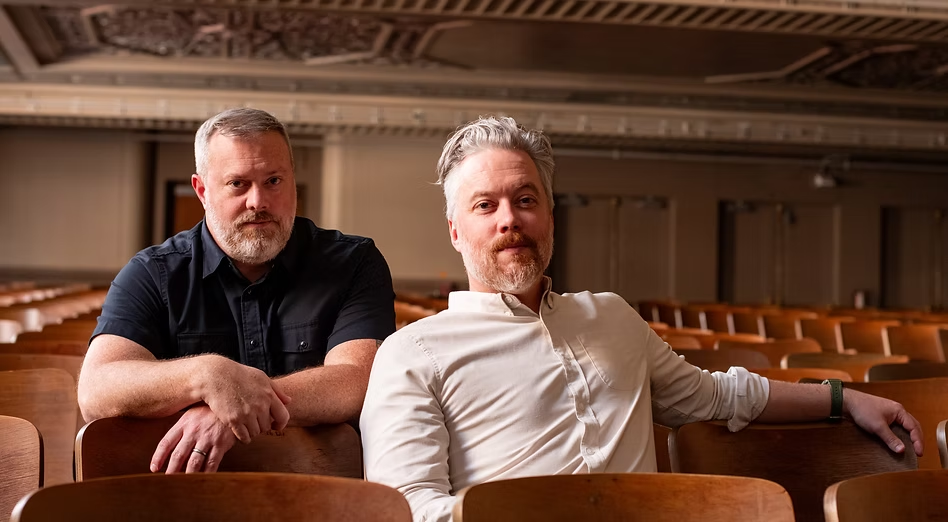
Interviewee: Will & Brooke Blair
Interviewer: Jason Tonioli
Jason Tonioli
Welcome to the podcast today. My special guests are Will and Brooke Blair, the brothers that are doing some amazing music for TV and film. I’ve actually had a ton of fun diving in and listening to your music, Will and Brooke. It’s one of those where you’ve got some really exciting, I don’t know whether you call it thriller or just really awesome, draw you in and cause some suspense. But then you’ve got quite a bit of other variety of music. I’m excited to chat with you guys today. So welcome to the show.
Will Blair
Thank you for having us. Thank you for having us. Happy to be here.
Jason Tonioli
So one of the places I like to start out with everybody, because One thing I’ve learned with, especially with composers that are doing music for TV and film, is it’s almost like you guys don’t come out and aren’t out in front of people. A lot of times there’s not a lot of fan following because people don’t know. They hide the musicians behind the TV and the actors get all the exciting attention, and then the musicians actually that made the film awesome are like an afterthought. Tell us a little bit about where you guys came from and how you got started with music, first of all.
Will Blair
Yeah, we are, in fact, brothers. We’re very close in age, so we were great apart growing up. I don’t know, we caught the bug, like a lot of kids as 9 and 10-year-olds, just wanting to just fall in love with rock and roll and taught ourselves. My primary instrument started as drums and eventually led to piano. Brooke naturally took directly to the guitar, and so that includes bass and Banjo and anything stringed. Brooke is a lizard at. But we put our bands together in the basement. Brooke had an older band with his buddies. Our band got to open up for Brooke’s band, and this took us through junior high school, high school. In college, we really started looking at working together and working with each other’s strengths at that point, taking it much more seriously. We found ourselves touring quite a bit, learning to record to a certain extent, and really giving a run for self-produced independent touring artists that could hopefully release something once a year and tour behind it. We had some success with that and a lot of great experiences. I think that a lot of that applies to what we’re doing today with film and television.
Will Blair
Throughout all of that, I think we loved movies. We grew up loving movies. We grew up loving the big classic film scores, John Williams’ music from ET, Star Wars, Indiana Jones, et cetera. We got into some smaller, weirder television shows and scores, Twin Peaks, the original TV series David Lynch, like 1990. That was a pretty influential score for us in that it sounded completely different and smaller and weirder and more intimate than these big John Williams scores. So always a love for music and movies, and With a focus on touring and performing, we always try to meet and stay in touch with young filmmakers as well. The most recent film that we were part of, Rebel Ridge, is out on Netflix right now. That filmmaker, Jeremy Sonier, we were fortunate enough to grow up with, so he was part of this. As he was off learning how to make movies, we were learning how to play music, and he has brought us along to score all of his movies, this being his fifth that we’ve been a part of. Jeremy really got her foot in the door and helped us transition from performing live to being in a band, and writing songs, helped us both on the creative and business side, transition into writing exclusively for film and television.
Will Blair
That was about almost 15 years ago at this point.
Jason Tonioli
Wow. And so did your mom have to force you guys to practice your instruments? Were you guys one of those kids? No?
Brooke Blair
Not at all. I think we both had the typical piano lessons as little kids. That didn’t really stick. Yeah, we played in the band in elementary school. I was trombone, and were you tuba?
Will Blair
I literally pretended to play the tuba. I didn’t learn to read.
Brooke Blair
That just wasn’t as exciting as picking up a guitar or a synthesizer or a drum set. I don’t think… Yeah, it’s like once we discovered those types of instruments, we pretty much locked ourselves in the bedroom and basement and just made our own music. Making our own music. Will learned how to… Will took the educational side a bit more seriously than I did. He can read and write, and I just taught myself by ear. So two wildly different approaches. But yeah, I think we learn the most from playing in bands and then being in a room with our friends and putting a cassette on and trying to figure out the parts and use your ear to hear it and what’s the bass doing, what’s the guitar doing, and just learning stuff that way and then recreating them with our buddies, essentially like little cover bands as kids. Then learning how to book our own shows and do our own recordings. All that was pretty much just a self-taught journey.
Will Blair
But it’s funny, your question about mom, she was… Bless her heart. We were fortunate to have these awesome supportive parents. Her catchphrase was, Go in the basement and be creative. So get out of my hair for a little bit and just go entertain yourself. That’s what we had to do, and that’s what we did. Later in life, as she realized, Oh, these guys are really starting to take it seriously. In some ways, they’re not half bad at it. You know what I mean? She really encouraged us to think about, how do I say, a real job and have music be a hobby. She really wanted, and this is just coming from a perfectly understandable motherly way, just wanting more stability and financial success. We were stubborn enough to just, A, stick with it in some way because we loved it so much, but B, we had gotten to the point where we really didn’t feel like we knew how to do anything else. It was a little bit of like…
Brooke Blair
There’s no plan B.
Will Blair
Yeah, there’s no plan B. Maybe we can prove mom wrong. At a certain point, we got to the point in our career where I think she was very proud of where we ended up, but it definitely caused a lot of anxiety for her over the years.
Jason Tonioli
I find it interesting. So a lot of musicians that I interview, they’ve I’ve been at it for a lot of years. And you guys have been doing the TV and film stuff for, what are we, 15, 20 years, almost 20 years now?
Will Blair
You’ve been at it? Professionally, about 15 years.
Jason Tonioli
15 years. And so I find a lot of People are like, Oh, I want to be a TV or film composer, and they have this idea. I think it’s easier than ever today to be able to get sync placements just because there’s more TV shows and movies being made than ever in the history of ever out there, which is awesome. But I think if you guys could rewind back the clock and go talk to the 20-year younger version, or maybe in the 30 years ago, as you guys were getting, go give yourself advice. If you’re thinking, Okay, I’m going to go to this point where I’m going to do the movie composing or what you’re doing, what advice would you have for yourselves to say, Focus on this or don’t? What advice would you have?
Will Blair
Yeah. Rick, I want you to discuss the recording engineering side of it in more detail. That’s whatBrooke does a lot of. I think we came up in a time where you save up every single dollar you can make in hopes of getting to go to a recording studio, give all that money away to an experienced engineer to make a CD. I think the speed in which we’re expected to work and just the amount of work, the amount of overdubs and tracks we need to produce quickly, we have to go record and engineer and mix, produce ourselves. Maybe I wish we got started on that earlier. I also think just, which applies to what we do today, seek out partnerships. You can do as much as you can on your own as well, but find collaborators, people in school or in your neighborhood who find your people who are doing something similar or completely different. Try to find as diverse of a set of musical experiences as possible and forget about genres, forget about what scene you’re in. Forget about maybe the optics of it for a little while. I know today with social media, that’s a huge part of it.
Will Blair
But if you could just try to gather as many varied musical experiences and relationships, that’s going to apply, I think, to a successful career composing for film and television, because we’re asked to do everything from dark, orchestral stuff to to recreate a hip hop song, to get hired for a western. Now we’re having to think about banjos and Appalachian-inspired things and Bluegrass-inspired things. Just having as wide of a set of experiences as possible, I think, is helpful for film and TV composition.
Brooke Blair
I think Will already mentioned the tech side. I think that was something that we had a lot of on the job, just learning, figuring it out as we went along. First couple of movies maybe We’re a little bit bumpy in that regard. But nowadays, most colleges have recording programs, and everyone, if you buy a computer, you’ve got recording software there. Those getting your feet wet in that sense, it’s a bit easier than when we were coming up. But I think spending the time to really figure out the recording process, engineering, we get what’s called a package deal, and that just means here’s your budget to pay yourselves, to pay musicians, and then deliver a completed mixed score that’s stemmed out and ready for the dub stage. There’s a big tech aspect of this, too. It’s more than just the writing sites. You have to be able to do a little bit of everything.
Will Blair
Or create that within a partnership. If that’s not your strength and your skill set or your interest, then partnering with someone who can help deliver that from the tech side and you focus on filling in whatever gap you’re interested in. LikeBrooke said, I can’t mix and deliver anything. It would sound like a box of rocks coming from me. SoBrooke does the final mixing. As Brooke mentioned, I’ll read and write and orchestrate at that level. Our levels of experience and interest are just very different in that regard, I think, so we can cover a good bit of ground. It’d be tough to do a full feature film by myself, for example.
Jason Tonioli
Yeah, interesting. You talked It’s great. When you think about the relationships being super important and just getting out of your comfort zone. I look at a lot of the younger generation today, and they want to just text and head down on the phone a lot of times. There’s a lot of talent there, but I’ve noticed in watching just even some of my kids that the comfort level of talking to people and just actually having relationships and getting around people is something that’s… I don’t know whether it’s a COVID thing a little bit, or it very well could be, I think, with some people. But talk a little bit about building relationships or how somebody would go about finding these producers or the directors. If they want to get into that, how do you even approach or even find, I guess, to start? You’ve got the film festivals. I mean, explain a little bit about that world, I guess, for our listeners here.
Will Blair
Yeah, I think from a getting the work perspective, there’s a few from a getting the work perspective. A few ways, and I think ours was relationship-based, again, specifically with Jeremy Sonier, a very talented kid in the neighborhood, essentially, who went on to study film at NYU and then start to make short films and now making big Netflix hits. Staying in touch with him, building a vocabulary with him. Jeremy doesn’t talk about music very succinctly, but he does know exactly what he needs on a scene-to-scene basis. He helped guide us and coach us through scoring our first few films. Like I said, if you’re making music in your town and you’re still in school or you’re getting into college or something, I guarantee you there’s a like-minded here that’s exploring film, that has aspirations and dreams of not being on stage playing music, but shooting films, shooting TV shows, shooting even commercials. Also, it’s not just film and TV anymore. Just think about all the content on your phone, little promotional videos, a lot of little creative short form media content. All of it needs music, whether it’s sync or something original. Getting to know the kids that are interested in film, you can still play in your band, you can still write your own songs, pursue a songwriting career.
Will Blair
But I think always keeping your ear out for who’s interested in movies, filmmaking, and creating friendships with them early on. That’s how we did it, at least.
Jason Tonioli
Got you. Earlier, you mentioned being willing to dive into different areas and different instruments and being willing to do that. I’ve heard it sometimes described as being a chef in the kitchen, and you’re learning to test out the different flavors and cook with the different things that you have. Actually, fairly often, I’ll talk with musicians and the whole idea of, Oh, I don’t want to sell my music, or I feel like I’m selling myself out if I don’t stay true to who I feel like I am. I’m curious what advice you’d have for that musician that thinks, Oh, I don’t want to become commercialized. It’s just this personal thing. What advice do you have for that type of musician or somebody who’s living in that headspace, I guess?
Brooke Blair
That’s a great question. I think for us, that actually crossing that line was fairly easy. Playing in a band is going up. I don’t think we ever found one particular style that just checked all the boxes for us. Every band that we played in, every project that we’re part of or session work we did, it was when one project ended, the next one was completely different. We would just try a new style out and never really settled in on one thing. What is really exciting about scoring the picture is that every couple of months Unfortunately, you’re out of a job, but that means the next one can be so different from what you just did. We get to constantly reinvent ourselves, and it keeps it fresh and exciting. I think the hardest part of that, though, is killing your darlings and letting go of the control of it. You really have to be ready to just move on from a piece of music that may have taken you three days, and then one quick email, it can be shot down. I think part of it is just disconnecting emotionally. If you sit there and write a song that really comes from your core, and that means everything to you, you’re going to hold on to it really tight, and then you really cannot have that approach in this field.
Brooke Blair
It’s more about doing whatever you can to serve the story, and you don’t have the final say. You’re part of a much bigger team. That keeps it exciting and fresh, and directors and producers will push you out of your comfort zone, and we will push each other out of our comfort zone. There’s a lot of new ground that we find in that approach.
Will Blair
But I think what you described in what I would guess might be younger musicians, where a lot of the best ideas come from younger imagination. There’s still so much possibility, and there’s less responsibility. That is a great time in life to create. But it does sound like that mindset of I want to do my thing, stay true to myself and not sell out is a comfort. It’s “I want to be in control of it”. I want to play when I want to play, and I don’t want money or expectations or hiring practices or anything. Sort of getting in the way of this thing that I need to tightly control. We do get asked this from younger musicians who have an interest in the process or the business of writing for film and TV. They’ll say, But it sounds like the director is telling you guys what to do. What if you don’t want to do it that way? There’s some truth to that. It is a very collaborative, hierarchical, work for hire situation. It is not someone coming into the studio and telling us what to do. The best relationships in this especially between a creative director and a composer are very, very trusting, very collaborative, very wide open.
Will Blair
But what it does do is, like Brooke said, gets you out of your comfort zone, and you are going to be asked to do something you would have never thought of on your own. You’re able to explore. Maybe to a younger musician, it feels creatively stifling. It is the most creatively wide open and challenging place to be. That doesn’t mean every single idea is going to work, and that doesn’t mean you’re going to be wildly in love with every single idea you come up with. But it will be a small part of this much larger hole in this much larger collaborative process. That’s super when it works well, and for us, we’re fortunate that it does. We do have good, healthy relationships in this business. We haven’t worked with a bunch of jerks. It’s an awesome place to create. I think it took some of the musical maturity and just emotional maturity to say, Hey, let’s disconnect ourselves emotionally a little bit, like Brookes said, from every little idea being so precious. Let’s just open ourselves up to working with this brand new medium of film and television.
Jason Tonioli
It’s interesting as you’re talking through that. You talked earlier about that team, just finding other people or partners to complement what you may or may not be good at. But I think what I’m hearing is this coachability or teachability in that collaboration. Maybe humility is the better word for it. Is just recognizing that you’re good, but that somebody probably can bring you a good idea. I was reading a… I ran across this. It was the word humility. I don’t know how much you got it. The word humility comes from the Latin word humus. When I saw it, I’m like, Oh, my gosh, that’s so good. Humus is really fertile soil, right? You’re a gardener. If you take the Latin word humus, it’s where humility comes from. Essentially, it’s somebody who’s willing to be willing to grow and just be that fertile place where if there’s a really good seed put in there, it’s going to thrive. I hear you describing that, and I think that’s some incredible advice, actually, not just for musicians, but just for life in general, is being willing to see the value that every single person can bring to a situation and help you Knowing that that seed and that plant might be the thing that gets all the applause and gets noticed, right?
Will Blair
But it wouldn’t be there without the support of the fertile soil in this metaphor. But Yeah, there’s something really exciting about how many different disciplines of art go into making a movie or making a TV show. Listen, even making a two-minute commercial. That’s as corporate and sell-out as it gets, but it’s the exact same filmmakers that are doing your favorite Netflix show. They’re also paying bills by pivoting into a health care commercial or a political commercial or something like that. You got to pick and choose what you want to be a part of. But it’s all the same. So many different folks from different artistic backgrounds crowns coming together with one vision. It’s exciting to be a small part of that or a big part of it in some cases with the music.
Jason Tonioli
I’m curious. If you scroll through your web page, you’ve got all these crazy projects you’ve worked on. I’m curious about each of you, if you were to pick, and I’m sure you have multiple moments, but if you were to pick one project in general that you feel like was that most memorable, you just felt like everything was clicking, and I’m curious, and it was a success. Maybe you share a little bit about that situation. Then what do you feel like made it feel so successful to you?
Will Blair
We definitely don’t agree on everything. We probably would agree on two of these films.
Brooke Blair
I don’t feel at home in this world anymore.
Will Blair
I don’t feel at home in this world anymore. It’s a Netflix original. As I mentioned to you before the call, Jason, our oldest brother, there’s three of us. He is a fan of music, but quickly veered when we were young towards filmmaking and acting and writing and directing. His name is Maken. Maken Blair, this was his first director feature that he made for Netflix. He wrote everything. He was able to cast Mom and Dad as small little parts in the movie, which made it very special. He invited us along. It was the first big family project that the three boys got to work on together, that movie went off to the Sundance Film Festival, and Maken actually won the Audience Award for Best Narrative Feature that year at Sundance. The whole family got to go and celebrate the effort. But we got to see Maken stretch in so many different ways. We got to see really how movies were made. We got to be on set for a couple of days. Then he was actually a big part of helping us compose. This does not always happen, but just because of the connection there, he was in the studio with us for at least a full week or so and helped encourage us to improvise and try this and try that.
Will Blair
That score itself resembles some of the mixtapes that we grew up with, that Maken would make, that we grew up with listening to, which are just all over the place as far as genres go. He had us doing really dirty, sludgy metal stuff and weird loungey stuff. We had a baritone saxophone player, psychedelic stuff. We had a theremin player.
Brooke Blair
Soul.
Will Blair
Yeah, it’s an old Motown soul flavor. It’s all over the place as far as feel and genre, but that one was special to us for sure for that reason.
Brooke Blair
Yeah. I think we may have touched on this earlier, too. Jeremy’s second film, Jeremy Sonier’s second film, Blue Ruin, was really special. That’s the one that got our foot in the door in the industry. It was a big surprise for all of us because it was a very small, low budget film. Jeremy and his wife, you can put their whole life savings into it and utilize every location they had at their disposal. It was a very scrappy production, but very artistic approach and a very streamlined, muscular story. Our older brother started making it as well. We did the music. That was our second feature. Once again, a lot of on the job learning with that. They went to the Cannes Film Festival and won some awards there and brought some attention to Jeremy and then in turn, us as well. That was another one that we had two weeks to score, and Jeremy was in the room for every single note that we played, and he was guiding us through that. We’re learning a lot and figuring out what a director is, how they look at film and how they are going to look towards the music to help tell the story.
Brooke Blair
It was just, number one, a huge learning experience, but then also helped us get started. Then that On the strength of that film, we started talking about maybe we can leave our day jobs at this point and maybe a little premature, but also a necessary step, something we had to do to get to the next step. Managed to get some work because of that film. I think other younger filmmakers were very excited about, number one, the film, but also the story of how the film got made. I think people were excited to work with us because of that. That was another special, like another milestone.
Will Blair
It wasn’t glamorous at all, despite it being a life-changing project for us, but it was two of the hardest weeks ever. Two weeks is not really ideal for scoring your first feature at all. But we had to put our heads down and trust some A lot of improv that we grew up doing together and just trust our collaborator, the leader of the whole thing, Jeremy. But he literally slept on our couch for two weeks, woke us up at 6:30 in the morning and said, We’ve got 12 minutes. It’s worth of scenes to do today, and we’re not going to sleep until it’s done. I remember sleeping on the couch, and you walked in at 6:30 one morning, and I said, My eyes are still closed. I said, Brooke, if This is what it’s going to be, I don’t think I want to do it. I think I’m ready to quit. I opened my eyes and it wasn’t Brooke. It was Jeremy, the director of the movie, waking me up. He said, Well, right now, it’s not an option because we’re going to the Cannes Film Festival in a couple of weeks. We got it. I think in that and being able to celebrate that, getting through that together is what really makes each film exciting to dig into.
Jason Tonioli
I think this would be an interesting perspective to get from you guys. So you’ve worked with several directors over the years and done a whole bunch of projects. So if you were giving advice to maybe the directors, and this would be good advice for anybody in the music side trying to work with directors, what can a musician do for the director, whoever the project manager, person in charge would be, what can a musician do to help that person be successful? And what makes a great partner from that side coming to the musician?
Brooke Blair
I think a lot of… Every film is different. We have to develop a new language with the director and sometimes the producers as well, because there’s very few directors that can speak in musical terms. There may have been a couple that are a little more proficient than others, but nine times out of 10, you have to figure out how you’re going to discuss what needs to happen. That’s more of our job is to… Translate. Translate and be the conduit to figure out these ideas. I think encouraging the directors to really just share almost the same information they would share with an actor. Like, what’s the motivation for the scene? Where are we trying to get from A to B? What needs to happen? The arc of any given scene, then also the film as a whole. Just speaking more emotionally and the subtext, what are we supposed to be feeling here? They don’t have to lay out, Oh, the instrumentation should be cello and piano and clarinet, or it should be this tempo or that tempo. That’s for us to figure out. But the more information we can get just about the feeling and the emotion is the most important thing.
Brooke Blair
They can speak about that, and they know the story inside out. They’ve lived with it for probably several years at that point that they’re working alongside a composer. They can really give us valuable information. There’s nothing musical about it, and we can take that and run with it.
Will Blair
I think in lieu of saying, Directors should really improve their musical vocabulary, I think they’ve got their hands on so many different things that I think would be more efficient, would be for young musicians who are serious about exploring a possible career in and writing music for film and television to develop more of a film vocabulary. To remove yourself a little bit from the personal nature of making music. It comes from an unknown place inside of you. It’s your own personal idea. But remove yourself from that for a little bit. Just remember, you’re a technician, you’re a part of this team. We look at it as like you’re a craft person, and you just have this toolbox full of your musical tools. Young directors or experienced directors would be very impressed with an emerging young musician who has an understanding of just the basics of what goes into making a movie or telling a compelling story. So read screenplays, look at behind-the-scenes videos on how directors think, look at what goes into blocking a scene with certain actors and discuss things like, like Brooke said, motivations, what are the stakes, the three-act structure. We find ourselves not talking about music when we get together with directors.
Will Blair
It’s more just emotional things, narrative things, character-driven things. I think having a true love for film helps us in those conversations.
Jason Tonioli
Awesome. I know we’re getting about out of time here, but curious, what is the best advice somebody’s maybe given to you over the years that you feel like, okay, that was, if I look back with whatever advice it was, What’s the moment or the person and what’s the story behind that advice?
Will Blair
A little full circle is after this two-week marathon of scoring Blue Ruin. Again, this is our second movie score, but the first, that was a wow. This is going to go to some festivals. People are going to see this. We asked Jeremy, the director, Man, that was a whirlwind. What just happened? I think we got through it, but what could we do better next time? And his comment was basically, he’s like, Musically, you guys have what you need, but just the tech, recording, engineering, proficiency in whatever DAW you’re recording on or 8 track recorder that you’re recording on, whatever your tools are, just being as quick and as proficient as that, just so that maybe that becomes second nature and you can focus more on the creative side of things. We took that very seriously, and Brooke, most specifically, has become the engineer, the mixer, the pro tools guy in our operation. That was the best bit of advice that I think really stuck with it. Yeah.
Jason Tonioli
And, Brooke, do you have any other- I think he took it right out of my mouth.
Brooke Blair
I mean, that felt like a challenge. That felt like a challenge to me. Just get better at your tools. I think things have to happen quickly in film. There are quick turnaround times. You have to produce a lot of music quickly. The quicker you are, the better you are, the less you second-guess decisions and can just shoot from the hip and trust your gut. I think not getting hung up on anything that slows you down as far as the recording side of it and the tech side and mixing because there are very tight schedules. You don’t have the benefit of, I’m going to write this song over three months and it’s done when it’s done. It’s done when it needs to go to the dub stage. You got to get it done. That’s just a practical piece of advice.
Will Blair
One other bit would be From a compositional standpoint, strictly just making music, I think the whole thing can feel intimidating, right? Because it’s like movies are big. They feel like they’re always expensive, that they’re… How do you even get started? Where do you start? They feel larger than life and grandiose. Maybe you feel like you have to have that level of talent or experience. Really, I want to remind young, aspiring film composers how the power of simplicity and minimalism, and that don’t ever forget, you are supporting, playing around, not competing against, but playing with dialog, very important dialog, sound effects, sound design, visual stuff going on. I think there’s a tendency, we did this a lot. You get your first film gig, we would overproduce and overlay and all the drums and percussion and so much density in the recordings. Some of the notes we got were, Hey, there’s just too much going on. It’s hard to remove everything. There’s power and just, as you know, Jason, just one low note sustained on the piano. There’s so much emotional information and ominous E or a D minor way down in the lower register, something just ringing out.
Will Blair
Then maybe one drone emerges on top of that. Less is more with this. A good place to get started, I think, is just learning how to tackle little scenes or little cues, little musical sketches. Give yourself three instruments and that’s it. Give yourself one emotion that you’re trying to convey and say, I’ve got just three notes on the piano, I’ve got to get happiness or sadness or spare or something. I’ve got to get that message across. I think limiting yourself with how many things you can write with is probably a helpful place to start.
Brooke Blair
I think one more thing I’d add, too, is something that we’ve had to learn over the 15 years and even push for and maybe advocate for ourselves and be easy on ourselves about the work-life balance with family. This is a job that you can easily do a 10, 12-hour day, work straight through the weekends, burn yourself out. But I think it is important to carve out that time and be okay with it and not feel like you’re going to get behind or your career is going to suffer. You have to keep yourself in such a creative place day in, day out. It’s not about the amount of time, it’s the quality of time you’re putting in. If you can really focus for 6 hours and get something really amazing, get a good two, three minutes of music that you can really get behind, that’s good enough. I think having that balance of going out on a hike with your daughter and your dog, that’s equally important. You even solve problems in the background. If you’re not even thinking about music, it’s like, we’ve got to re conform to this picture, or we got four pages of notes, and it’s really weighing heavy.
Brooke Blair
But if you let that stuff process in the background, then you come in fresh. That’s another big thing that…
Will Blair
We were bad at that early in our…
Brooke Blair
Absolutely. If we were in that balance. Yeah, we had to work nonstop. Maybe you do have to put in your hours in the beginning, but the longer we’ve been doing this, I think the better we’ve gotten about that, protecting that balance and setting expectations. Was it under promise a little bit and then over delivered? We’re going to definitely get this amount done by Friday.
Will Blair
But again, another reason why a partnership in something like this is just not a requirement, but just really makes sense for us, at least, to be able to push and pull a little bit and cover for each other and just see things through to the end together.
Jason Tonioli
As you were just talking about, I just had this full circle moment. I remember one of the very first times I was down at a recording studio. I think when you’re starting out and you’re in this big, fancy studio, and again, you’re saving up all your money to go do that thing, and you’re thinking, Okay, I got to get in and out as fast as I can. I know for me personally, I was just recording piano, but I’ve got all these other people that you look up to, and you have this imposter syndrome a little bit where you feel like, Okay, I’m not good enough to be here. My stuff’s not as good as these people. I had this moment where I was playing the piano, and Chuck was my producer at the time, and came in, and he essentially told me almost the same thing you just repeated. So I just want to emphasize that advice of simplicity. And he basically said, Look, your music is better than most everybody else’s that I’ve worked with. I’m thinking, I’m not good at this because my stuff’s really simple. And he says, It’s harder to write simple and have it sound good than it is to just throw layers and layers of stuff on there to cover up the thing.
Jason Tonioli
He says, I can throw 12 layers of strings and other things, but the real beauty is that simplicity of getting the three notes like you mentioned, or just a one note droning there and just being okay with that one note. I mean, that one note can probably create more suspense than 100 notes that I could play over a whole bunch of time, right? And just being okay with that.
Brooke Blair
And the space between the notes where things are not happening and you’re just letting things breathe. You have to fight against that. I think most musicians do want to fill things up or maybe show off chops, but just a well-written melody, especially with working the picture, just how you let things breathe and leave room for other things to come through. That’s really where you’re doing your job well. You know that you’re part of a bigger team effort.
Jason Tonioli
I think the one thing I feel like happens often in a lot of the TV stuff that’s out there, and it’s not that it’s bad, but finding a melody is sometimes really, really difficult in that just texture music. Sometimes the texture music is what is needed, but I think the real master. I mean, that’s why John Williams and Hans Zimmer and all these guys that are really, really good at their craft, you can almost always find that melody that’s there. It’s very prominent but subtle and supports the pitcher like you’re talking about.
Brooke Blair
Well, it’s interesting thing is that there are a number of filmmakers where their approach is to keep things very simplistic and almost void of melody at times. How do you make that interesting? And then it does become a question of textures and layers and the sounds that you lean on and the way you create momentum and suspense and push and pull and release. There are a lot of filmmakers that I think grew up with the Williams type film music and then are pushing against that. The younger filmmakers of today, we’ve come across that quite a bit where naturally, as musicians, we want to maybe inject a little more melody, and it’s like that gets pulled back at times. But then sometimes it’s really a treat when a director is like, I want a very strong motif for this character and this character and this character. That’s another complete challenge is how can you create something that’s really unique and you haven’t heard a million times and really fits the picture, but then it’s very simple. I mean, that’s way harder than showing off your chops.
Will Blair
With Rebel Ridge coming out this week, this is a very specific type of movie that I think is very well done and very detailed and well-executed. I don’t think we get a lot of… How do I say this? We don’t get a lot of compliments on our music. We get compliments on the movie in general, and that feels like, Okay, we did our job. It doesn’t get noticed, and oftentimes it shouldn’t, despite being like, We’ve got an hour and a half of score throughout a two-hour movie. We got a lot of like, I was on the edge of my seat. The whole time. My pulse. Okay, that’s the whole time. That’s all we need to do.
Brooke Blair
We did our job.
Jason Tonioli
I watched the trailer as I was preparing for this interview. I mean, that show is going to be awesome. I’m going to be watching that. And congrats on doing that. I mean, it’s going to be a fun one to see that be successful. Well, good. I appreciate you guys taking time. I know you have to jump out and do some other things here, but Thank you so much for the advice. I know there’s going to be somebody out there. I hope that somebody will be out there and we’re like, Okay, that advice helped me. 20 years from now, when we’re like 80 years old or whatever, however old we’ll end up being, we can know we made a little bit of difference in the world to help somebody do something awesome down the road. So thank you so much for sharing your time. If people do want to find out more about you, where’s the best place to go? Just your website, and we’ll put that in the show notes.
Will Blair
We do spend time on X, or we still call it Twitter. We try to promote things that are coming out as regularly as possible. Again, Rebel Ridge just came out. We’ll put out another score from a movie we did last year. We’ll put that out later this week. So @BlairBros on X and our website, www. Blairbrothersmusik. Com.
Jason Tonioli
I can vouch for you that you got a whole bunch of example music on there. If somebody’s wanting good soundtrack music to just work in the background. I had a good time just listening as I was working earlier today.
Will Blair
Oh, that’s great.
Jason Tonioli
Keep up the awesome work, guys. So again, thank you for your time, and hopefully we’ll be talking again soon.
Will Blair
Thank you for your time. Thank you, Jason.
Brooke Blair
See you.