
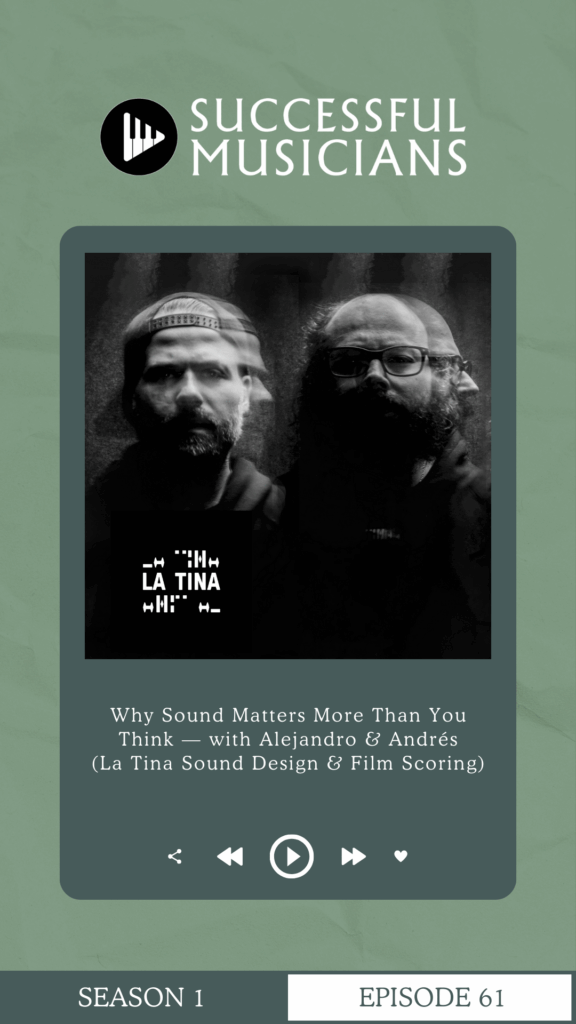
Successful Musician Podcast Episode 61
Interviewee: Andres and Alejandro of La Tina
Interviewer: Jason Tonioli
Jason Tonioli
Well, welcome to the podcast today. Today, our guests are Alejandro and Andres, and they are coming from Bogotá, Colombia. I’m going to try not to break into Spanish, just so anybody listening to the podcast can continue to understand us in English. But this will be my first Colombian interview. I’m excited to talk with you guys. As I’ve done research, I’ve loved what you guys have been up to with just your music style and what you’ve got in a… It’s outside of the normal US-based production studio. Alejandro and Andres, welcome. I’m excited to chat with you guys today.
Andres
How are you, Jason? Thank you very much.
Alejandro
Very, very happy to be here.
Jason Tonioli
You know what? Just to get started, I don’t know which one of you wants to go first. I would love to have you tell a little bit about a Colombia and just your growing up in music in Colombia and just your experience and just a little bit about the culture and things that have done historically, because I don’t know that a lot of people understand all of the really cool things that have happened in the last 10 years in Colombia to really have it progress out of where maybe you guys… It was stuck for a long time. Who wants to go?
Andres
I’ll start. Well, I would say that Colombia is a very musical country, very few countries in the world. I mean, of course, you have music elsewhere, but like Brazil, Cuba, Colombia, Southern US, UK, Jamaica, there are some hubs with really original styles and rhythms. For example, Kumbia is Colombian, and Kumbia probably has the biggest rhythm in all Latin America. It’s part of the Caribbean. Of course, we have a lot of tropical music in our ears happening. But the truth is that Alejo, myself and Manuel, which is our other partner, we are two rock and rollers. Actually, we got a lot of the influence from rock and roll. I think it’s through this that we ended messing up with music and sound for film, which is what we do. And yet that is a bit of our background. I mean, I’m a drummer, Alejo plays the guitar, and Manuel, he’s a bassist, but he’s a composer. He composes music for an orchestra, and that’s what we do now.
Jason Tonioli
So, for learning, I’m just curious about when you were learning guitar or learning the drums, in Colombia, is it like normal lessons or is it just one of those things you dive in and do it? Tell me your story. How did you end up learning to do music as a kid?
Andres
All right. I had a friend. I had a good friend who played music with me. We started playing like… It was Nirvana by then in the ’90s, learning to play easy songs like Pixi’s Influence and this type of thing. I used to sing, but I was a really bad singer. I was a kid and a really bad singer. The school where we were playing bought a drum set. It was the first time I sat on a drum set and I could play. It was like something natural for me. And from then on, I haven’t stepped from this chair, the drum chair, and I loved it. So, it was really like a God feeling, really a God feeling. And then when I was starting to decide what was going to do with my life. I went for music because I really didn’t know what I wanted to do. I haven’t been an academic with music. It’s not my thing. For me, it’s more passion and gut feeling. But I went to the university anyway, studied music, did fairly well, but I’ve never been too academic. But then I’ve played, composed, recorded, produced. I had a label, and I have La Tina, which is a sound post-production studio.
Andres
It’s all been passion and gut feeling.
Jason Tonioli
Got you. The studio you guys have now, it’s amazing. Looking at it online, I’m like, wow, it’s just a gorgeous studio. So, I think it’s awesome. Alejandro, how did you end up getting into the guitar? Tell us your journey of how you ended up where you are.
Alejandro
Well, it was almost like Andrés. Since I was a little kid, I just watched a lot of rock videos and hear a lot of rock music, punk rock, metal dance, and all that stuff. I started to try to give myself some money selling candies and all the stuff in school. I bought my first guitar, and I learned in a very empiric way, just watching the videos, how these guys put their fingers on it and try to understand. I started in a German school and music is really important to Germans. So, theory was pretty good at it. So, I started to learn it more. And when I entered the university where I met Andres and Manuel, my partners, I profoundly learned this theory stuff. And I’m more like Andrés, and I don’t like it very much, a theory, and it was more gut feeling and what you want to do. And yeah, that’s it.
Jason Tonioli
Got you. It sounds like you guys met in the university, if you were to rewind the clock back, the 15, 20 years since you were in the university, what advice would you give yourselves? If somebody was saying, hey, I want to get into TV and film and be able to be doing types of shows. If you guys are doing a lot of music for a lot of very cool shows for Netflix, and I know you’ve got the 100 Years of Solitude that’s coming out that has fantastic music. If you could rewind back to when you were in college, what advice would you give yourselves that maybe would help you fast track and get to where you are faster?
Andres
I would say, I just want to make one thing clear. For 100 Years of Solitude, we did the sound design, all the sound design. We got into sound design through music. But answering your question, depending on what you want, for example, if you want to be a performer, then I would say, yeah, stick to really understanding your abilities and expanding your abilities. But then you need to learn about the ecosystem where you’re in and then try to be smart playing your cards on that ecosystem, knowing which are the Music studies that can get you somewhere else or meeting the right people. I mean, relationships are very important. Learning to charge for what you do properly. This is something. But of course, you want to be a performer, the skill is king, right? For us, answering the question in my own case, I would have mixed my music studies with something else, probably film or art or literature, something that could give me a broader view of the world so I could relate my art to other languages. In my case, film and literature would have been very cool. But then, when you’re young, say 18 years old, 20 years old, up to 25, I would suggest just to be free and take the time to think about who you are and what you want to be and then getting more serious towards life because eventually, you can do a master’s degree and specialize in get a bit of experience and then deciding. So, it’s a matter of really being calm and thinking yourself through.
Jason Tonioli
Alejandro, what advice, if you could go back and talk to yourself in college, what advice would you give yourself?
Alejandro
Well, I think keep doing it, do not be so harsh with yourself, thinking about doing everything so really professionally and worry about economics and all that stuff. You have to worry, of course, but just study. Study hard, study hard, and try to be yourself. So, yeah, just keep real with your art, keep real with your music. There’s music for everyone. So, yeah, probably I should say that to myself that. 11:11 Be more organized because artists, musicians are not so well organized. They keep their instruments clean and their computers clean, everything clean, but their room is a mess. Everything is a mess. So be more organized with yourself. And you’re going to have time for everything because artists, well, everyone thinks you have to be a night old and all that stuff just for learning music and staying up but really late. That’s not the way. That’s the way to do that. You have to compromise with yourself and have a real good schedule to do, to learn.
Jason Tonioli
I love that. Being yourself. I talk to musicians, especially, you watch the career path of some people who maybe struggle. I think even if I look at myself, there’s times where you’re trying to be somebody that you’re not. And I think that advice of being yourself and doing what feels right and feels good to you is always going to win. You mentioned that you didn’t love the theory part of knowledge, right? That you wanted to just do what you felt. I have to smile because when I look at my university experience, I lasted two days in the music department at the university.
Andres
Wow, that’s a long way, man.
Jason Tonioli
Yeah, I lasted two days and then I quit.
Andres
That’s like double for most people.
Jason Tonioli
It wasn’t so much that I didn’t want to do music. It was one of those where, essentially, what I was told is I had to spend the next two years studying the theory, and I had already been writing lots of music, but I was told that you had to learn the theory and go back to, that you weren’t allowed to be creative and do your music and do orchestration until I’d spent two years going through class learning what a half note was and quarter notes. In two days, we made it to, I think we made it to eighth notes to talk about it with this. I’m just like, this is going to be miserable.
Andres
I mean, of course, depending on what you want. I mean, theory can be amazing, especially harmony. It’s beautiful. But everything needs to come from a real interest. It’s like the gut feeling.
Jason Tonioli
Well, and I think one of the things, at least for me, I’ve learned theory, and I mean, I had quite a bit of theory background even before I started trying to do the classes, and they tried to rewind it back and say, oh, you have to go back to basics. There’s a lot of wisdom, I think, in doing the basics, but I do feel like oftentimes, if you overthink things when you’re doing the music, that takes away from some of the discovery that can come from just listening to your gut and filling the music, if you want to discover new ways of doing it and just the way it sounds. Alejandro, I love what you’re saying about being organized as well. I’m smiling. Nobody can see my background. I’m clean on my desk where I work, and then it’s like, I know where everything is, right? But I always feel better when it is clean. So that’s some amazing advice. And I do also, I love what you said about being scheduled and just trying to have some routine, some structure to your day in order to make progress. If you’re not organized, what could probably take you one day, maybe takes you six weeks because you keep getting distracted.
I think that’s definitely a musician trait, just with a creative brain that we like to go different directions. Especially, I think, you guys are running a sound production studio and doing music. If you guys aren’t able to stay organized and on schedule, you’re not going to be doing too many more jobs at all, right?
Andres
This, what you’re mentioning is, we feel it. We see the progress every day. We manage a team of up to 13 people, and when we have a project manager and the discussions that we have with her, how we start to manage resources, space, people, budget, time. After two, three months of really starting to focus on this, you’ll see that eventually the results are sounding better. You’re being more to the ground. Eventually, you come to a mix session and you and it’s sounding how you wanted it to be from the first discussions that you were having at the beginning. It’s really a win-win.
Jason Tonioli
Yeah. Well, Andres, you said something that I find interesting, and I think it’s something that musicians always, well, everybody struggles with, but you said about charging a fair fee. Talk to me more about if you were giving yourself advice about charging the music, what advice would you have there? And how do you charge? How do you do that when it feels really uncomfortable to say, hey, I need to be paid for my time or for my music?
Andres
It’s important to I have to take into account that the ecosystem, I was talking about this at the beginning because I’m sure that the United States has a very established music industry and the way they work, it’s totally different from how we did in Colombia or how we did it in Colombia in the music industry and in the film industry. Because here the industry is developing. So not many people know. It can be a good way, a good thing and a bad thing, because then you can take advantage of being the first to do things right. But also, people don’t know what the tariff is. And maybe you create a budget, and you charge, and people are like, I don’t know, this is too much. 17:37 It’s important to have the language and a clarity of mind to know where you are in the industry and what you are supposed to be charging, which is the number? So, I would say, of course, you have a creative fee, something that you feel could be what you should earn per hour, I would say. But also, you did an investment. You did an investment in your equipment, and then you need to at least depreciate these things. So, you spend, let’s say, $5,000 in your equipment, and they’re going to last, I don’t know, five years, 10 years. So, you need to divide this in your working hours and add this to a fee so that eventually, when five years pass by, you’ll have new equipment. This works a lot for studios. Instruments can last a little bit longer or sometimes longer. But understanding the resources that you’re using for what you create and your creative fee. And I’m thinking of a tariff and then comparing this tariff to people similar to you or your aspirations. And then, having a straightforward conversation about money. It’s very important.
Jason Tonioli
Yeah. I think that’s an uncomfortable conversation. And I think a lot of times as a creative person, we undersell the value we bring to a project or to whatever we’re working on. I’m curious. So, Andres, you guys have done a lot of Dolby Atmos sound design. Because you guys were doing more music, I believe, with your studio. And then in the last couple of years, it evolved into more of the sound. Talk more about that. I’m just curious how that happened and what you’ve learned from doing that.
Alejandro
Actually, the three of us, we started music, and thanks to music, we try to explore more hearing sounds and watching sounds, but with the ears of music. So, we try to experiment and do this. It’s like sound design in a more musical way. So, the La Tina, sound design and film scoring, is starting to offer the two services, but very linked through music. So, Andrés and I were more electro-acoustical in more empiric and crazy ways. Manuel did a master’s degree in Berkeley for film scoring. So, he is like the head of the film scoring department. But Andrés and I, we both did music for a lot of our projects, and in our spare time. But yeah, so in La Tina, we make music, and we make sound design. So, the path going through Dolby Atmos, it is really linked through both disciplines.
Andres
Yeah, I can complement. We are doing a Netflix series right now, and we’re working with a client that we like very much. We were in a mixing session last week, and eventually, he said, Stop. We stopped the video, and he said, what am I listening to? Like these drones, are they coming from the score or this is the sound design? We said, no, in this case, this is the sound design. He said, Yeah, I love working with you guys because you guys intertwine the languages. This is what we do. For example, when you design backgrounds for a scene, it’s a very musical element. You can start the scene, establish what you’re listening to. For example, you can establish time and place. Then the scene starts and then dialogs come and then the narrative starts to develop. Then you massage the brain of the spectator with the backgrounds. Sometimes the backgrounds, the tone of the backgrounds can become music, and the music can be composed through this feeling that the scene is starting to develop. For us, doing sound is a total composition. It’s like music of the 20th century, like getting rid of the stuff and the notation rules and understanding sound in a very broad way. You cannot write down the sound of a motorboat on a notation. Just get rid of this and start exploring and understanding sound in a very broad way, but it’s also a composition.
Jason Tonioli
As I’ve listened to some of the projects you guys have done. It’s interesting. You’ve creatively used others… You’ve used instruments, but to make your own sound and known instruments. As you look at some of the projects you’ve done, what are some of the, I guess, unique instruments or the way you’ve played some things that stand out to you that have been really fun?
Andres
Yeah, I know that Manuel, for example, he designed… I mean, he attached some strings, metal strings to a cello that are not in the proper way you would… I mean, he crossed the cello with metal parts, so it creates a very noisy, rough sound. Then he samples these instruments and creates textures with it. It sounds like cello-ish, but then it goes into some textural elements. Other stuff is, for example, playing Colombian instruments, like string instruments, like tiple, which is an instrument from the Andes Mountains. I’m playing it with a bow. It’s not supposed to be played like this. So, this creates a different texture. It’s like having the instrument and it’s an element, it’s an object. There are many things that can happen with this object and many sounds it can produce other than what they are supposed to be performed. It’s a mixture of these two that can open up a huge color palette.
Alejandro
To complement what Andres is saying, it is only about the mic setting and the place that you’re recording your instrument. If you record the instrument in a very rewerp stage, it’s going to sound way different in a different position with a mic pretty far or pretty close. You have to learn the environment and how you’re going to record this instrument or this piece that you made and make it sound the way you like it.
Andres
For example, 25:01 in terms of being sound designers and musicians, we are not thinking about what the sound is, but also on how it is sounding. For example, you can record a cello in a wide space, put up a mic very close, but then have a stereo pair really far away. Then depending on the music part, you can change how this instrument is sounding. Just having the attention to enjoy how the sound is performing.
Jason Tonioli
What you guys are doing, I don’t feel like is something that you can do near as well as if you just used a virtual instrument. It’s one of those where you guys are thinking, dreaming it up. Really, the only other place I’ve seen, I mean, I’m sure there’s lots of people doing it, but my friend Chuck Myers, he was the lead composer on Hogwarts Legacy for the Harry Potter video game. And it was almost six years leading up to that as he was working on before that release. I mean, he had a 20-foot sheet of metal hanging off of the upstairs that he could play with little rubber balls, and he’d take a cello bow or a bass bow. When we were playing around with the sound one night there, I had the recording and was just sharing it with my wife, and my daughter was in the room listening to me. I had her listen to it, and it sounded like this scary, scary, just terrifying breach. But it was like a musical, scary, beautiful thing. It’s really hard to describe that, but my daughter actually started crying. She was scared. She goes, Dad, I’m scared. I don’t like this.
Andres
I was like, we got it. We nailed it. It’s so beautiful. That sound is very abstract to talk about. There are few languages to describe with sound, but it gets to you. It’s your feelings that are happening, which is something that is very beautiful with sound. Exactly. 27:10 We do sound design and music, and we try for the spectator not to notice it. We work like ninjas in the back. If it’s very well done, you shouldn’t notice. You should be focused on the story, focus on the narrative. We’re like massaging the brain there. If it’s well done, nobody thinks of sound.
Jason Tonioli
People talk about the surround sound, and I even feel like a lot of the films, they have that piece available to them with the multiple speakers and all of that available. But I think it’s actually rare that somebody gets it really great. You know what? Does that make sense? Where they have the tool, but I almost feel like, whether it’s the music or the dialog, I had somebody reach to me and he said, hey, they want to do this with multiple speakers. And he’s like, we don’t even know how to do that. And it’s interesting how few people actually understand how that works. How do you learn to do that well? Do people even appreciate it? You guys, I’m sure, think about it all the time, but is it something that is recognized when it’s done great on projects?
Andres
28:24 In all sound, it’s not recognized. People don’t think about it. Although if it’s poorly done, they know. Some people think, no, I’m tone deaf and I don’t listen to anything. Everybody listens a lot. We rely on our ears for many things, for understanding the mood of somebody. You know the subtleties of sound, and then you get a feeling from it. But as you mentioned, for example, I like the Beatles very much, and I’ve listened to the remixes in Dolby at most of what the Beatles have done, and I absolutely hate it. I don’t like it. I mean, it’s not the format for it. It’s 60’s rock and roll. Stereo is properly fine. Even mono. The feeling is there.
Alejandro
It’s like hearing the Beach Boys in stereo. It’s not good. The Beach Boys should be mono.
Andres
Yeah. But there is some music that is thought of in this way. For example, Dark Side of the Moon. We listen to this, the remaster version of the studio in the Dolby Atmos. It’s such a beautiful album. It’s like, wow. There is another language, another layer to it. It’s very properly mixed. I think the Dolby Atmos stuff is not supposed to be many stuff coming out of lots of places. No, it can be subtle. We listened recently to Neil Young’s album, On the Beach, and there is a song where it’s him, a Banjo, some guitar is playing some solo sporadically, and a guy hitting the floor with the foot, and that’s it. Three elements in Dolby Atmos. It’s so beautiful because the reverbs are in Atmos, so you feel the space, but nothing is moving and being crazy. It comes very natural. It’s like technology becomes transparent. It’s not like you’re bringing up technology and saying, hey, look, you can do this, you can do that. No, it’s just disappearing technology. I think it’s a very nice approach.
Alejandro
It’s much about the environment and immersiveness that puts a bunch of stuff going on the top.
Andres
For example, silent scenes, very quiet scenes, they sound amazing in Dolby Atmos. It doesn’t necessarily have to be the crazy panning action type of scenes, but subtlety.
Jason Tonioli
It’s going to be interesting as time goes on. More and more people will have access to a theater or listening space to even appreciate it. I still think there’s too many people who just have their basic TV to hear it, and it just doesn’t… They’re missing out, aren’t they?
Alejandro
Well, but actually, some TVs come with Dolby Atmos, and they’re like these Dolby Atmos bars. 31:30 Dolby Atmos is not only to have a bunch of studio monitors on the roof, but it actually produces the technology of audio in different ways. If you hear Rocket Man or Elton John or Billy Eilish songs in your headphones and they’re mixed in Dolby Atmos, you’re going to hear it like, so well done, the mix. It’s very immersive. So, you don’t have to buy 17 monitors, but if you have the TV with the Dolby Atmos codec or the soundbar or a proper headset, you’re going to hear the difference in Dolby Atmos.
[00:32:17.11] – Andres
Maybe add a subwoofer to that. That’s it. Just a subwoofer.
Alejandro
A subwoofer will help.
Jason Tonioli
Got you. Well, I know we’re running low on time, but one last question for each of you is, what’s the best advice that you’ve received from someone that’s helped you in your music career?
Alejandro
To be organized. Be organized. Yeah, be organized.
Andres
Probably, I think 32:51 honesty. Keep it real. It sounds cliché, but I think it’s very straightforward. Keep it real because music is a very sophisticated language. It’s a beautiful, sophisticated language, and you need to do it with the heart so you can pass that passion and people feel and reverberate it with this passion if you do it properly. I think this is probably the best advice I’ve heard.
Jason Tonioli
I love it. Awesome. Well, if people want to learn more about the studio and what you guys are doing. You guys are, you’re in Colombia and you’re doing a lot of work. I know about La Tina stuff, but you’re doing some Netflix series. You guys are working worldwide. I mean, you’ve got stuff that’s happening all over the world, right? So, it’s one of those where I feel like if you’re listening to this, you should really check these guys out. We’re going to include a link to their studio. It’s la-tina.co. If you want to go check out the studio, but definitely go check it out and listen to… I would recommend when you go to the site, be sure to watch some of the videos there because I’d love when I was researching you guys, some of the sound on there, it’s really well done. Much better than a lot of stuff with that immersive. You’ve got a lot of suspense type of stuff on there. I think you guys are doing it as well as most people in the world. I congratulate you on this, and I hope things continue to go super well for you guys. Thank you very much. Thank you very much.
Andres
Thank you very much. Yeah, I mean, the web page is there. Our social media is there in the web page as well. Instagram and Twitter and LinkedIn. And I mean, we are available if you want to write us down, whatever. I mean, we’re happy to talk to anybody. So very welcome to La Tina.
Jason Tonioli
Awesome. Well, thanks so much. Thanks for sharing your time with us today, guys, and look forward to continuing our relationship.
Andres
Thank you so much, Jason. For sure.
Alejandro
Hope to see you soon, Jason.
Jason Tonioli
Thanks a lot. Ciao, ciao.
Andres
Welcome to Colombia.
Alejandro
Have a good one. Bye.